
The rapid rise of Artificial Intelligence (AI) has transformed modern civilization in ways unimaginable just a few decades ago. AI now influences education, healthcare, communication, business, governance, warfare, and even religion. While these technologies promise efficiency and innovation, they also raise profound ethical and spiritual questions. Concerns regarding surveillance, inequality, unemployment, militarization, and the erosion of human dignity have become central issues in global discussions about the future of humanity. In this context, Pope Leo XIV’s first encyclical, Magnifica Humanitas (2026) [1-2], emerges as a significant moral intervention. The Pope emphasized that AI must serve humanity rather than empower political elites, military systems, or corporate monopolies. His warning against a “culture of power” rooted in technological domination resonates strongly with Sikh philosophical and ethical teachings [3].
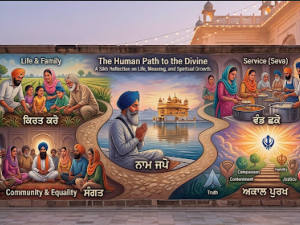
Sikhism offers a balanced and deeply humane perspective on science and technology. The Sikh Gurus never rejected knowledge or innovation; instead, they emphasized that all human progress must remain grounded in ethical responsibility, spiritual awareness, and collective welfare. Sikh thought teaches that technology should uplift humanity rather than exploit it. Therefore, the concerns raised in Magnifica Humanitas can be meaningfully examined through Sikh principles such as Sarbat da Bhala (welfare of all), Seva (selfless service), Kirat Karni (honest labour), and Naam (spiritual consciousness).
Human Dignity
One of the central themes of Pope Leo XIV’s encyclical is the protection of human dignity. The Pope warned that AI systems must never reduce people to mere economic resources, data points, or tools of productivity. Sikhism strongly supports this idea because it views every human being as carrying divine light within. Guru Granth Sahib teaches that all humanity is one and equal before the Divine. Human worth is not determined by wealth, social status, race, or technological capability. Every person possesses spiritual dignity and moral value.
From a Sikh perspective, any technological system that objectifies people or increases social inequality violates the divine principle of equality. AI systems controlled solely by corporations or governments may create structures of exploitation where ordinary individuals lose autonomy and privacy. Sikh philosophy opposes all forms of domination and injustice. The Sikh Gurus consistently challenged oppressive systems that concentrated wealth and power in the hands of elites. Therefore, Sikh ethics support the Pope’s call for democratic oversight and moral accountability in the development of AI technologies.
Economic Justice
Another important issue raised in Magnifica Humanitas concerns economic inequality and labour displacement caused by AI. Automation increasingly threatens traditional employment, especially among vulnerable populations. Pope Leo XIV warned that technological advancement should not enrich only a privileged few while leaving millions economically marginalized. Sikh teachings similarly emphasize economic justice and honest labour. The Sikh principle of Kirat Karni encourages individuals to earn through ethical and honest means while contributing positively to society.
Sikh history demonstrates a commitment to equality through institutions such as Langar, where all people share food together regardless of social background. This institution symbolizes economic sharing, dignity, and social harmony. In the age of AI, Sikh philosophy would encourage governments and corporations to ensure that technological progress benefits society collectively rather than concentrating wealth. AI should be used to improve healthcare, education, environmental protection, and poverty reduction rather than merely maximizing corporate profits.
The Sikh concept of Vand Chhakna, meaning sharing resources with others, also offers guidance for the ethical distribution of technological benefits. Knowledge and technological power should not become instruments of exclusion or monopolization. Instead, they should be shared for the common good. Pope Leo XIV’s warning against the concentration of AI power aligns closely with Sikh teachings against greed (Lobh) and selfish accumulation.
Militarization
The militarization of AI is another major concern addressed in the encyclical. AI-driven weapons systems, surveillance technologies, and autonomous warfare create serious ethical dangers. Pope Leo XIV cautioned that removing human moral judgment from warfare could normalize violence and dehumanization. Sikhism offers a nuanced approach to this issue through the doctrine of Miri-Piri, which combines spiritual wisdom with temporal responsibility.
Sikh history recognizes the necessity of defending justice and protecting the oppressed, but violence is never glorified. Ethical responsibility remains central even in conflict situations. From a Sikh perspective, delegating life-and-death decisions to machines undermines moral accountability. Human beings possess conscience, empathy, and spiritual awareness, qualities that machines cannot replicate. Therefore, Sikh ethics would strongly question the use of autonomous AI weapons and surveillance systems designed primarily for domination and destruction.
Sikh teachings emphasize compassion (Daya) and humility. The pursuit of technological supremacy through AI arms races reflects collective ego (Haumai), which Sikhism identifies as a major spiritual obstacle. Instead of fostering fear and competition, technology should promote peace, cooperation, and human welfare. The Sikh prayer for Sarbat da Bhala calls for the well-being of all humanity, reminding society that true progress cannot emerge from systems rooted in fear or aggression.
Spiritual Consciousness
Perhaps the most profound concern raised by both Pope Leo XIV and Sikh philosophy is the danger of losing spiritual consciousness in a technology-driven world. Modern society increasingly measures success through efficiency, data, and material achievement. AI has the potential to deepen this materialistic mindset by encouraging dependence on machines for decision-making, relationships, and identity formation. Pope Leo XIV warned against building a future that excludes spirituality and moral reflection.
Sikhism teaches that human fulfillment cannot be achieved through material advancement alone. The remembrance of the Divine (Naam) remains central to meaningful existence. Technology may enhance comfort and convenience, but it cannot replace compassion, wisdom, humility, or spiritual awareness. Human beings are not merely biological machines or computational entities; they are spiritual beings with moral responsibility.
The Sikh Gurus repeatedly warned against ego-driven attachment to power, knowledge, and possessions. In today’s world, technological power itself can become a source of ego and domination. Sikh philosophy, therefore, calls for balance between material progress and spiritual wisdom. AI should remain a tool under ethical human guidance rather than a force shaping humanity without moral accountability.
Ethical Technological Future
Pope Leo XIV’s Magnifica Humanitas raises critical ethical questions about the future of Artificial Intelligence and human civilization. His warning that AI must serve humanity rather than powerful elites reflects concerns shared by Sikh philosophy. Sikh teachings emphasize equality, justice, compassion, humility, and spiritual consciousness as essential foundations for any social or technological system. The principles of Sarbat da Bhala, Seva, Kirat Karni, and Naam provide valuable guidance for navigating the ethical challenges of the AI age.
Sikhism does not reject technological advancement, but it insists that scientific progress must remain connected to moral responsibility and collective welfare. As humanity enters an increasingly AI-driven future, spiritual traditions such as Sikhism can help ensure that technology remains a servant of humanity rather than its master. The true measure of progress will not be the intelligence of machines, but the wisdom, compassion, and humanity of those who create and govern them.
References
-
Leo XIV. (2026). Magnifica Humanitas: On safeguarding the human person in the time of artificial intelligence. Vatican Press.
-
Religion News Service. (2026, May 25). In his first encyclical, Pope Leo XIV says AI must serve humanity, not the powerful few.
-
Sri Guru Granth Sahib (1983). Amritsar, India: S. G. P. C.