
The tragic murder of Henry Nowak in Southampton has shocked Britain and rightly evoked grief, anger, and demands for justice.

The loss of a young life is a profound human tragedy, and the suffering of the Nowak family deserves the sympathy and support of all communities, including Sikhs.
The subsequent conviction of Vickrum Digwa and the widespread condemnation of his actions by Sikh institutions and leaders affirm an important principle: criminal acts must be judged on the basis of individual responsibility, not collective identity.
Yet the controversy that followed has revealed something deeper about contemporary society: how religious symbols acquire meaning in the public sphere and how minority communities become visible primarily in moments of crisis.
At the centre of the debate stands the kirpan, one of the Five Ks of the Sikh faith. For initiated Sikhs, the kirpan is not a weapon in the ordinary sense of the term. It is a sacred article of faith symbolizing justice, responsibility, courage, and the duty to protect the vulnerable. It embodies the ethical vision of Guru Gobind Singh, who sought to create a community committed to defending righteousness and resisting oppression. Yet in the aftermath of the Southampton case, the kirpan became the focus of intense political, media, and public scrutiny. Calls emerged for restrictions or outright prohibition, transforming a symbol of spiritual discipline into an object of public suspicion. This transformation tells us as much about society’s modes of interpretation as it does about the symbol itself.
The Southampton case demonstrates that the politics of the kirpan is fundamentally a politics of interpretation. What was at stake was not simply the regulation of a religious object but the struggle over the categories through which that object is understood. Law, theology, media discourse, and political rhetoric each approached the issue through different frameworks, often producing conflicting narratives. Within Sikh theology, the kirpan signifies ethical responsibility. Within legal discourse, it is an object protected under carefully defined provisions of religious freedom. Within sensationalist media narratives and political rhetoric, however, it can be reframed as a symbol of danger.
When these distinct frameworks become conflated, misunderstanding inevitably follows.

The result is a troubling tendency to substitute symbolic association for evidential distinction. One individual commits a violent crime, and an entire community finds itself required to explain, defend, or justify a religious practice observed peacefully by millions worldwide. Such reasoning reflects a broader pattern within liberal democracies.
Exceptional acts of violence committed by members of minority communities are often transformed into collective judgments about the communities themselves.
The burden of explanation shifts from the individual offender to the wider religious or ethnic group. In doing so, the principle of individual accountability is weakened, while suspicion of minorities is reinforced.
This dynamic exposes the fragility of religious freedom. Legal protections for religious expression are often assumed to be secure, yet their durability depends not only on legislation but also on public understanding. Rights may exist on paper, but they become vulnerable when public discourse is dominated by fear, misinformation, or symbolic simplification. The Southampton controversy illustrates that even longstanding accommodations can come under pressure when public perception is shaped more by emotional association than by informed analysis. The challenge, therefore, is not merely legal but educational and cultural.
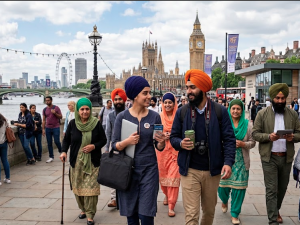
Equally revealing is the manner in which Sikh visibility has been produced within British society. The Sikh presence in Britain spans more than a century. Sikh soldiers fought in the World Wars. Sikh workers contributed to post-war reconstruction. Sikh professionals, entrepreneurs, educators, healthcare workers, and public servants continue to enrich British society. Gurdwaras provide extensive charitable services, including food banks, community support programmes, and humanitarian relief. Yet despite these contributions, Sikh identity often becomes widely visible only during moments of controversy.
The sudden interest in the kirpan following the Southampton case exposes a politics of recognition structured by crisis. Colleagues, institutions, politicians, and media commentators who may have had little prior engagement with Sikh history or philosophy suddenly became eager to discuss Sikh identity, but primarily through the language of security concerns. This pattern is not unique to Sikhs. Minority communities frequently become objects of public attention only when linked, however unfairly, to questions of risk, conflict, or exception. The consequence is a distorted form of visibility in which communities are recognized not through their everyday contributions but through extraordinary moments of tension.
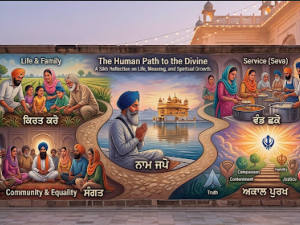
Such a condition raises an important question. Why must Sikh visibility depend upon the spectacle of violence rather than the ordinary reality of Sikh life? Why do discussions of Sikh identity emerge most prominently in the context of security debates rather than conversations about service, ethics, equality, and community engagement? These questions challenge not only media institutions but also educational systems, political leaders, and civil society organizations.
The answer lies partly in the contemporary media environment. News cycles are driven by conflict, controversy, and emotional intensity. Complex traditions are often reduced to simple narratives that can be communicated quickly and consumed easily. In such an environment, symbols become detached from their historical and spiritual meanings and are reinterpreted through the lens of immediate events. The kirpan, stripped of its theological context, risks becoming a mere object of anxiety rather than a profound expression of Sikh ethics.
For Sikhs, the response to such challenges must be thoughtful and constructive. Defensive reactions alone will not address the deeper issue. Greater public education about Sikh history, philosophy, and practice remains essential. Community engagement must continue to emphasize the values that the kirpan represents: justice, compassion, humility, and responsibility. At the same time, Sikh institutions should seize this moment to deepen public understanding rather than merely correct misconceptions.
The Southampton case is ultimately about more than one tragic crime or one misunderstood symbol. It reveals the ongoing struggle over how religious minorities are perceived in modern pluralistic societies. It reminds us that recognition grounded in crisis is unstable and often unjust. Genuine inclusion requires a different foundation: one based on knowledge rather than fear, dialogue rather than assumption, and evidence rather than symbolic association.
As Britain reflects upon the tragedy of Henry Nowak’s death, it must resist the temptation to transform individual wrongdoing into collective blame. Justice demands accountability from those who commit crimes. Democracy demands protection for the rights of peaceful communities. Social cohesion demands the courage to distinguish between a sacred symbol and its misrepresentation. Only then can the kirpan be understood not as an emblem of danger but as what it has always been intended to be: a reminder of humanity’s enduring responsibility to stand for truth, justice, and the protection of others.
******