
Pope Leo XIV’s recent condemnation of religious violence and call for universal brotherhood at the Council of Nicaea anniversary echoes Sikh teachings articulated five centuries earlier. This article highlights parallels between the Pope’s message and Sikh principles such as rejecting extremism, affirming universal fraternity through “Ik Onkar,” and translating spirituality into service, exemplified by langar. Historic interfaith gestures, such as the foundation of the Golden Temple, reinforce this shared ethos. Amid rising global tensions, these convergent teachings offer urgent guidance for peace and human dignity.
In a powerful address in the historic town of Iznik, Turkey, Pope Leo XIV delivered a message that transcends denominational boundaries, resonating profoundly with Sikh philosophy and practice.
Rejecting Religious Violence
Speaking at the 1700th anniversary of the Council of Nicaea, Pope Leo firmly declared that "we must strongly reject the use of religion for justifying war, violence, or any form of fundamentalism or fanaticism" [1-3]. This unequivocal stance against religious extremism parallels a core Sikh principle established over five centuries ago.
The Sikh Gurus consistently taught that true spirituality cannot coexist with oppression or forced conversion. While Sikhism recognizes the duty to defend the oppressed, embodied in the concept of the Sant-Sipahi (saint-soldier), it draws a clear distinction between protecting human dignity and perpetrating violence in religion's name. The sixth Guru, Guru Hargobind Ji, formalized this principle through the doctrine of Miri-Piri, which balances spiritual authority with temporal justice, never for conquest but for protection [4].
Universal Fraternity
The Pope's assertion that "there is a universal fraternity of men and women regardless of ethnicity, nationality, religion or personal perspectives" closely mirrors the foundational Sikh teaching of the oneness of humanity. When Guru Nanak Dev Ji proclaimed "Ik Onkar" (One Divine Creator), he established that all people emanate from the same divine source, making distinctions based on caste, creed, or nationality spiritually meaningless [5-7].
This wasn't merely philosophical speculation. Guru Nanak travelled extensively, engaging in dialogue with Hindu ascetics, Muslim clerics, and people of various faiths, demonstrating that genuine spiritual inquiry requires openness rather than insularity. His message that "there is no Hindu, there is no Muslim" challenged people to look beyond labels and recognize their shared essence [8].
From Belief to Action
Pope Leo emphasized that religions "should encourage individuals, groups and peoples to recognize this and put it into practice,"[1-3]. This call for practical application of spiritual principles is central to Sikh tradition, where faith is inseparable from action.
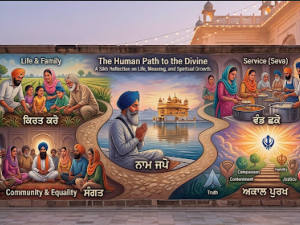
The institution of langar exemplifies this philosophy in daily practice. Established by Guru Nanak and formalized by subsequent Gurus, the langar is a community kitchen where people of all backgrounds sit together as equals, sharing meals without regard to social status, religion, or ethnicity [9]. What Pope Leo advocates in principle, the langar has demonstrated in practice for five centuries, creating spaces where universal brotherhood is not an abstract ideal but a lived reality.
Interfaith Cooperation
The Pope's participation in an interfaith gathering [1-3] that brought together Eastern Orthodox, Oriental Orthodox, Protestant, and Eastern Catholic leaders reflects the inclusive spirit that has characterized Sikhism from its inception. When Guru Arjan Dev Ji invited the Muslim Sufi saint Mian Mir to lay the foundation stone of Harmandir Sahib (the Golden Temple) [10], he sent a powerful message: Sikhism's holiest site would welcome all seekers, regardless of faith.
Similarly, the design of Harmandir Sahib itself, with doors opening in all four directions, symbolizes the Sikh commitment to accessibility and inclusivity. Pope Leo's call for "fraternal encounter, dialogue and cooperation" echoes this architectural and spiritual openness.
Paths to Peace
The pontiff urged religious communities to follow "the paths of fraternal encounter, dialogue and cooperation" in response to "the whole of humanity afflicted by violence and conflict." This vision aligns with the Sikh concept of "Sarbat da Bhala," the well-being of all humanity, which concludes daily Sikh prayers [11-12].
This isn't passive wishful thinking but an active commitment. Sikh history is marked by sacrifices made to protect others' religious freedom, from Guru Tegh Bahadur Ji's martyrdom defending the right of Kashmiri Hindus to practice their faith, to countless Sikhs who have served in humanitarian missions worldwide without regard to the recipients' backgrounds [13].
A Shared Vision for Our Times
As religious extremism and sectarian violence continue to challenge global peace, Pope Leo's message [1-3] serves as a crucial reminder of religion's true purpose. From a Sikh perspective, his words don't introduce new concepts but rather reaffirm ancient wisdom that humanity must urgently reclaim. Both traditions recognize that authentic spirituality must manifest in compassion, justice, and service to all. Both understand that religious identity should unite rather than divide, inspire rather than intimidate, and heal rather than harm.
The Sikh community, having experienced both persecution and the responsibility of protecting others, stands firmly alongside leaders like Pope Leo who advocate for interfaith harmony and human dignity. The path forward requires not the abandonment of our distinct traditions, but rather a deeper commitment to the universal values they share. In this moment of global uncertainty, Pope Leo's message and Sikh teachings offer complementary wisdom: that recognizing our common humanity is not just a spiritual ideal but a practical necessity for peace. As Guru Gobind Singh Ji taught, "Recognize all of humanity as one," a truth that becomes more vital with each passing day.
References
-
Lamb, C., & Haq, S. N. (2025, November 28). Pope Leo denounces misuse of religion for ‘justifying’ war, violence or fanaticism. CNN World. https://www.cnn.com/2025/11/28/europe/pope-leo-iznik-turkey-first-foreig...
-
McElwee, J. (2025, November 28). Pope Leo meets Middle East Christian leaders, condemns religious violence. MSN. https://www.msn.com/en-us/news/world/pope-leo-meets-middle-east-christia...
-
Porter, L. (2025, November 28). Religion must not be used to justify war, Pope Leo says at historic site in Turkey. The National News MENA. https://www.thenationalnews.com/news/mena/2025/11/28/religion-must-not-b...
-
Sidhu, K. B. S. (2025, May 19). Miri-piri concept of Guru Hargobind Ji: A point of inflexion in the evolution of Sikhism. The KBS Chronicle. https://kbssidhu.substack.com/p/miri-piri-concept-of-guru-hargobind-ad3
-
Sri Guru Granth Sahib. (1983). Reprint, S. G. P. C., Amritsar. India. 1-1430.
-
Singh, Devinder Pal (2019). Universal Relevance of Guru Nanak’s Teachings, The Sikh Review, Kolkata. WB. India. Part -I; 67(11). 15-21. Part-II 67(12). 19-30.
-
Singh, Deviinder Pal (2014, July-Aug.) Relevance of Sri Guru Granth Sahib in 21st Century, The Sikh Bulletin, USA. 17 (7& 8). 18-22
-
There is no Hindu and no Musalman - SikhiWiki, free Sikh encyclopedia. (n.d.). https://www.sikhiwiki.org/index.php/There_is_no_Hindu_and_no_Musalman
-
Khalsa, S. (2019, May 1). All about sacred Langar and the guru's free kitchen. Learn Religions. https://www.learnreligions.com/langar-and-the-gurus-free-kitchen-2993455
-
Paying respect to Saint Hazrat Mian Mir - SikhiWiki, free Sikh encyclopedia. (n.d.). https://www.sikhiwiki.org/index.php/Paying_Respect_to_Saint_Hazrat_Mian_Mir
-
Singh, D. P. (2019). The Doctrine of World Peace and Universal Fellowship in the Hymns of Guru Nanak. Punjab Dey Rang. Lahore, Pakistan. 13 (4). 5-11.
-
Singh, D. P. (2022, July 21). Guru Nanak – An Apostle of Peace. Asia Samachar. Malaysia. https://asiasamachar.com/2022/07/21/guru-nanak-an-apostle-of-peace/
-
Singh, Devinder Pal & Lal, Bhai Harbans (2025). The Martyr for Religious Freedom: Guru Tegh Bahadur’s Legacy in Pluralistic Societies. The Sikh Review, Kolkata, India. 73 (11). 57-65.