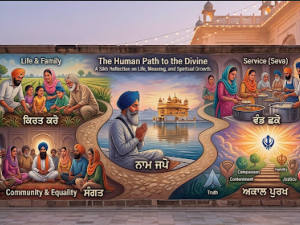

To ask “Why am I a Sikh?” is not merely to inquire about religious affiliation; it is to explore the deepest layers of identity, meaning, and purpose. For me, the question opens a window into history, culture, ethics, and the lived experience of a tradition that has shaped my intellect, spirituality, and social consciousness. My perspective is not confined to inherited belief but emerges from an informed, scholarly engagement with Sikh philosophy and its universal relevance in the modern world.
1. Sikh Dharam offers a Rational and Universal Spiritual Framework
I see Sikh Dharam as a tradition where spirituality and rationality coexist harmoniously. Guru Nanak’s foundational declaration: Ik Oankaar is not just a theological statement; it is a metaphysical principle asserting unity behind the multiplicity of the universe. Sikh philosophy rejects superstition, rituals, astrological determinism, and priestly mediation. It encourages inquiry, reflection, and experiential understanding.
For me, this aligns naturally with a contemporary scientific worldview. Sikh Dharam's emphasis on the laws of nature (hukam), the evolutionary character of creation, and the moral agency of the human being creates a framework in which faith does not conflict with rational thought. It provides a space where spirituality becomes a quest for truth grounded in ethical living rather than dogma.
2. Sikh Dharam is a Path of Dignity, Equality, and Social Courage
A profound reason I identify myself as a Sikh is that the Sikh tradition stands uncompromisingly for human dignity. In an age that still struggles with discrimination, class, caste, gender, and race, Sikh Dharam offers a radically egalitarian model.
The institution of langar, the rejection of caste hierarchies, the affirmation of women’s equality, and the defense of human rights exemplified throughout Sikh history illustrate that Sikh identity is inseparable from social responsibility.
For me, being a Sikh means belonging to a community that chooses courage over complacency. The sacrifices of Guru Arjan and Guru Tegh Bahadur, the sahibzades, and numerous Sikhs, along with the saint-soldier ideal of Guru Gobind Singh, all reinforce that Sikhs do not merely contemplate virtue; they embody it, even at personal cost.
3. Sikh Dharam Integrates Spiritual Depth with Daily Life
Many spiritual paths divide the sacred from the secular; Sikh Dharam bridges them. It is emphasized in Sikh philosophy that spirituality expresses itself through:
- Kirat karni – earning through honest work
- Naam japna—continuous remembrance of the Divine
- Vand chhakna – sharing with others
This integration liberates spirituality from asceticism and embeds it in everyday living. As a scholar and educator, I find in Sikh teachings an ethic that elevates labor, disciplines the mind, and transforms work into worship. The Sikh ideal of grihasth (householder’s path) inspires a balanced life of family, service, and reflection.
4. Sikh Gurus Provide a Model of Ethical Leadership
My admiration for Sikh Dharam is also rooted in the Gurus' leadership philosophy: compassionate, visionary, and morally luminous. The Gurus did not claim divinity; they embodied humility. They did not demand followers; they walked beside seekers. They did not withdraw from society; they reshaped it.
What resonates most for me is how the Gurus transformed ordinary people into self-aware, socially conscious individuals. Sikh Dharam, therefore, is not just a faith but a movement for personal and collective transformation.
5. Sikh Dharam Encourages Intellectual Freedom and Moral Autonomy
A central theme in my perspective is Sikh Dharam’s respect for the individual mind. The Gurus rejected blind obedience and insisted on vivek (discriminatory intellect). The Guru Granth Sahib encourages questioning, reflection, and the internalization of truth, rather than accepting inherited beliefs uncritically.
This intellectual freedom resonates deeply with my academic orientation. Sikh Dharam allows one to engage critically with the world, draw insights from other traditions, and remain open to evolving paradigms, without compromising core principles.
6. Because Sikh Identity Is an Ethical Responsibility
For me, being a Sikh is not merely a matter of heritage. It is a responsibility toward society, toward truth, and toward oneself. The Sikh ideal of the sant-sipahi (saint-soldier) inspires a life of:
- spiritual maturity
- moral integrity
- resilience in adversity
- active compassion
To me, being a Sikh means striving to be fearless yet humble, rooted yet progressive, and spiritually aware yet socially engaged. It means being committed to sarbat da bhala (the welfare of all).
7. Sikh Dharam Offers a Vision of Oneness for a Fragmented World
Finally, I find in Sikh Dharam a profoundly needed message for contemporary humanity: the unity of all creation. Guru Nanak’s philosophy transcends religious borders, presenting a vision of interdependence, ecological consciousness, and universal kinship. Sikh thought dissolves divisive categories and invites humans to recognize their shared essence.
In an age of ideological polarization and ecological crisis, this vision is both spiritually uplifting and existentially necessary.
Conclusion: A Personal, Intellectual, and Spiritual Choice
Thus, when I say, “I am a Sikh,” it reflects a layered understanding:
- A spiritual philosophy grounded in reason
- A moral framework built on equality and justice
- A heritage of courage and sacrifice
- A lifestyle that integrates work, devotion, and service
- A worldview rooted in unity, compassion, and universality
Being a Sikh, for me, is not simply about who I am; it is about who I strive to be. It is a conscious commitment to walk a path illuminated by wisdom, shaped by ethics, and anchored in the timeless teachings of the Gurus.