
Walking the Threefold Path: A Self-Reflection on Naam, Daan, and Ishnaan
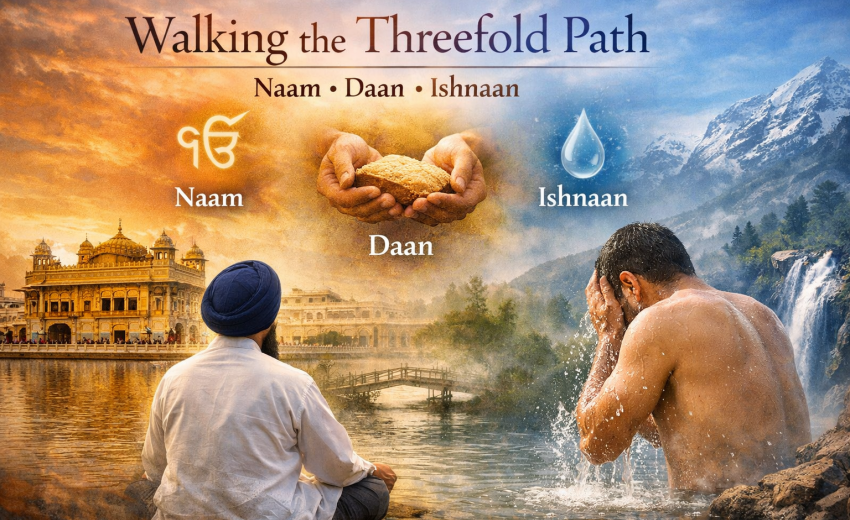
My journey in Sikhi has not been a straight road marked by certainty, but a slow awakening, layer by layer, through remembrance, responsibility, and renewal. The Gurmat path does not demand escape from the world; instead, it insists on immersion within it, transformed by awareness. Over time, I have come to understand that Naam, Daan, and Ishnaan are not three separate practices but a single rhythm of living, a breath that flows inward, outward, and again inward, aligning the soul with the Divine Hukam.
Naam: Learning to Remember What Was Never Forgotten
My earliest understanding of Naam was simplistic; repetition of the Divine Name, a verbal act confined to prayer hours. Yet life, with its trials and distractions, slowly taught me that Naam is not something I do; it is something I return to. Naam is remembrance, but also recognition: the quiet realization that the Divine Presence was never absent, only unattended.
In moments of anxiety, ambition, or loss, Naam became my anchor. The Gurus remind us that Naam is the lifeline in the ocean of existence, and I have found this to be profoundly true. When the mind scattered itself across worries of future and regrets of past, Naam gathered it back into the present. It softened my ego’s sharp edges and reminded me that I am not the center of existence, but a participant within a vast, compassionate order.
Gradually, Naam moved beyond the tongue into consciousness. It appeared in silence, in ethical hesitation, in awe before nature, and in the humility of admitting my own limitations. Remembering the Divine in this way reshaped my understanding of success and failure. Achievements lost their intoxicating power; setbacks lost their cruelty. Naam did not remove suffering, but it gave suffering meaning and direction.
Through Naam, I began to sense that the Divine is not distant or abstract but immanent—present in breath, in labour, and in relationships. This remembrance cultivated gratitude and dissolved the illusion of isolation. I was no longer alone in my striving; I was held within a greater rhythm.
Daan: Learning That What I Possess Never Truly Belonged to Me
If Naam softened my inner world, Daan confronted my external life. The Sikh tradition does not glorify renunciation but sanctifies honest earning (kirat) and generous sharing (vand chhakna). Yet practicing Daan demanded more than occasional charity, it demanded a re-examination of ownership itself.
Initially, my acts of giving were transactional, even self-affirming. I gave because it felt virtuous, because I could afford to, because it reinforced an image of myself as “good.” Over time, Sikhi challenged this subtle ego. Gurbani repeatedly reminds us that everything we call ours is a trust, not a possession. Wealth, intellect, influence, even time: none originate from the self alone.
This realization transformed Daan from an act of generosity into an act of justice. Sharing with the needy was no longer benevolence flowing downward, but balance being restored. I began to see inequality not merely as social failure but as spiritual imbalance. To eat while another starves, to accumulate while others lack dignity, is to forget Naam in action.
Daan also extended beyond material wealth. Listening without judgment, offering time, mentoring without expectation, standing with the marginalized—these forms of giving demanded more courage than writing a cheque. They required vulnerability and presence. In giving myself, I encountered my own discomfort, impatience, and hidden prejudices.
Yet paradoxically, Daan enriched me. It loosened the grip of fear—the fear of scarcity, insignificance, and loss. In giving, I experienced abundance not as accumulation, but as circulation. What flowed out returned as contentment, humility, and a deeper connection to humanity.
Ishnaan: Cleansing Beyond Water
Of the three, Ishnaan took the longest for me to understand. For years, I associated it primarily with physical cleanliness or ritual bathing. But Sikhi, uncompromising in its rejection of empty ritualism, compelled me to look deeper. True Ishnaan, I learned, is not about washing the body alone, but about cleansing consciousness.
Physical cleanliness remains important—it reflects discipline, respect for the body, and mindfulness. Yet the Gurus insist that one can bathe endlessly and still remain internally polluted by ego, lust, anger, greed, attachment, and pride. My real struggle lay there.
Mental Ishnaan demanded honesty. It required me to confront my intentions, question my motivations, and recognize how often ego disguised itself as righteousness. Prejudice, resentment, and self-deception are harder to wash away than dirt. This cleansing was uncomfortable; it stripped away comforting narratives about who I thought I was.
Naam became the water of this inner Ishnaan. Through remembrance, the mind slowly released its toxins. Through Daan, selfish impulses were weakened. Through reflection and repentance (pashchatap), clarity emerged. I learned that cleansing is not a one-time act but a daily discipline, much like tending a garden where weeds continuously return.
Ishnaan also involved ethical hygiene, what I consumed intellectually and emotionally. News, conversations, digital spaces, and ambitions all left residues. Learning when to withdraw, when to speak, and when to remain silent became acts of purification.
The Interwoven Path
Over time, I realized that Naam without Daan becomes self-absorption, Daan without Naam becomes egoistic charity, and Ishnaan without both becomes hollow ritual. The genius of the Sikh worldview lies in this integration. Spirituality is not divorced from economics, nor ethics from remembrance, nor inner purity from social responsibility.
Walking this path has not made me flawless, but it has made me aware. I stumble, forget, and falter—but I now recognize the direction. Naam re-centers me, Daan grounds me, and Ishnaan renews me.
In a world obsessed with speed, consumption, and self-promotion, this threefold discipline offers quiet resistance. It teaches me to live attentively, share responsibly, and cleanse continuously. My journey is unfinished, but it is anchored. I walk not toward personal salvation alone, but toward a life aligned with Sarbat da Bhala, the well-being of all.
And in that alignment, I glimpse the purpose of human life as envisioned by Sikhi: to remember the Divine, serve creation, and remain inwardly pure while standing firmly in the world.