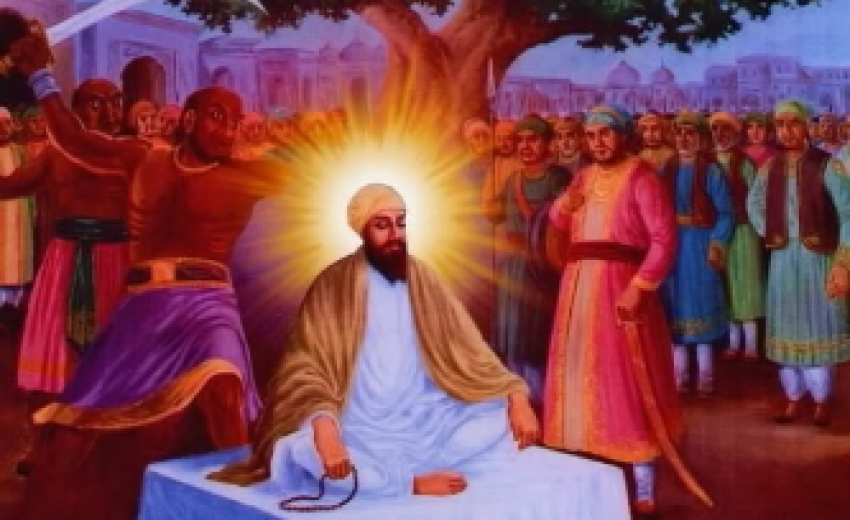

This November, the Sikh community remembers the 350th anniversary of Guru Tegh Bahadur’s sacrifice to protect freedom of conscience and belief for all people. Yet while Guru Tegh Bahadur endured martyrdom to protect religious freedom, he also sought to inspire a certain consciousness within his own students.
One compelling story from his life that demonstrates this, happened in the first days after the public recognized him as Guru.
My favorite book on the 9th Master is Guru Tegh Bahadur by Dr. Trilochan Singh published in 1967 by the Gurdwara Parbhandak Committee, Sis Ganj, Chandi Chowk, Delhi. Dr. Trilochan Singh offers a moving description of this event. My recounting of the tale relies heavily on the details provided in this book.
Dhir Mal, the nephew of Guru Tegh Bahadur through the Guru’s older brother, Baba Gurditta, had presented himself as the rightful heir to the Guru’s throne. When the ship trader Makhan Shah came to Bakala to give an offering to the true Guru for protecting his ships during a storm, Dhir Mal and 21other pretender Gurus failed the test. Guru Tegh Bahadur alone knew the inner secret of Makhan Shah’s heart, that he had promised 500 dinars to the Guru for charitable purposes, should his ship be spared from a storm.
Dhir Mal watched as his grip on the minds, hearts and money of the Sikhs began to slip away. At the urging of a conspirator named Shihan, Dhir Mal set in motion a plot to assassinate Guru Tegh Bahadur and steal the gifts offered to the Guru by the sangat. Shihan and Dhir Mal planted spies in Guru Tegh Bahadar’s court, seeming devotees who mapped the comings and goings of the Guru’s guards. At a particular moment of vulnerability, Shihan led about 100 armed men into the Guru’s court, with Dhir Mal in the rear. Shihan shot at Guru Tegh Bahadur, attempting to kill him, but the Guru was protected by the Divine. The bullet simply grazed his shoulder. In the chaos that ensued, Dhir Mal ordered the armed men to plunder as much as they could gather and bring back to his residence.
With the Guru mildly wounded, other Sikhs hurt during the attack, and the Guru’s durbar ransacked, the Sikh warriors furiously wanted to strike back. The Guru’s guards, along with Makhan Shah and his men, planned and executed their revenge. They stormed Dhir Mal’s home, arrested the masands, bandits, Shihan and Dhir Mal, seized their property and brought everything and everyone back to Guru Tegh Bahadur for judgement. Dhir Mal and Shihan wept and repented of their actions, and Guru Tegh Bahadur ordered their immediate release.
Guru Tegh Bahadur was not pleased with what his Sikhs had done.
“When they were gone, (Guru Tegh Bahadur) told Makhan Shah and Kirpal Chand that it was not proper for them to stoop to the very type of battle for wealth, power and superiority, to which Dhir Mal and his masands had abandoned themselves, in utter ignorance and madness. Has not Sheikh Farid said,
Return good for every wrong you suffer,
In your mind, no wrath entertain;
Free from agony will be your vesture,
All blessings of life you will gain.Sheikh Farid – Sloka, 78.” (Singh, Page 154)
In economics and politics, there is a branch of applied mathematics called game theory which examines how people, in interdependent situations, make decisions in order to succeed. These interdependent situations can be cooperative, competitive or a combination of the two.
Game theory was originally developed by Hungarian-born American mathematician John von Neumann and his Princeton University colleague Oskar Morgenstern, a German-born American economist, to solve problems in economics. Simply put, game theory examines the rivalries between competitors with mixed interests. It explores how the players of a game make choices, how those choices interact with one another, and what outcomes are affected by those choices.
What does game theory have to say about this moment in the Guru’s life?
The throne of the Guru, viewed from an earthly perspective, endowed its possessor with wealth, territory and influence. Because of the desire for these benefits, the players in this story attempted to secure that throne by earthly means. At first, this depended on intrigue and alliances. The pretender Gurus in Bakala all claimed the throne for themselves, and each attracted their supporters and followers. Yet when the hand of the Divine intervened, and revealed the True Guru, the game changed. The choices that the pretenders faced was to either leave the throne to Guru Tegh Bahadur, or pivot to war-games of spies, violence, seizure and assassination.
The secret, of course, is that spiritual authority has a non-human player involved. One name for that non-human player is Kartaa Purakh: The One who Does everything and who Protects everything. While many people profess to follow a faith or spiritual tradition, believing in something is not necessarily the same as total surrender and trust. This is the key difference.
Surely, Guru Tegh Bahadur knew his identity long before Makhan Shah appeared in Bakala. Yet the Guru had no need to outwardly proclaim his identity or display it. The Guru’s throne is a spiritual seat of authority, and even though it has a worldly component, the point isn’t the power, the influence, or the wealth. The purpose is to be a source of wisdom to elevate people’s minds.
Dhir Mal, Makhan Shah and others played the earthly game of fighting to secure property and territory – as if that is what would secure the claim to the Guru’s throne. Guru Tegh Bahadur sought to play a different game. One that attempted to bring his Sikhs to their higher senses: don’t just believe in the Divine, have absolute trust that the One will take care of things.
“Return good for every wrong you suffer…All blessing in life will you gain.”
Returning good for wrong is so difficult to do. When we feel attacked, our earthly nature instinctively reacts and lashes out to protect itself. Returning good for wrong requires tremendous self-restraint. It demands emotional intelligence, and some level of spiritual maturity. The strength to restrain oneself comes from relying on that Higher Being; of trusting that Kartaa Purakh will protect and provide.
When Makhan Shah and the warrior Sikhs brought what they had reclaimed from Dhir Mal’s house before the Guru, Guru Tegh Bahadur noticed items which had never been in his court. He questioned the Sikhs about these items. Makhan Shah explained that they took items from Dhir Mal’s home that “should have come” to the Guru, if Dhir Mal hadn’t pretended to the throne.
Guru Tegh Bahadur rejected this reasoning. He ordered that everything – even the items originally stolen by Dhir Mal’s men – should be given to Dhir Mal. Nothing that had been taken by force from Dhir Mal’s place, regardless of its origins, should remain with them.
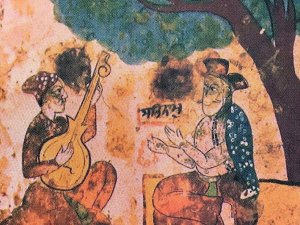
In this moment, the Guru embodied the values espoused in Kabir’s shabad. He returned good for wrong.
The Sikhs obeyed the Guru’s instructions. Except for the essential property of the durbar and some particular offerings from the sangat, everything else was given to Dhir Mal. The next day, humiliated by these events, Dhir Mal left for Kartarpur.
Yet that morning, Guru Tegh Bahadur mysteriously disappeared as well.
The attack of Dhir Mal’s armed men did not disturb his state of mind. The bullet fired at him by Shihan did not seriously wound him. Yet the violent actions of his own students caused him to withdraw into solitude. His spiritual ancestors, Guru Angad and Guru Amar Das, had similarly withdrawn when fighting, insults, and political gamesmanship had arisen around the earthly territory of the Guru’s throne.
For four days, no one knew the whereabouts of Guru Tegh Bahadur. “Mata Gujari, the Guru’s wife, knew that he had gone into elected silence once more, and it might take time to persuade him to forgive all transgressors who had hurt him.” (Singh, Page 156). Parties were formed to search the forests, to see if the Guru had gone hunting. Messengers were sent to nearby villages to inquire whether the Guru had decided to visit. Everyone searched for him. Five days passed. A farmer was driving his cattle into a thick, grassy grove. The cattle refused to enter. When the farmer investigated, he found the Guru.
“For five days Guru Tegh Bahadur had been sitting there in silent meditation, without having taken any food or water.” (Singh, Page 156).
Humans desire luxuries, treasures, and physical prosperity. The Creator has created these gifts for humans to enjoy. But when people fight over wealth, argue over territory, plot and scheme to grab power; when people prefer the Game of Thrones to the Game of Consciousness, suffering ensues and the Guru withdraws.
Students of these teachings can choose to play a different game. By developing trust for the One, people can discover another way to live. This chapter from Guru Tegh Bahadur’s life demonstrates the road he asked his Sikhs to follow.
Bibliography
Singh, Trilochan. Guru Tegh Bahadur. Gurdwara Parbandhak Committee, Sis Ganj, Chandi Chowk, 1967.
Brahms, Steven J., and Morton D. Davis. “Game Theory.” Encyclopædia Britannica, Encyclopædia Britannica, inc., 6 Sept. 2025, www.britannica.com/science/game-theory.