
Eleanor Nesbitt and Sikh Studies: A Legacy of Scholarship and Dialogue
Eleanor Nesbitt is a distinguished British scholar, educator, Quaker thinker, and author whose work has significantly shaped the academic understanding of Sikhism, interfaith dialogue, and multicultural education in the United Kingdom and beyond. Born in 1951 to Martha Eleanor Nesbitt and William Ralph Nesbitt, she received her early education at Talbot Heath School in Bournemouth, then studied classics and theology at Girton College, Cambridge. Her academic journey later included teacher training at Oxford, laying the foundation for a lifelong commitment to education, comparative religion, and intercultural understanding.
Nesbitt’s engagement with India proved transformative for her scholarly career. From 1974 to 1977, she taught in Nainital, India, where she developed a deeper appreciation for South Asian religious traditions and cultures. Upon returning to England in 1977, she taught at a comprehensive school in Coventry before undertaking research in Nottingham. She later joined the University of Warwick, where she became Professor of Education Studies and eventually Emeritus Professor. Throughout her academic career, she combined ethnographic research with educational theory, producing influential scholarship on religion, identity, migration, and multiculturalism.
Over more than four decades, Eleanor Nesbitt has become one of the foremost Western scholars of Sikh studies. Her research has focused especially on Sikh communities in Britain, documenting the lived experiences, identities, and religious practices of Sikh children and families. Between 1991 and 2009, she published several groundbreaking studies on Sikh children in Coventry, examining how faith, culture, and identity are negotiated within diasporic contexts. Her work has been widely praised for its empathetic and participatory methodology, which foregrounds the voices and experiences of the communities she studies.
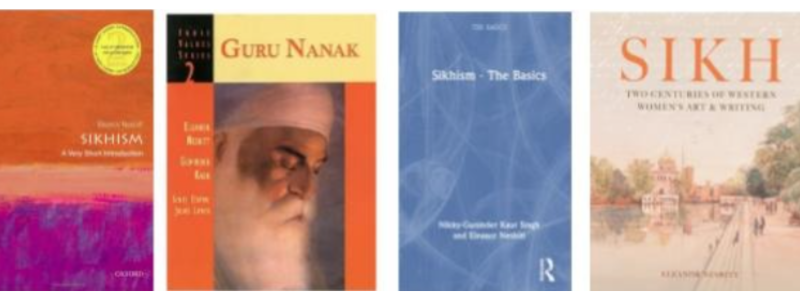
Among her notable contributions is the award-winning book Guru Nanak, co-authored with Gopinder Kaur. This important work introduced many readers to the life and teachings of Guru Nanak in an accessible yet academically rigorous manner. She also authored Sikhism: A Very Short Introduction, published by Oxford University Press, which remains one of the most widely read introductory texts on Sikhism. Her recent publication, Sikh: Two Centuries of Western Women's Art and Writing, explores Sikh history and culture through the perspectives of Western women writers and artists, offering a unique interdisciplinary contribution to Sikh historiography and gender studies. In 2025, together with Nikky-Guninder Kaur Singh, she co-authored Sikhism: The Basics, further enriching contemporary Sikh scholarship.
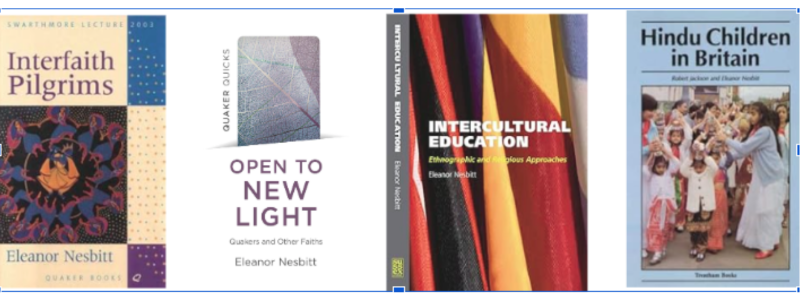
Beyond Sikh studies, Nesbitt has made substantial contributions to interfaith understanding and religious education. A committed Quaker, she has explored the relationships between Quakerism and other faith traditions through works such as Interfaith Pilgrims and Open to New Light: Quakers and Other Faiths. Her scholarship emphasizes dialogue, mutual respect, and openness to spiritual diversity. These themes also appear in her influential educational work, Intercultural Education: An Ethnographic and Religious Approach, which advocates culturally sensitive, ethnographically informed approaches to education in pluralistic societies.
Nesbitt’s academic influence extends through her institutional contributions as well. She was a founding member of the Punjab Research Group and helped establish the Journal of Sikh and Punjab Studies. She also served as co-editor for Brill’s Encyclopedia of Sikhism, helping to shape a major scholarly resource for researchers worldwide.
Her achievements have been recognized through prestigious lectures and honours. In 2003, she delivered the Swarthmore Lecture, and in 2009, she presented the George Richardson Lecture, reflecting her standing in both religious and academic communities. In addition to her scholarly and educational work, Nesbitt is also a poet. She co-authored Making Nothing Happen: Five Poets Explore Faith and Spirituality alongside Gavin D’Costa, Mark Pryce, Ruth Shelton, and Nicola Slee, demonstrating the breadth of her intellectual and creative engagement with spirituality.
Eleanor Nesbitt’s career represents a remarkable synthesis of scholarship, intercultural dialogue, spirituality, and education. Through her meticulous research and compassionate engagement with religious communities, she has deepened her understanding of Sikhism and promoted respectful interfaith relations in an increasingly diverse world. Her work continues to inspire scholars, educators, and readers interested in religion, identity, and the possibilities of meaningful cross-cultural understanding. During one of my recent meetings with her, I had the opportunity to learn more about her contributions and insights into Sikhism. I'm sharing a brief write-up of the interview for readers' benefit.
Dr. Singh: Over four decades of engagement with Sikh studies, what initially drew you, as a Quaker scholar, to the life and teachings of Guru Nanak?
Dr. Nesbitt: My first contact with Guru Nanak was probably in November 1974. As a new teacher at All Saints’ School, Nainital, in the foothills of the Himalaya. I was asked to accompany a group of Sikh pupils down to the lakeside gurdwara for the celebration of the Gurpurab. I had previously visited only one other gurdwara, the Sis Ganj Gurdwara in Delhi, and, although I had studied religious studies at university in the UK, I had arrived in India with no prior knowledge of Sikhs or their faith. When I asked my pupils to tell me about the celebration, there was very little that they could tell me.
On my return to England in 1977, I was appointed to teach in Coventry, a city with one of the largest Sikh populations in the UK. I resolved to learn more about the Sikh religion, and I was fortunate in getting a funded research fellowship at the University of Nottingham to conduct a study of the local Sikh community.
At the same time, I was reading as widely as I could about Sikh history, and this included encountering Guru Nanak’s life and teachings initially through the work of Max Macauliffe, Hew McLeod, Ganda Singh and Khushwant Singh. I enjoyed reading Janamsakhīs (including the beautifully illustrated B40 manuscript in London), but most of all I was drawn to Guru Nanak’s poetry: its imagery, its irony, and its directness.
Dr. Singh: How does your Quaker background influence your interpretation of Sikh theological concepts such as Naam, Daan, Ishnaan, seva, and sarbat da bhala?
Dr. Nesbitt: I have been a Quaker (i.e. a member of the Religious Society of Friends) for over 40 years, but I was brought up in the Church of England. So, I have been influenced by two distinct Christian denominations. The Church of England emerged during the Protestant Reformation, which marked a departure from Roman Catholicism. Then, in the 17th century, Quakerism’s co-founder, George Fox, rejected aspects of both the Catholic and the Anglican church. He emphasised that there was ‘that of God’ in everyone and that priests, church buildings and rituals were unnecessary: everyone could have direct communication with God.
This resonated for me with Guru Nanak’s rejection of the dominance of brahmin priests. I felt too that Jesus and Guru Nanak would have sensed a strong affinity. The prominence of dān (giving), of sevā (selflessly serving others) and sarbat dā bhalā (the welfare of all) accords with Quaker values and, indeed, with Jesus’s teaching and example.
I continue to explore the profound meaning of Nām, a concept which eludes direct translation into English. Similarly, the inward (or inner) Light is central yet elusive in Quaker spirituality. There is no disjunction between my idea of the divine presence and my understanding of Nām and the inner Light.
I understand ishnān to include both literal ablution, exemplified by bathing in the sarovar of Darbar Sahib, and also spiritual purification. This reminds me of Christian belief in the ‘washing away’ of sins and also the English dictum that ‘cleanliness is next to godliness’.
Dr. Singh: As a non-Sikh scholar, how do you navigate the balance between academic objectivity and personal engagement when studying Sikh scripture and tradition?
Dr. Nesbitt: Unlike Theology, an ethnographic approach to Religious Studies requires its practitioners to listen to and report what people, whatever their faith and culture, say and do. One may note discrepancies between what people do, what they say they do, and what they, or others, state that they should do. One notes all this but without passing judgment. As a scholar, one judges the rigour of a piece of research but not the quality (the orthodoxy) of a faith and its practitioners.
In conducting a series of fieldwork projects, I have tried to be transparent and reflexive. While researching and writing, I try to take into account my own position vis-à-vis the community that I am studying, acknowledging that, in relation to any community, I am neither an insider in every respect nor a total outsider. I do not equate this approach with objectivity; rather, it is a self-conscious recognition of inevitable subjectivity. I am alert to ways in which my presence may itself be affecting the people whose lives I am observing, and I am also alert to ways in which they and their tradition are influencing me.
In approaching Sikh scripture, I examine the original text alongside multiple English renditions. The similarities and differences between translations are a pointer to the diversity of interpretation. In the same way, in what is called Friendly Bible Study, a group of Quakers will deliberately read from different Bible translations.
Dr. Singh: Guru Nanak’s teachings are often described as universal. What aspects of his message enable it to transcend cultural, linguistic, and temporal boundaries?
Dr. Nesbitt: Guru Nanak’s teachings are often, and rightly, described as universal. I understand this to mean that they speak to and would benefit women and men of all generations, continents, and cultures.
If only Guru Nanak’s theological and ethical insights were embraced by all humans, society worldwide would be Gurmukh (oriented towards the Divine teacher) rather than manmukh (preoccupied with ego). The ‘five thieves’ (lust, anger, covetousness, attachment and pride) would no longer dominate human behaviour, and everyone’s life would be contemplative, industrious and generous. Moreover, regardless of prevailing norms, every human’s life should be committed to truth, not as an abstract principle but as the basis of daily behaviour: ‘Highest is truth but higher still is truthful living’.
I am reminded too of the story of the actor Balraj Sahni telling the Bengali poet, Rabindranath Tagore, that he should compose an international anthem, to which Tagore responded that we already have a universal anthem – one composed by Guru Nanak. Of course, Tagore was referring to Guru Nanak’s Arati verse, gagan mein thal ravi chand dipak bane. In this case, just visualising the heavenly bodies circling like the tray and the wick light that are rotated in Hindu worship, is mind-blowing.
Above all, ikkoankar, the divine oneness, includes everyone and everything that is. As a logo, the digit and the alphabetic character are unambiguously memorable.
Dr. Singh: Guru Nanak employed a poetic vernacular rather than elite or scholarly language. How do you interpret this choice in terms of accessibility and inclusivity?
Dr. Nesbitt: ‘The sacred language of the Sikhs’ is how the British scholar, Christopher Shackle, describes Guru Nanak’s poetic vernacular. For Nanak’s north Indian contemporaries, this would have communicated far more directly than either Sanskrit, the language of the Hindu pandits, or Arabic, the language of the Qur’an. Whilst the language of the Qur’an and the Hindu scriptures was fully accessible only to religious specialists, Guru Nanak’s shabads had a demotic appeal to people of many backgrounds. At the same time, by incorporating so many words from Persian, Arabic, and Sanskrit, his poetry connected with earlier scriptures and was readily understood by the diverse populations he encountered on his travels, or at least those in much of north India.
Of course, just as modern English differs from Geoffrey Chaucer’s and William Shakespeare’s English, so too speakers of twenty-first-century Punjabi and Hindi have to apply themselves to fully comprehending the language of the Guru Granth Sahib.
Importantly, the metrical character of poetry means that the Guru’s words are more easily recalled than bare prose would be. Most memorable of all is poetry that is set to music. We do not know by what date each of Guru Nanak’s shabads was apportioned to a specific raga, each moving its hearers with its association to times of day and states of mind: whether peaceful contentment, wonder, or energetic action. We do know that, when the Bānī descended, he sang his words to the accompaniment of his rabāb-playing companion, Bhai Mardana.
Dr. Singh: Guru Nanak’s imagery often draws from everyday life: nature, trade, and social relationships. How does this grounded imagery contribute to the enduring relevance of his teachings?
Dr. Nesbitt: Like the compositions of Sheikh Farid, Kabir and other medieval saint-poets and, indeed, like the poetry of Guru Nanak’s successors as Guru, Nanak’s poetry is bursting with images. His deft word-pictures draw on and illuminate so many aspects of daily life, whether agriculture, sugar-making, business transactions, the skills of the dyer and jewellery-maker, or the religious routines of Muslim and Hindu devotees. Domestic chores, too, suggest spiritual parallels to Guru Nanak: cleaning soiled clothing, polishing utensils, and mending one’s clothes.
From nature come images of flowers and fruit, plants and trees, as well as insects (such as the ant, and also the black bee that is attracted to the lotus flower), birds (among them koels, and sparrows which call for God in Persian – khudai, khudai, and parrots), plus amphibians, reptiles and other creatures. Crocodiles, elephants and the rhinoceros all enliven Guru Nanak’s verse and drive home his spiritual teaching. A person who does not contemplate Nām is like a frog in a well. Individuals who turn their backs on the Guru are like donkeys, pigs and cats. The crow, too, is his image for egotistical, greedy people.
For me, an especially powerful image for the soul and God is the fish, living in a sea which it cannot measure and which it cannot leave without dying. Boats provide images, as do the seasons of the year, and the love between man and woman offers a metaphor for the relationship between God and the human soul.
Dr. Singh: Your book Sikh: Two Centuries of Western Women's Art and Writing explores Western women’s engagement with Sikhism. What key patterns emerge in how Guru Nanak’s message resonates across gender and cultural boundaries?
Dr. Nesbitt: My book, Sikh: Two Centuries of Western Women’s Art and Writing, reports the responses of women from North America, Great Britain, and mainland Europe to Guru Nanak’s message. The earliest was Maria Graham (Lady Maria Callcott), whose book, Letters from India, published in 1814, declared that ‘Nanac… appears to have been a man of singular virtue and benevolence’ who called upon Hindus ‘to abandon the idolatry which had crept in among them, and to abide by the pure faith of their ancestors’. Forty years later, an anonymous artist explained that ‘Nanuk’ was ‘holy and devout in his life’.
The women all had Christian backgrounds, but their relationship with Christianity ranged from the evangelism of missionaries such as Charlotte Tucker to the eclecticism of two leading Theosophists, Helena Blavatsky and Annie Besant. Yet all concurred on Guru Nanak’s distinctive nobility of character. Tucker (who, unusually for a Britisher, had learned to read the Guru Granth Sahib in Gurmukhi) described Guru Nanak as ‘eminently devout, gentle, and lowly’ and Besant called him ‘the first, the purest, the saintliest and the noblest of them all’.
Anjela Duval, a Breton peasant, was so moved by a French translation of Guru Nanak’s Arati that she translated it into Breton. In her novel The Casual Vacancy, J. K. Rowling, the creator of the Harry Potter novels, describes Parminder Jawanda, a central character, seeking solace in the words of the Kirtan Sohila.
Dr. Singh: In Sikhism: A Very Short Introduction and your recent collaboration with Nikky-Guninder Kaur Singh on Sikhism: The Basics, what challenges and opportunities arise when communicating Sikhism to global audiences?
Dr. Nesbitt: I felt privileged when Oxford University Press asked me to write Sikhism: A Very Short Introduction (2005 and 2016) and then, more recently, when Professor Nikky-Guninder Kaur Singh invited me to co-author Sikhism: The Basics (Routledge 2025). Naturally, both commissions were challenging. I commend anyone who is interested in the challenges of writing introductory accounts of this sort to read my 2007 article ‘Issues in Writing Introductions to Sikhism’, Religions of South Asia, 1 (1) 47-63.
One challenge is to write in a way that engages readers, regardless of their prior level of familiarity with the subject. Another challenge is to compress a large amount of material into the word count required by the respective publishers. When writing about matters of faith, one is venturing onto the holy ground of devotees. On occasion, it is hard to find a way of relating history in a way that is academically sound without being hurtful to people of faith. In this regard, it is good for an ‘outsider’ to be teamed with an ‘insider’. My experience of co-authoring books with Sikh authors has been unfailingly positive, and it reassures me for taking on such projects as a sole author, provided I proceed cautiously and sensitively.
It has been wonderful to discover that readers in many countries have been reading what I’ve written. What moved me most was an appreciative email from a boy studying his religion at a Khalsa school in Malaysia.
Dr. Singh: From your long engagement with interfaith scholarship, including Quaker Quicks: Open to New Light: Quakers and Other Faiths, what lessons can contemporary societies draw from Guru Nanak’s approach to interreligious dialogue?
Dr. Nesbitt: ‘Interreligious dialogue’ tends to refer to organised events in which individuals of goodwill from a number of faiths come together for conversations that are a little more formal than everyday conversations. In Guru Nanak’s case, we have poetic compositions in the Guru Granth Sahib that evoke or respond to people whose outlook, behaviour, and devotional practice differed from his. I think especially of the Sidh Gosht. These verses appear to be the basis for the Janamsakhi narrative of his meeting with Nath yogis.
Clearly, the Guru not only met a range of people but went far out of his way in order to do so – in the yogis’ case, this meant climbing to their hilltop refuge. His close friendship with Bhai Mardana beautifully exemplifies interreligious companionship, and his interest in Islam is believed to have taken him as far as Mecca. This readiness for travel is the basis of his udāsīs, long journeys to unfamiliar places.
Regarding the Indic (‘Hindu’) tradition, he challenged discriminatory social norms (regarding caste and women), and he asked penetrating questions. At the same time, he assumed such characteristically Hindu concepts as karma and rebirth, while shifting the emphasis to principled living.
We can learn from his clarity and his humour. We can also learn from his readiness to go out of his way to engage with people from very different backgrounds and beliefs, and above all from his steady friendship with Mardana.
Dr. Singh: From an ethnographic perspective, how do Sikh communities in the diaspora maintain continuity while adapting to new cultural contexts?
Dr. Nesbitt: The continuities and disjunctions in the behaviour of individual diaspora Sikhs exemplify an ongoing interaction between three factors: panjābiat, sikhī and western modernity. Sometimes, these are mutually reinforcing: diaspora Sikhs’ philanthropy accords with Punjabi cultural values, the Gurus’ teachings, and Western values. To take another example: marrying out of caste is consistent with the Gurus’ rejection of prejudice that is based on one’s hereditary status, and it accords with the norms of Western societies, but it runs counter to Punjabi family tradition. Diaspora Sikhs face many dilemmas, but this is also true of Sikhs in India’s rapidly changing society.
Sikh communities worldwide perpetuate collective religious activity – they gather weekly to worship as a sangat, they maintain the langar and carry out sevā. Vaisakhi and Gurpurbs are celebrated. However, differences in the law make continuities more difficult in some countries than others. So, in France, wearing a turban is not allowed in state schools and in Italy, gurdwaras are not officially recognised as places of worship.
Here in the UK, the scale and architectural grandeur of gurdwaras are increasing, and more and more women are wearing turbans; some Sikhs are reclaiming the martial art of shastar vidyā. Sikhs’ public profile is increasing thanks to the organised provision of meals for people in need, as well as Sikhs’ distinguished service in politics and the professions. The number of statues of Sikhs is increasing.
The internet helps Sikhs to learn about their tradition and to find Sikh solidarity online.
Dr. Singh: As both a scholar and a poet, how has your engagement with spirituality influenced your creative expression, particularly in Making Nothing Happen: Five Poets Explore Faith and Spirituality?
Dr. Nesbitt: Poetry has been important to me since my early schooldays. Naturally, I was influenced by what I heard and read, including Christian hymns. Later, I realised that the hymns that moved me most deeply were in fact poems by accomplished poets – Emily Brontë, John Greenleaf Whittier and Francis Thompson.
For over twenty years, I have, in one group, shared my poems for critical discussion with poet-friends, Catholic and Anglican, all of them professionally involved in theological education. This group affirms faith and spirituality. In 2014, we published a selection of our poems in a volume titled Making Nothing Happen: Five Poets Explore Faith and Spirituality. Each of us prefaced our selected poems with an essay. Mine was the hardest assignment I can remember. For me, the experience of feeling compelled to write a poem is similar to the sense of being called to speak (to give ‘vocal ministry’) in a Quaker Meeting.
My poems range over many subjects, and many have been prompted by an experience of nature or of a place of pilgrimage.
Dr. Singh: Finally, what future directions do you envision for Sikh studies, especially in relation to communication, gender, and intercultural understanding?
Dr. Nesbitt: My hope is that Sikh Studies proceeds as a strongly multi-disciplinary subject, embracing not only history, theology, philosophy and social anthropology but also musicology, art and architecture, politics, economics, psychology and cultural geography, as well as language, literature and film studies. Postcolonial and feminist theory, as well as the roles of IT and AI, are likely to feature in future research.
Having said this, I cannot second-guess the topics that will fire researchers’ imaginations or the issues that will impinge on Sikhs and call for investigation.
I hope that more students will engage with source material in Farsi and that historical documents in Pakistan will become available to scholars before they deteriorate further. As regards intercultural understanding, the interfaces now and in the past between Sikhs’ religion and Hinduism, Islam and Christianity need more attention both in the sub-continent and overseas.
Dr. Singh: Thank you, Dr. Nesbitt, for sparing your valuable time for this interaction. It was wonderful meeting you and listening to your views on various aspects of Sikh doctrine, history, and philosophy.
Dr. Nesbitt: Thank you very much, Dr. Singh, for your intelligent and thought-provoking inquiry. The questions have given me much to think about, and I appreciate the care that went into framing them. I appreciate your input and efforts very much.
******