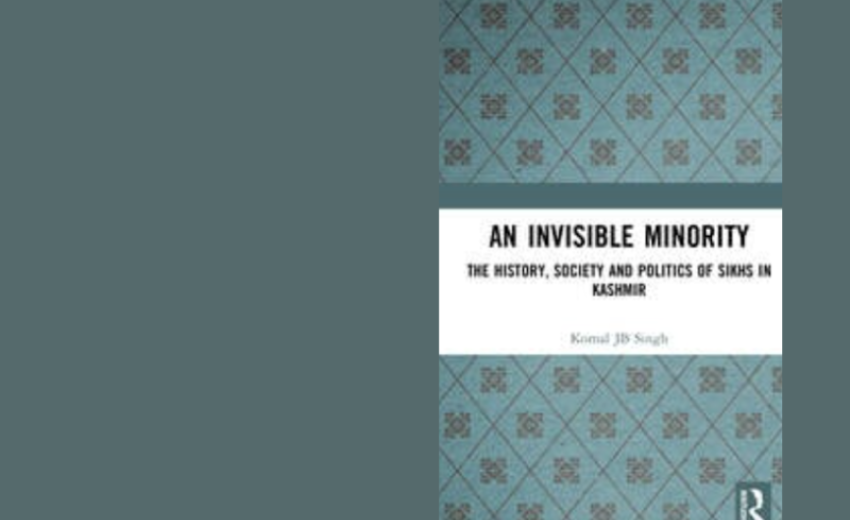

Komal JB Singh’s An Invisible Minority
The History, Society, and Politics of Sikhs in Kashmir (Routledge, 2025) is a long-awaited and necessary intervention in South Asian scholarship. At a time when Kashmir is largely represented through the lens of Hindu-Muslim conflict or the Indian-Pakistani geopolitical rivalry, Singh offers a radically different narrative: one that centers the voices, histories, and political silences of the Kashmiri Sikh community. Drawing from ethnographic fieldwork, personal testimony, oral histories, and memory studies, Singh’s book brings to light the experiences of a community caught between state neglect and insurgent violence, resilience and marginalization.
The Sikh community in Kashmir constitutes less than one percent of the Valley’s population, yet their presence dates back centuries, from the time of the Sikh Gurus through the reign of Maharaja Ranjit Singh. While their history has been intertwined with Kashmir’s sociopolitical transformations, they have rarely been foregrounded in academic literature. Singh’s work corrects this historiographical oversight with meticulous documentation and theoretical depth. Her use of constructivist identity theory, intersectionality, and memory studies enables a multidimensional analysis of how Sikh identity in Kashmir has been shaped—not only by violence and trauma but also by faith, community, and a sense of belonging that transcends binary nationalisms. What distinguishes this book is its deeply personal voice. Singh is not just an academic observer but an embedded participant in the community she writes about. Having grown up in Baramulla in the 1990s, her own story becomes a method—a point of entry into the larger narrative. This autoethnographic approach enhances the book’s emotional and scholarly depth. Her realization of being “invisible” in dominant discourses—neither perceived as a Muslim nor as a Hindu migrant—becomes a recurring theme. Her identity as a Kashmiri Sikh woman is not merely background but a driving force of the research, adding authenticity and urgency to the work.
The book traces four major moments in the evolution of Sikh identity in Kashmir: the 1947 Partition and tribal invasions, the anti-Sikh violence of 1984, the 2000 Chittisinghpora massacre, and the 2019 abrogation of Article 370. Each of these events is not just a historical rupture but a lens through which collective memory and identity have been constructed. The violence of 1947 displaced thousands of Sikhs, rendering them refugees in their own homeland, a trauma that remains deeply etched in community memory. The massacres of 1984 and 2000 added further layers of fear, silence, and alienation, reinforcing the sense of being doubly marginalized—by the state and by insurgents, by national policies and regional hostilities.
Singh presents silence as both a strategy and a symptom. Her interviews with community members reveal how expressions of political opinion are often met with laughter, evasion, or quiet resignation. “Na koie fayada, na koie nuksan”—there is neither benefit nor harm—becomes a refrain, capturing the quiet despair of a community whose voices are consistently excluded from policymaking and representation. While their spiritual ethos of Chardi Kala (eternal optimism) forbids open expression of victimhood, this very injunction imposes an additional burden of silence, making their struggles even more invisible.
Equally compelling is Singh’s analysis of the political aftermath of the 2019 abrogation of Article 370. Despite being one of the only minority groups that did not migrate en masse from the Valley, Sikhs have received no special status, benefits, or recognition. Their demands for political reservation and inclusion of Punjabi as an official language have been largely ignored. Singh critiques how state-driven narratives of development and security fail to account for the everyday marginalization of Kashmiri Sikhs. Her fieldwork reflects the frustration of young Sikhs migrating out of the Valley in silence, their struggles unnoticed even by the government that claims to be protecting minorities.
Memory plays a central role throughout the book—not just as a recollection of past trauma but as an active force in shaping identity and community. Singh draws on theoretical insights from Berger and Luckmann, Busekist, and J. Edward Mallot to show how collective memory consolidates belonging, reaffirms boundaries, and provides moral grounding in moments of uncertainty. Her work reminds us that for many Sikhs in Kashmir, violence is not a historical anomaly but a recurring reality that links the past to the present. The Sikh identity, thus, is not constructed in isolation but emerges from a continuum of remembrance, resistance, and negotiation.

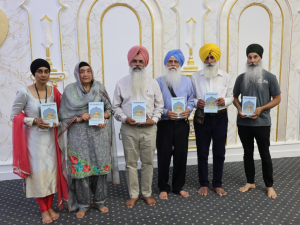
(Author of the book: Komal JB Singh)
The prose is scholarly yet accessible, deeply empathetic yet analytically rigorous. Singh writes with care and precision, aware of the ethical responsibility that comes with documenting community histories. Despite facing multiple obstacles—including two lockdowns (post-370 and COVID-19), political instability, and the fragility of oral sources—her research is comprehensive and methodologically sound. If anything, the limitations she candidly acknowledges further underscore the urgency and importance of this work. This book is not only a historical account but also a critical political document. It challenges scholars and policymakers alike to rethink Kashmir’s plural landscape beyond reductive binaries. It also opens new pathways for research on other marginal communities in conflict zones—those who remain unnamed, uncounted, and unheard.
An Invisible Minority is essential reading for students and researchers in South Asian Studies, Political Science, Sociology, History, and Religious Studies. It also holds value for journalists, policy analysts, and human rights workers seeking to understand the nuanced dynamics of identity, memory, and marginality in contested regions. Komal JB Singh has crafted a work that is as much a narrative of survival as it is a call for recognition. It demands to be read, discussed, and remembered.