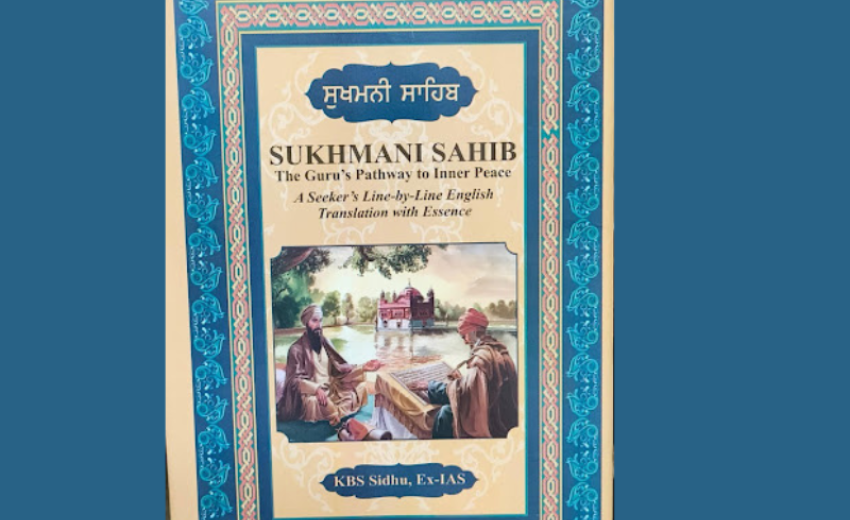

Sukhmani Sahib: The Guru’s Pathway to Inner Peace

A Seeker’s Line-by-Line English Translation with Essence
By K. B. S. Sidhu, Ex-IAS, Former Special Chief Secretary of Punjab
Total Pages 471
The Guru’s Pathway to Inner Peace is an ambitious and deeply contemplative work that seeks to make one of Sikhism’s most revered compositions accessible to a wide, global readership. Neither a conventional translation nor a purely academic commentary, the book positions itself as a “seeker’s engagement” with Guru Arjan Dev Ji’s Sukhmani Sahib—offering a line-by-line English rendering accompanied by reflective exposition and spiritual essence.
Composed around 1602–1603 at Ramsar Sahib, Amritsar, Sukhmani Sahib occupies a central place in Sikh devotional and philosophical literature. Sidhu approaches this sacred text with reverence and humility, explicitly disclaiming scholarly authority while nevertheless displaying a disciplined familiarity with Sikh theology, history, and devotional practice. This self-positioning is one of the book’s defining features: it speaks not from the pulpit of dogma, but from the reflective interior of lived spiritual inquiry.
Structurally, the work mirrors the internal architecture of Sukhmani Sahib itself—24 Ashtpadis, each with a Salok and eight Pauris—yielding 192 short, meditative essays. This methodical progression allows the reader to engage slowly and deliberately, making the book particularly suitable for sustained reading, daily reflection, or group discussion. Sidhu’s stated intention of sharing one or two Pauri-based reflections a day is reflected in the measured pace and clarity of exposition.
The translation style is careful and restrained. Sidhu avoids ornate language or excessive interpretive flourish, opting instead for lucid English that seeks to preserve the spiritual cadence of the original Gurmukhi. His accompanying “essence” sections function as bridges between text and lived experience, drawing out ethical, metaphysical, and devotional implications without collapsing the poetic density of the Bani into simplistic moralism.
A notable strength of the book lies in its inclusive spiritual vision. Sidhu repeatedly emphasises that the Divine Names—Ram, Hari, Prabh, Gobind, Murari—point toward the same Akal Purakh, the Formless and Timeless One, and that terms such as Brahmgyani, Sant, and Saadh signify spiritual attainment rather than sectarian identity. In doing so, the work extends beyond confessional Sikh readership to address “all spiritual seekers across the globe,” without diluting the distinctly Sikh philosophical framework of Naam, Shabad, and Hukam.
The contextual chapters on the composition, structure, and musical foundation of Sukhmani Sahib—particularly the discussion of Raag Gauri—add scholarly value, situating the text within its historical, musical, and contemplative milieu. While not a technical musicological study, this section effectively underscores the integral relationship between raga, mood, and spiritual discipline in Sikh scripture.
If there is a limitation, it lies precisely where the author himself is most candid: the book does not aim to replace rigorous philological or comparative scholarship. Specialists may occasionally desire deeper engagement with variant readings, classical exegetical traditions, or intertextual analysis within the Guru Granth Sahib. Yet this is less a shortcoming than a conscious choice, consistent with the book’s declared purpose.
In sum, Sukhmani Sahib: The Guru’s Pathway to Inner Peace is a substantial and sincere contribution to contemporary Sikh devotional literature in English. It combines clarity with reverence, structure with introspection, and personal humility with intellectual discipline. For readers seeking not merely to read Sukhmani Sahib but to dwell with it—line by line, breath by breath—Sidhu’s work offers a thoughtful and dignified companion.