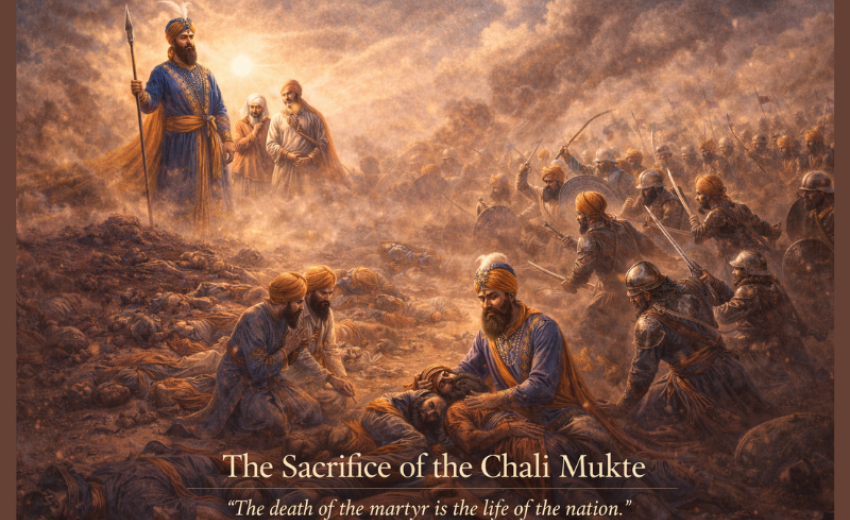

A Blood-Stained Chapter of Sikh History: From the Bedāvā to Khidrāṇe dī Ḍhāb
This episode stands among the most poignant and morally charged chapters in Sikh history, unfolding between the act of renunciation (bedāvā) and its redemptive annulment at Khidrāṇe dī Ḍhāb (later Muktsar). It is a narrative of remorse, moral awakening, martyrdom, and ultimate spiritual liberation.
In the town of Patti in the Majha region, Sikhs from near and far had assembled on the thirteenth day following the death of Chaudhri Des Raj Waraich, a prominent Sikh and the father of Bhai Sultan Singh. During this gathering, a Sikh addressed the congregation with grave news from Anandpur Sahib. He reported that Guru Gobind Singh had been compelled to leave Anandpur and had proceeded towards the Malwa region. Guru Sahib’s aged mother, the four Sahibzadas, and devoted Sikhs such as Bhai Uday Singh had already attained martyrdom on the battlefield. The speaker expressed collective remorse that the Sikhs of Majha, despite their strength and numbers, had failed to reach Anandpur in that hour of extreme crisis.
He further recalled a painful incident: Duni Chand, a leading Majha chief and grandson of Bhai Salo, had fled from Anandgarh Fort by lowering himself with a rope under cover of night, accompanied by a few Majhail Sikhs. This act of desertion had stained the honour of the region. In an effort to atone for this disgrace, Duni Chand’s grandsons, Bhai Anup Singh and Bhai Sarup Singh, had laid down their lives at the battle of Nirmohgarh.
Deeply moved, the assembly unanimously resolved that Guru Gobind Singh was then in the vicinity of Dina Kangar in Malwa and that it was their moral duty to seek him out—to share in his suffering, to inquire after the martyred members of his family, and to request him to return to Majha. It was suggested that Bhai Bhag Singh of Jhabal, a man of influence, might even negotiate a reconciliation with the Mughal authorities. With the resounding cry of Jaikāra, the decision was sealed.
From Patti set out a jatha of forty Sikhs, led by Bhai Bhag Singh Jhabalia and Bhai Sultan Singh, accompanied by Mata Bhag Kaur as the forty-first member. Crossing the Beas and the Sutlej, they reached Zira, and while proceeding towards Moga learned that Guru Sahib had already left Dina Kangar for the Lakhi Jungle. Continuing their search, they finally met Guru Gobind Singh near Rupana, in the sandy tract of Rohi.
Guru Sahib ordered Bhai Man Singh to spread a cloth and invited the Sikhs to sit. Their first inquiry concerned the fate of the Guru’s family and the martyred Sikhs. Bhai Bhag Singh then proposed that, through their mediation with the Mughal state, Guru Sahib might live the rest of his life in peace, and that they would remain his followers. Guru Gobind Singh responded with stern moral rebuke. He reminded them of their historical failures: the absence of Majha Sikhs during the martyrdom of Guru Arjan, during the armed struggles of Guru Hargobind, at the execution of Guru Tegh Bahadur in Delhi, and throughout the prolonged siege of Anandpur. “Where were you then?” he asked. “And what have you come to seek now?”
Ashamed and shaken, the Sikhs lowered their heads. Bhai Bhag Singh finally declared that under such conditions they could not sustain their discipleship and would return home. Guru Sahib replied calmly yet decisively: if they chose to depart, they must put it in writing that from that day onward there would be no Sikh of the Guru in Majha. At his command, writing materials were brought forth. Bhai Bhag Singh signed first, followed by Dilbagh Singh, Gharbagh Singh, and Ganda Singh. The remaining thirty-five hesitated, torn between pride and conscience, and refrained from signing.
At that moment a scout arrived with urgent news that Mughal forces were approaching. Guru Sahib departed with his retinue. After his departure, Mata Bhag Kaur addressed the Sikhs with a fierce and honour-laden rebuke. She reminded them that the earlier disgrace of desertion had not yet faded, and now they had compounded it by signing a renunciation in the very presence of the Guru. “With what face,” she asked, “will you return home?”
Her words ignited a moral transformation. The forty Sikhs, including those who had signed the bedāvā, resolved to redeem themselves. Mounting their horses and chanting Sat Sri Akal, they rode after the Guru and took position on the banks of Khidrāṇe dī Ḍhāb, facing east, awaiting the advancing Mughal army. Guru Gobind Singh stationed himself on a nearby sand mound.
A spy sent by Wazir Khan of Sirhind attempted to locate the Guru but was detected and slain by a single arrow. Soon the Mughal forces arrived. The Sikhs launched a fierce resistance with arrows and firearms, halting the enemy advance. When their ammunition was exhausted, they drew their swords and charged, raising the cry of Sat Sri Akal. Steel clashed with steel, and the Sikhs fought with such ferocity that the enemy was thrown into confusion. By sunset, seeing no Sikh left standing, the Mughal commander ordered a retreat.
After the battle, Guru Sahib reached the banks of the Isar Sarovar and ordered the bodies of the fallen to be brought. Bhai Man Singh lay foremost among the martyrs. Guru Gobind Singh wiped his face with his own handkerchief and declared him his “one-and-a-quarter lakh” Sikh, a supreme expression of honour. Each martyr was similarly acknowledged, some being blessed symbolically as leaders of tens of thousands. Three Sikhs—Bhai Rai Singh, Bhai Sundar Singh, and Bhai Maha Singh—were still alive. Guru Sahib comforted them, gave them water, and listened to their final supplication: that he tear up the written bedāvā and restore them to the Sikh fold. Guru Gobind Singh thrice proclaimed, “Blessed is Sikhi,” and tore the document to pieces.
Mata Bhag Kaur, though wounded, survived, seated beneath a tree in meditation. The forty Sikhs attained martyrdom on 30 Poh, Samvat 1762 (1705 CE), a Sunday. Guru Sahib bestowed upon them the exalted title of the Chālī Mukte—the Forty Liberated Ones—and named the place “Ishar Sar Muktsar.” The following morning, Asa di Var was sung, karah prasad was prepared, and Guru Sahib personally performed the final rites of the martyrs, reciting Sohila and offering ardas. Addressing the congregation, he declared that those who bathe in this sacred tank on the day of Maghi would receive the merit of bathing at all major pilgrimage sites.
In time, a shrine was established at the site, and from December 1725 onward, the annual Maghi gathering at Muktsar became an enduring tradition. Thus was written a blood-soaked yet luminous page of Sikh history—a testament to repentance transformed into sacrifice, and to martyrdom as the very life-force of the community:
“The death of the martyr is the life of the nation.”