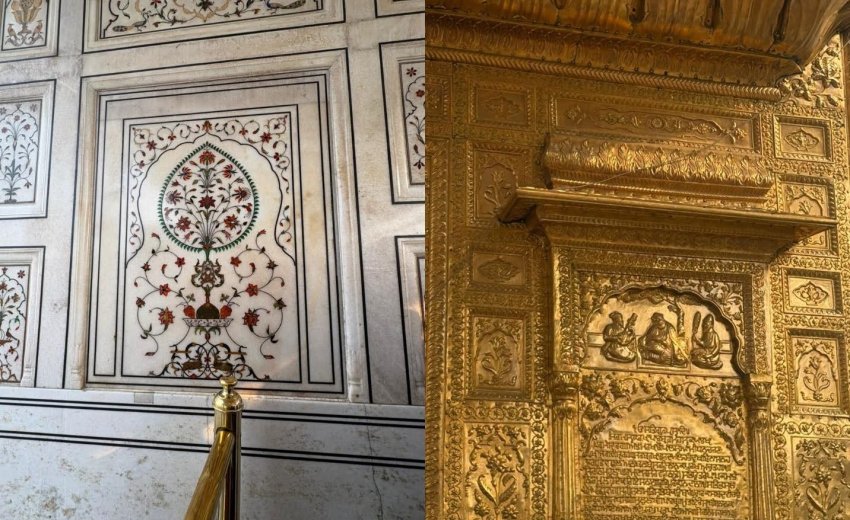

Marble, Motif, and Meaning: The Sacred Language of The Golden Temple
A quiet transformation begins to unravel as one walks barefoot onto the marble inside the Golden temple. It feels alive with memories. As pilgrims walk slowly along the parikrama looking at the golden sanctum, a much deeper story of the sacred space begins under the feet. Before transcendence, one feels humble.
Sri Harmandir Sahib stands apart from many sacred spaces in one profound way i.e., it is built lower than the surrounding ground level so one needs to descend to enter. This particular architectural choice is not incidental but reflects a key Sikh teaching i.e., humility is the only path to connect with the divine. The marble forms the base of the golden temple and hence reinforces the idea that a shared ground resolves all differences and walking barefoot slowly the body, stills the mind and prepares the devotee for inward reflection. It echoes the teachings of Sri Guru Granth Sahib that humility is not just an abstract virtue but a way of being.
The extensive use of white marble in the Golden temple is both symbolic and aesthetic. Since marble cools, endures and reflects softly it creates an atmosphere that is balanced inviting contemplation. Historically, parts of the complex were adorned with frescoes but many were replaced with marble slabs donated by devotees. Each slab of marble is more than material as it represents faith and gratitude.
Within the marble slabs, one can notice the intricate art of jaratkari i.e., an intricate form of pietra dura/inlay art which involves embedding finely cut and polished semi-precious stones into marble to create colorful, detailed geometric or floral patterns. The motifs are deeply intentional as floral designs suggest growth, renewal whereas geometric patterns evoke order and harmony. These patterns are meant to guide attention and create rhythm much like meditative repetition of Naam as if walls are participating themselves in the act of remembrance.
A closer look at the motifs show that everything in the world is rooted in unity as these motifs celebrate interconnectedness. And in the teachings of Sri Guru Granth Sahib, it has been expressed that God is present in all and gives an unspoken reminder that sacredness is not separate from the world rather woven into it.
As soon as one enters the sanctum, the experience shifts from stillness to luminous details including mirror work, intricate ceilings and reflective surfaces transform light into a dynamic presence. The mesmerizing interplay of pattern and illumination creates a sense of depth that feels almost infinite.
As Light in Sikh philosophy is associated with divine awareness, so when it moves touching stone, marble or glass, it becomes a metaphor for inner awakening. The rich architecture thus moves the devotee from external to internal.
One of the most remarkable aspects of the Golden temple is the anonymity of its artisans. Although some names are recorded in history yet a majority remains unknown still. But this anonymity is not a loss but a reflection of seva, selfless service. So, the artisans' work becomes an offering since their skill, devotion and patience stays embedded in every carved motif. The result is a scared environment shaped by collective humility.
The architecture of the Golden temple is a beautiful visual relationship between gold and marble that defines its aesthetic identity. The lower structure in white marble shows serenity but the above golden sanctum is radiant and transcendent. This contrast shows a deep symbolic journey from awareness to awakening. It is a great reminder that spiritual elevation is rooted in humility because without the grounding of marble, the brilliance of gold loses its meaning.
To walk through the Golden temple is like encountering a sacred language expressed not only in words but also in stone, pattern and light. The marble beneath one’s feet, beautiful intricate motifs along the walls and shimmering reflections within merge into a single immersive experience of devotion. The architecture of the Golden temple accomplished what the highest spiritual teachings aspire to do i.e., it quiets the mind, centers the self and opens a space for reflection. It gently invites one to become still and one with God.