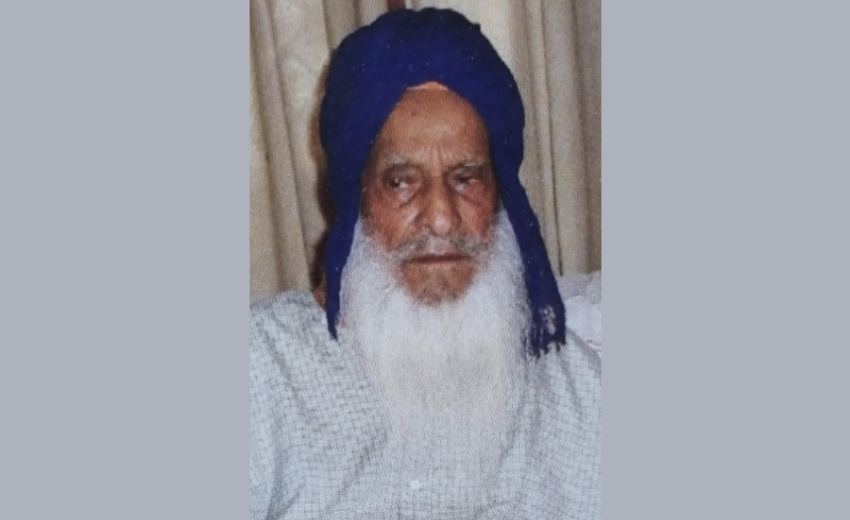

In the collective memory of the Sikhs of Jammu and Kashmir, few names evoke as deep a sense of admiration, reverence, and gratitude as that of Sardar Sant Singh Tegh—a charismatic leader, a fearless defender, and an extraordinary human being whose life embodied sacrifice, political wisdom, and unwavering commitment to justice. Popularly known as the “Blue-Turbaned Lion of the Mountains,” Sant Singh Tegh emerged as a symbol of strength and unity during a time when the Sikh community in the region faced political uncertainties, social pressures, and periodic threats to their cultural and religious identity.
His life traversed multiple dimensions—political activism, social leadership, inter-community harmony, grassroots organization, and moral education. For the Sikhs of Kashmir, he became more than a leader; he became a living institution, a walking university of traditional wisdom, a guide whose words shaped collective consciousness, and a guardian whose presence offered protection and dignity.
This biography attempts to present a comprehensive and scholarly account of his life, contextualizing his contributions within the broader socio-political landscape of Kashmir. Drawing from oral traditions, community memory, contextual evidence, and socio-historical analysis, it seeks to reconstruct his legacy in its fullest possible form, offering a portrait of a man who lived courageously, thought deeply, and served tirelessly.
Sardar Sant Singh Tegh was born on 13 April 1909 in the village of Hattian-Dupatta in Muzaffarabad (now in Pakistan-administered Kashmir), to S. Nihal Singh and Mata Hushnak Kaur. His early education was received under the guidance of his father, who served as the village granthi. After completing his matriculation from the school in Muzaffarabad, he attained proficiency in Punjabi, Urdu, English, and other languages. As a young boy, he also witnessed the horrific massacre of Jallianwala Bagh with his own eyes—an event that left a deep imprint on his mind. His grounding in Sikh religious teachings was likewise acquired directly from his father.Sardar Tegh was married twice. His first marriage took place in 1928 with Bibi Lakhwinder (Lakshmi) Kaur, and the second in 1945 with Bibi Tirath Kaur. From childhood, Sant Singh Tegh embodied a unique bouquet of religious and ethical virtues; the spirit of Panthic dedication flowed through every fiber of his being. His village, Hattian-Dupatta, was situated near the main Domel–Srinagar road. Because of this proximity, he learned driving at a very young age. In one of his conversations, he mentioned that he had driven trucks for many years along the Srinagar–Rawalpindi route, which brought him into close contact with people from all walks of life.
In 1934, he became the President of Gurdwara Chehvin Patshahi, Naluchi. Gradually, his influence grew within Panthic circles, and he became widely known for his commitment to public welfare. In 1950, he served as President of the State Akali Dal, a position he held until 1957. In 1990, he became the State President of the Akali Dal (Mann). Before the Partition of 1947, he was also an organizer of the Shiromani Khalsa Darbar of Jammu and Kashmir. In 1945, he efficiently fulfilled his role as General Secretary of the historic Gurdwara at Naluchi.
He also travelled to Punjab and actively participated in the Punjabi Suba Morcha, leading large jathas of Sikh men and women from the state and offering voluntary arrests. When he was released from jail and returned to Baramulla, the Sikhs of the area arranged a spectacular reception: 150 boats in river Jhelum, carrying Sikh congregations with saffron Nishan Sahibs, moved in procession from Khoja Bagh to Gurdwara Chehvin Patshahi, Baramulla—an unforgettable and deeply moving sight.
Sardar Sant Singh Tegh maintained close relations with prominent leaders such as Master Tara Singh, Giani Kartar Singh, S. Ishar Singh Majhail, and S. Gian Singh Radewale. During his presidency of the State Akali Dal, he organized numerous Akali conferences throughout the region, injecting new life into Panthic ranks. He also remained a member of the Shiromani Akali Dal for a considerable period. Under his supervision, the tercentenary of Guru Tegh Bahadur Sahib was celebrated in Kashmir, for which Brigadier Rajinder Singh of Chakar served as convener.
During the tribal invasion of October 1947, Sant Singh Tegh performed an extraordinary service that remains etched in the collective memory of the people. Using his influence, personal courage, and leadership, he arranged trucks, buses, and horse-carts to evacuate Sikh and Hindu families from Baramulla, Kupwara, Budgam and other affected areas, ensuring their safe passage to Srinagar. This incomparable humanitarian effort is still remembered with deep respect and is recorded in history in golden letters.
Though many details of Sant Singh Tegh’s early life remain rooted in collective oral narratives, what is unequivocally clear is that he grew up in a Kashmir that was socially complex and politically layered. The region’s pluralistic society, comprising Sikhs, Hindus, and Muslims living in close proximity, created a uniquely intertwined social fabric—yet one also vulnerable to political volatility.
From a young age, Sant Singh absorbed the values of:Sikh martial tradition(Shastar-Vidya),Community service (Seva),Moral uprightness,Fearlessness in the face of injustice and Deep spiritual grounding in Sikh teachings.
Raised in an environment where the legacies of Guru Hargobind Sahib and Guru Gobind Singh had been deeply internalized by the Sikh population of the region, the young Sant Singh cultivated a temperament that seamlessly blended spirituality with courage. Oral accounts emphasize his discipline, self-reliance, and exceptional physical strength even in his youth, traits that later shaped his public persona.
His signature blue turban—worn with pride and imbued with symbolic meaning—would eventually become synonymous with his identity. It symbolized not only martial grace but the dignified responsibility of leadership.
Sardar Sant Singh Tegh’s life was the ethos of sacrifice, which he embraced not as an occasional act but as a continuous moral principle. He became known as a “mujassama of sacrifice”—a person in whom sacrifice took physical form.
While specific episodes are varied and numerous, community memory preserves many instances in which he intervened directly during times of local tension. Whenever Sikh villages faced external pressure—whether from local authorities, exploitative power structures, or communal misunderstandings—Sant Singh Tegh did not hesitate to step forward.
In several documented recollections: He placed himself between vulnerable families and aggressors, sometimes at great personal risk.He mediated disputes to maintain social order.He escorted endangered families to safer areas, using his influence and authority.He mobilized young Sikhs to remain vigilant, organized, and resilient.Such actions earned him a reputation not merely as a leader but as a guardian figure. For the Sikh community of Kashmir, he became an embodiment of reassurance—someone whose presence itself neutralized fear.
Sant Singh Tegh’s patriotism was broad and inclusive. He believed that the worth of a nation lay in its ability to uphold justice for all its citizens, regardless of religion or ethnicity. His understanding of governance was rooted in fairness, not in allegiance to power. This made him a natural advocate for the marginalized.
Despite operating in a politically sensitive region, he maintained a principled stance:He engaged with state officials without compromise on Sikh rights.He resisted discriminatory measures with firm resolve.He cultivated relationships with political authorities to ensure community safety.He encouraged Sikhs to remain politically aware and informed.
His political activism was not rooted in personal ambition; rather, it stemmed from his commitment to community upliftment and social harmony. His ability to speak candidly with administrators earned him respect that extended far beyond his immediate region.
Perhaps the most distinctive aspect of Sant Singh Tegh’s leadership was the intellectual depth he brought to community discussions. He was not formally trained in academic institutions, yet he possessed what may be called “taksali wisdom”—a polished and refined understanding of Sikh history, tradition, and ethics, gained through immersion rather than formal study. Dozens of young Sikhs regarded him as their moral and intellectual mentor. They sought him out for advice on:Sikh philosophy,Ethical living,Courage and resilience,Community service and Cultural continuity.
His knowledge, delivered with clarity and conviction, shaped many future leaders. He was known to quote from Sikh scriptures, recount historical episodes, and interpret them in ways relevant to contemporary circumstances.
His teachings often emphasized:The primacy of justice,The responsibility of courage,The necessity of unity and The sacredness of human dignity.The depth of his guidance earned him the sobriquet: “A living, moving university of the Jammu and Kashmir Sikhs.”
For the Sikhs of Jammu and Kashmir, Sant Singh Tegh was not merely an organizer or a political figure; he was affectionately called a “messiah”—a savior-like personality who stood with the community through every ordeal. His leadership proved especially vital during times when the Sikh minority felt politically isolated or socially vulnerable.
He tirelessly worked to preserve: Religious freedom,Cultural practices,Land rights,Access to education and employment and Protection of Gurdwaras and historical sites.Numerous Gurdwaras in the region survived difficult phases due to his interventions. His ability to mobilize community resources—material as well as moral—made him indispensable.
One of Sant Singh Tegh’s most remarkable qualities was his ability to foster harmony in a region often turbulent with socio-religious tensions. His personality transcended sectarian boundaries. Muslims appreciated his fairness and sought his counsel even in intra-community matters.Hindus valued his support during difficult times and saw him as a mediator and Sikhs revered him as their principal defender and spokesperson.
He believed deeply that peace was a collective responsibility. His presence often defused conflicts before they could escalate, and he maintained a reputation for impartiality even while advocating firmly for Sikh rights.His life stands as testimony that leadership rooted in integrity can build bridges even in the most fractured landscapes.
Sant Singh Tegh’s physical appearance contributed significantly to his charismatic leadership. The blue turban, carefully tied and symbolically resonant, became an emblem of his identity. His strong physique, resolute posture, and penetrating eyes gave him a presence that commanded attention and respect. He upheld the Sikh warrior heritage not through aggression but through poise, control, and a deep sense of responsibility. Eyewitness accounts describe him as a man whose very approach could restore confidence among allies and induce restraint among adversaries.He represented the ideal saint-soldier—a person capable of compassion and courage in equal measure.
The long-term influence of Sant Singh Tegh extends far beyond the events of his lifetime. His leadership shaped attitudes, strengthened institutions, and inspired a culture of resilience within the Sikh community of Kashmir. Many families attribute their safety and continuity to his efforts. Several community organizations were strengthened or revitalized by his involvement.His emphasis on education and unity continues to guide young Sikhs and his reputation still travels orally among elders as a benchmark of leadership.
In many parts of Jammu and Kashmir, stories about him circulate not as ordinary recollections but as living legends—tales that define community identity.
Sant Singh Tegh’s legacy can be understood as a multi-dimensional phenomenon:
Moral Legacy: A model of integrity, courage, and selflessness.
Political Legacy: A defender of minority rights who upheld the idea that justice must be universal.
Social Legacy: A unifier who built trust across religious lines.
Cultural Legacy: A preserver of Sikh tradition and heritage in a diverse region.
Spiritual Legacy: A practitioner of Sikh values whose life exemplified the wisdom of the Gurus.
To this day, he remains a moral compass for countless individuals who look to his life for guidance and inspiration.
Sardar Sant Singh Tegh was not merely a leader of his time; he became an enduring symbol of Jammu and Kashmiri Sikh identity. His life illustrates that leadership rooted in selfless service, moral clarity, and unwavering courage can transform entire communities. He stood as a sentinel of justice, a defender of the weak, and a harmonizer among diverse communities.
For the Sikhs of Jammu and Kashmir, he remains:A guardian of their collective dignity,A beacon of unity and resilience,A timeless inspiration for future generations
His biography stands as a testament to how one individual—armed not with wealth or titles but with integrity, courage, and compassion—can shape the destiny of an entire region. The memory of the Blue-Turbaned Lion lives on, echoing through the valleys and mountains of Kashmir, and within the hearts of the people he served so fearlessly.