
The Nihang Singh occupies a unique and revered place within the Sikh tradition as the living embodiment of the Khalsa ideal envisioned by Guru Gobind Singh in 1699. Distinguished by a distinctive martial appearance, unwavering adherence to Sikh discipline, and commitment to the defence of righteousness, the Nihang represents not merely a soldier but a spiritual warrior whose entire physical form serves as a visible manifestation of Sikh theology, history, and ethics. The “anatomy” of a Nihang Singh is therefore not merely a description of attire and weaponry but an exposition of a sacred tradition in which every article possesses historical, religious, and symbolic significance.
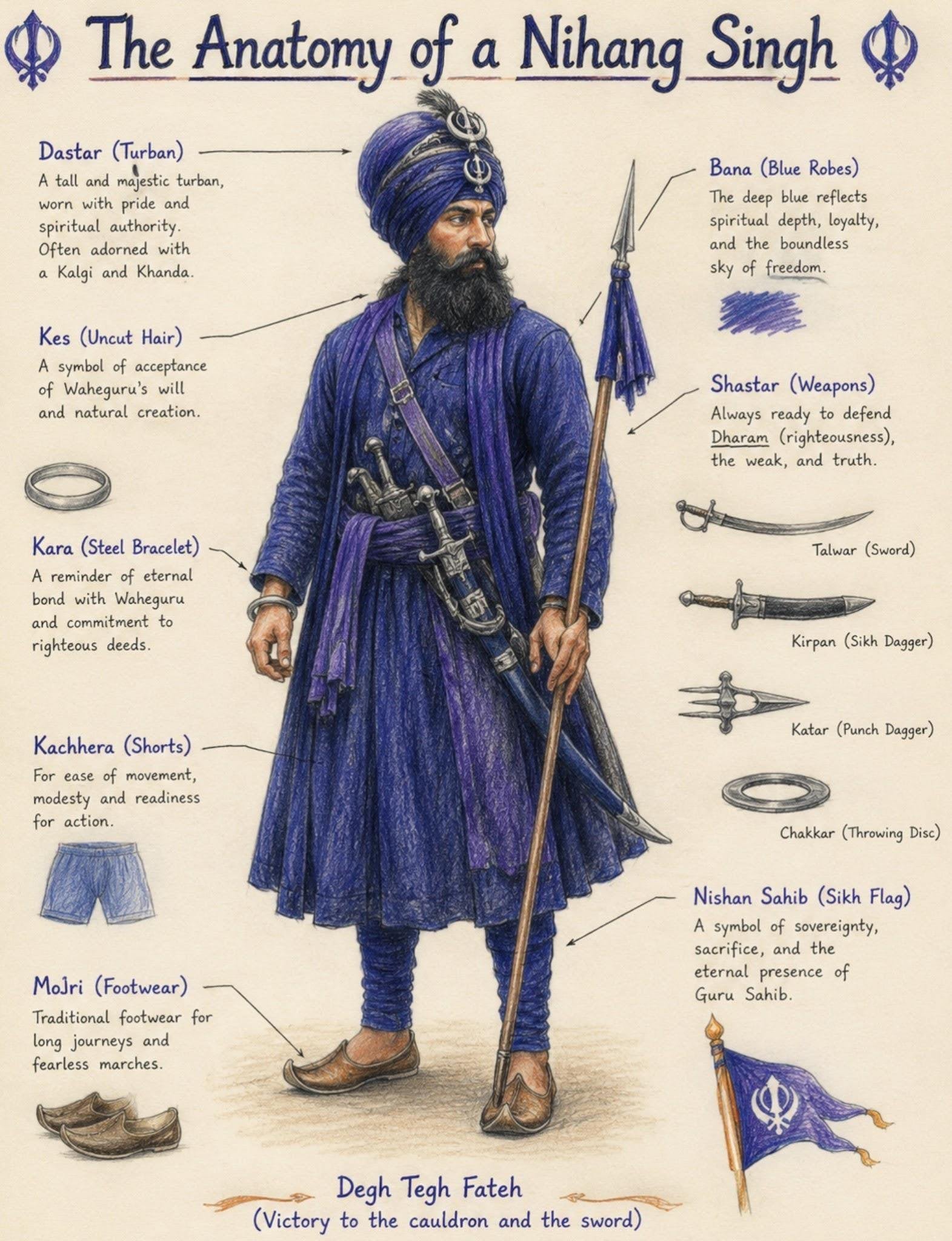
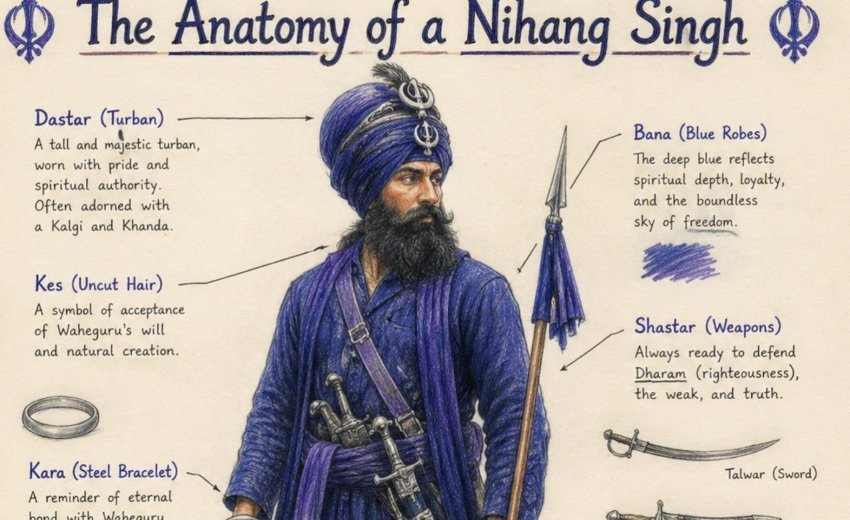
The most striking feature of a Nihang Singh is the Dumalla, the magnificent multi-layered blue turban. Unlike the ordinary Sikh turban, the Dumalla symbolizes sovereignty, spiritual authority, and military readiness. It frequently incorporates Farla, the flowing blue pennant originally bestowed upon distinguished Khalsa warriors, signifying honour, fearlessness, and continuity with the martial heritage of the Khalsa. Embedded within the folds of the Dumalla are miniature weapons such as the Chakkar (quoits), Khanda, and small daggers, transforming the turban into both a defensive apparatus and a visible proclamation of readiness to protect justice.
The face of a Nihang Singh reflects another defining characteristic: the unshorn hair (Kes) and naturally flowing beard. These constitute the foremost of the Five Ks prescribed by Guru Gobind Singh. The Kes symbolize complete submission to the Divine Will, rejection of bodily vanity, and acceptance of the natural human form as bestowed by the Creator. The beard, left untrimmed and often tied with dignity, further reflects discipline and spiritual maturity.
Around the neck, many Nihangs wear Mala or Gatras, while the sacred Gatra supports the Kirpan, representing the perpetual obligation to defend the weak and uphold justice. The Kirpan is not an offensive weapon but an ethical responsibility, constantly reminding its bearer that power must always remain subordinate to righteousness.
The torso is commonly clothed in a deep blue Chola, a flowing martial robe that facilitates mobility during combat while symbolizing detachment from worldly ostentation. Blue, traditionally associated with the Nihang order, evokes courage, resilience, and sacrifice. Over the Chola, crossed bandoliers historically carried ammunition, while broad Kamarkassas (waistbands) securely held swords, daggers, and other essential equipment. These functional elements transformed the Nihang into a self-sufficient warrior capable of prolonged campaigns.
The arms of a Nihang Singh are seldom unadorned. Heavy Karas (iron bracelets), often larger than those worn by ordinary Sikhs, symbolize restraint, unity with the Divine, and the unbroken commitment to righteous conduct. Additional iron armlets occasionally served practical defensive purposes during close combat. The hands remain trained in the traditional Sikh martial discipline of Shastar Vidya, preserving techniques of swordsmanship, spear fighting, archery, and mounted warfare that have been transmitted across generations.
Suspended from the waist or shoulder are a variety of traditional weapons, each possessing symbolic as well as practical significance. The Khanda signifies Divine sovereignty and justice; the Talwar embodies courage and honour; the Barcha (spear) recalls the cavalry traditions of the Khalsa; the Katar symbolizes decisiveness in battle; while the circular Chakkar, worn upon the Dumalla, represents eternity and the infinite nature of the Divine. Collectively these weapons express the Sikh doctrine of Sant-Sipahi—the Saint-Soldier—where spiritual devotion and martial preparedness exist in perfect harmony.
The lower body is clothed in loose Churidar or martial breeches that facilitate rapid movement, mounted combat, and long marches. Strong footwear completes the attire, reflecting practicality rather than ornamentation.
Beyond external appearance lies the inner anatomy of Nihang Singh. Daily meditation upon Naam, recitation of Nitnem, participation in Gurbani, communal service (Seva), and adherence to the Rehat Maryada form the spiritual foundation upon which the martial identity rests. Without these disciplines, external attire alone cannot constitute the authentic character of a Nihang.
Historically, the Nihangs served as the mobile military arm of the Khalsa during the eighteenth century, preserving Sikh sovereignty through periods of severe persecution. They played decisive roles in resisting Afghan invasions, protecting Sikh shrines, and ultimately contributing to the establishment of Sikh political authority under Maharaja Ranjit Singh. Their battlefield discipline, mobility, and uncompromising adherence to Khalsa principles earned them enduring respect within Sikh history.
Thus, the anatomy of a Nihang Singh extends far beyond the physical body. Every visible article—from the Dumalla to the Kara, from the Kirpan to the Chola—constitutes a sacred text in material form, narrating the ideals of sovereignty, sacrifice, spiritual discipline, and martial courage. The Nihang remains a living reminder that, in Sikh thought, the perfected human being is neither an ascetic withdrawn from society nor merely a soldier devoted to warfare, but a Sant-Sipahi: one whose body, mind, and spirit are wholly dedicated to the service of the Divine and the protection of humanity.