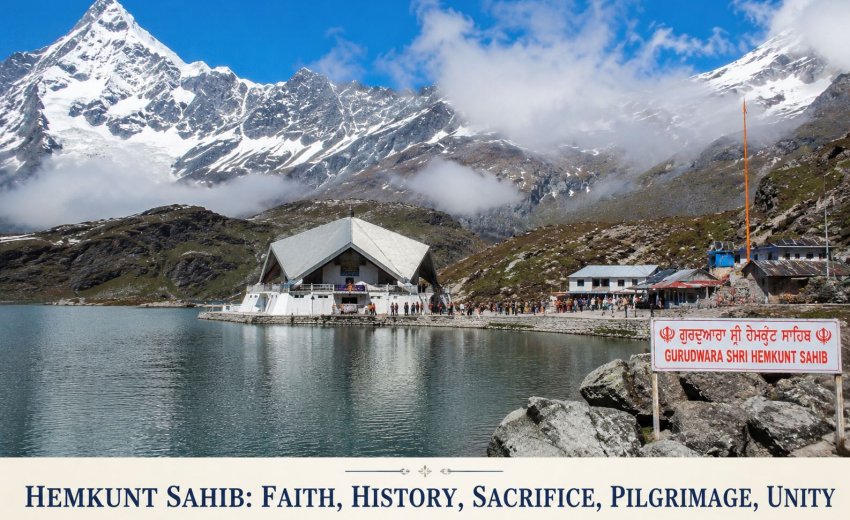

Gurdwara Hemkunt Sahib is situated at an altitude of about 4,632 meters in the Garhwal Himalayas of present-day Uttarakhand, beside the glacial Hemkunt Lake surrounded by seven snow-clad peaks.Its sacred significance derives from the Bachitra Natak in the Dasam Granth, where Guru Gobind Singh recounts a prior life of deep meditation at Hemkunt.
For centuries the site remained unidentified in physical geography and survived only in scriptural memory.
In the early twentieth century, Bhai Vir Singh initiated scholarly efforts to locate Hemkunt on the basis of Sikh textual sources.
These efforts were realized by Sant Sohan Singh of Tehri Garhwal, who identified the present site in 1934 after a rigorous Himalayan exploration.
The first modest Gurdwara structure was erected in 1936 amid extreme climatic conditions.
Post-independence, the shrine’s development was undertaken by Sikh institutions, leading to the construction of the present permanent Gurdwara complex.Over time, Hemkunt Sahib evolved into a major Sikh pilgrimage center of profound spiritual and symbolic importance. The annual yatra, open only for a few months due to heavy snow and glacial conditions, is among the most physically demanding pilgrimages in Sikh tradition. The site embodies the ideal of spiritual austerity preceding divine and historical. It also reflects the synthesis of ascetic discipline and sovereign power central to Guru Gobind Singh’s personality.
The surrounding region holds parallel sanctity in Hindu tradition, indicating a shared Himalayan sacred landscape.
Hemkunt Sahib today attracts pilgrims from across the world, transcending regional and national boundaries. It stands as a living testament to the interaction between Sikh scripture, sacred biography, and physical geography.
Thus, Hemkunt Sahib occupies a unique place in Sikh history as both a metaphysical locus and a monumental center of lived devotion.