
Abstract
This article examines the historical evolution, religious foundations, and enduring nationhood of the Sikhs of Punjab. Emerging in the late fifteenth century through the teachings of Guru Nanak, the Sikh community developed into a distinct spiritual and socio-political order under the guidance of the Ten Gurus. The formation of the Khalsa by Guru Gobind Singh in 1699 marked the decisive institutionalization of Sikh collective identity, sovereignty, and resistance to oppression. Grounded in the eternal authority of the Guru Granth Sahib and the collective institution of the Guru Panth, the Sikhs established a unique model of nationhood rooted in religious principles, egalitarian ethics, and political autonomy.
The article traces the transformation of the Sikh Panth from a spiritual fellowship into a self-conscious nation that endured persecution, organized military resistance, and ultimately established territorial sovereignty under Maharaja Ranjit Singh. It further explores the impact of colonial annexation, the trauma of the Partition of India, and the continuing significance of Punjab as the historic and spiritual homeland of the Sikh people. The study argues that Sikh nationhood is not contingent upon transient political arrangements but is sustained by a revealed scripture, distinctive institutions, collective memory, and a sacred territorial consciousness.
By situating Sikh history within broader discussions of religion, sovereignty, and identity, this article demonstrates that the Sikhs constitute a distinct historical nation whose existence is inseparable from the teachings of the Gurus and the land of Punjab. It concludes that no external force can extinguish Sikh nationhood, as it is rooted in enduring theological convictions, historical experience, and the sovereign ideals of the Khalsa.
Introduction
The Sikhs of Punjab constitute one of the most distinctive religio-political communities in world history. Emerging in the late fifteenth century through the spiritual revelations of Guru Nanak (1469–1539), the Sikh Panth evolved into a sovereign collective bound by theology, ethics, and a profound sense of nationhood. Rooted in the revealed scripture of Guru Granth Sahib and institutionalized through the Khalsa inaugurated by Guru Gobind Singh in 1699, the Sikhs developed a unique identity that transcended conventional categories of religion, ethnicity, and polity.
Punjab, literally the “Land of Five Rivers,” is not merely the geographic region where Sikhs reside; it is the historical and spiritual homeland of the Sikh nation. It is the land sanctified by the lives and teachings of the Ten Gurus, by the martyrdoms of Sikh saints and warriors, and by the rise of Sikh sovereignty under Maharaja Ranjit Singh. The relationship between the Sikh people and Punjab is therefore inseparable. For Sikhs, Punjab represents the territorial embodiment of their civilizational memory, collective aspirations, and national identity.
The Sikh understanding of nationhood is grounded in spiritual principles rather than racial or linguistic exclusivism. The Khalsa is conceived as a divinely ordained community, sovereign under the eternal Guruship of the Guru Granth Sahib and the collective authority of the Guru Panth. As proclaimed in the Sikh liturgical tradition, Raj Karega Khalsa (“the Khalsa shall rule”) expresses not a temporal ambition alone but a theological affirmation of justice, righteousness, and self-determination.
No political arrangement, territorial division, or external pressure can erase the nationhood of the Sikhs. Their identity is sustained by scripture, historical consciousness, institutions, and an enduring commitment to the principles articulated by the Gurus. Despite conquest, colonial rule, partition, and displacement, the Sikh community has maintained an unbroken sense of distinctiveness and sovereignty.
This article examines the historical evolution of the Sikhs of Punjab, the development of Sikh nationhood, and the enduring significance of Punjab as the homeland of the Sikh people.
The Origins of the Sikh Panth
Sikh history begins with Guru Nanak, who articulated a radical spiritual vision centered on the oneness of God, the equality of humanity, and the rejection of caste, ritualism, and oppression. Through extensive travels across South Asia and beyond, Guru Nanak established a community of disciples (Sikhs, meaning learners) dedicated to divine remembrance, honest labor, and sharing with others.
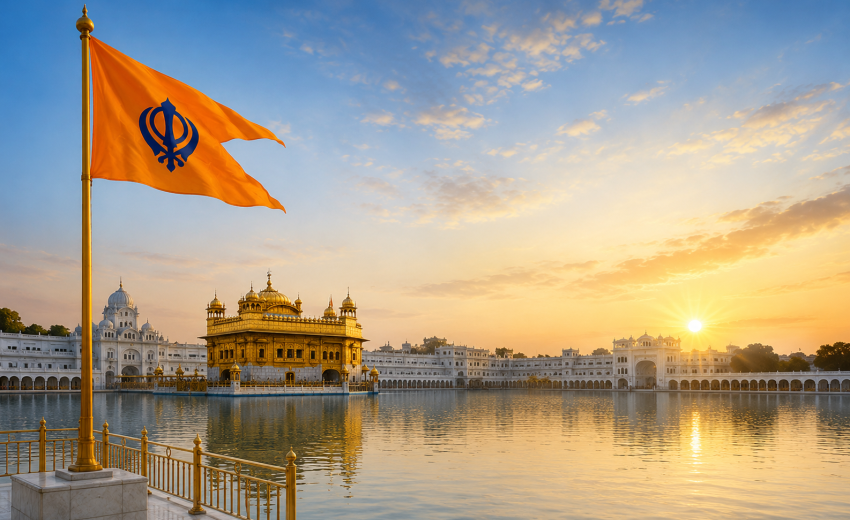
The successive Gurus transformed this spiritual fellowship into a highly organized community. Guru Angad standardized the Gurmukhi script, which became the literary and cultural medium of the Sikhs. Guru Amar Das strengthened institutions of equality such as langar. Guru Ram Das founded Amritsar, and Guru Arjan compiled the Adi Granth and built Harmandir Sahib, the preeminent Sikh shrine.
The martyrdom of Guru Arjan in 1606 marked a turning point. Faced with imperial persecution, Guru Hargobind introduced the doctrine of Miri-Piri, integrating temporal authority with spiritual leadership. This concept established that the Sikh community was destined to function as both a spiritual and political body.
The Formation of the Khalsa and Collective Sovereignty
The defining moment in Sikh nationhood occurred on the festival of Vaisakhi in 1699 at Anandpur Sahib, when Guru Gobind Singh created the Khalsa. Initiated through the Amrit Sanchar, the Khalsa was conceived as a disciplined order of saint-soldiers committed to justice, equality, and resistance against tyranny.
Guru Gobind Singh abolished inherited hierarchies and bestowed a common identity upon all initiated Sikhs: men took the surname Singh (“lion”) and women Kaur (“princess”). The Khalsa was distinguished by the Five Ks and by an explicit code of conduct. More importantly, it was invested with collective sovereignty.
Before his passing in 1708, Guru Gobind Singh vested eternal Guruship in the Guru Granth Sahib and the Guru Panth, thereby ensuring that authority would remain with the revealed Word and the organized community. This institutional arrangement endowed the Sikhs with a permanent and self-governing national structure unparalleled in religious history.
Martyrdom, Resistance, and the Emergence of the Sikh Commonwealth
The eighteenth century was marked by severe persecution under Mughal and Afghan rule. Banda Singh Bahadur led the first major Sikh uprising and established agrarian reforms that dismantled feudal oppression.
Despite repeated campaigns aimed at their annihilation, including the Chhota Ghallughara and the Vadda Ghallughara, the Sikhs survived and reorganized into autonomous confederacies known as misls. These misls collectively governed territory, maintained military forces, and met at the Sarbat Khalsa to make decisions through Gurmata (collective resolutions).
This period demonstrated the extraordinary resilience of Sikh political institutions. Far from being extinguished, the Sikh nation emerged stronger and more cohesive.
The Sikh Empire and Territorial Sovereignty
The consolidation of Sikh power reached its zenith under Maharaja Ranjit Singh, who established the Sikh Empire. With its capital at Lahore, the empire extended from the Khyber Pass to Tibet and from Kashmir to Multan.
The Sikh Empire represented one of the most significant indigenous states in nineteenth-century Asia. It was characterized by administrative efficiency, military modernization, religious tolerance, and strong patronage of education and architecture. Harmandir Sahib was gilded during this era, reinforcing its central place in Sikh life.
The empire confirmed that the Sikhs were not merely a religious sect but a sovereign nation capable of establishing and administering an extensive state.
British Annexation and the Preservation of Sikh Identity
Following the Second Anglo-Sikh War, the British East India Company annexed Punjab in 1849. Although political sovereignty was lost, Sikh institutions and collective identity remained intact.
The Singh Sabha movement of the late nineteenth century revitalized Sikh religious and historical consciousness. The Gurdwara Reform Movement culminated in the establishment of the Shiromani Gurdwara Parbandhak Committee in 1920, restoring Sikh control over major shrines and reaffirming community self-governance.
These developments ensured that colonial domination did not erode Sikh nationhood.
Partition of Punjab and the Trauma of 1947
The Partition of India divided Punjab and displaced millions. Sikhs, whose sacred geography and historic centers were spread across the undivided province, suffered catastrophic losses. Lahore, Nankana Sahib, and numerous historic gurdwaras were left in what became Pakistan.
Despite immense human suffering and cultural dislocation, the Sikhs reconstructed their communal life in Indian Punjab. The subsequent Punjabi Suba movement led to the creation of the modern state of Punjab in 1966, which became the principal territorial center of Sikh life in India.
Punjab as the Homeland of the Sikh Nation
For the Sikhs, Punjab is not solely an administrative unit; it is the cradle of their faith, language, institutions, and historical memory. Every major development in Sikh history—from the birth of Guru Nanak to the rise of the Khalsa and the formation of the Sikh Empire—is rooted in the landscape of Punjab.
The homeland concept in Sikh thought is spiritual, historical, and political. Punjab contains the principal Takhts, sacred shrines, battlefields, and memorials that define Sikh collective consciousness. It is also the heartland of Punjabi language and Gurmukhi literature, both central to Sikh civilization.
While Sikhs are now a global diaspora, their attachment to Punjab remains foundational. The region continues to function as the cultural and institutional center of the Sikh nation.
Sikh Nationhood: A Theological and Historical Reality
Sikh nationhood derives from doctrines embedded in scripture and history. The Guru Granth Sahib provides the spiritual constitution of the community, while the Guru Panth embodies collective authority. The Khalsa, formed through initiation and ethical discipline, constitutes a sovereign order dedicated to divine justice.
This nationhood does not depend solely upon modern state recognition. Rather, it is sustained by: A revealed scripture and canonical tradition; Distinct religious institutions and codes; A shared historical memory of martyrdom and sovereignty; A common language and script; A sacred territorial homeland. Thus, Sikh nationhood is both a theological conviction and a historical fact.
The Enduring Sovereignty of the Khalsa
The Sikh tradition affirms that temporal setbacks cannot extinguish the identity of the Panth. Empires have risen and fallen, borders have shifted, and political powers have attempted to suppress Sikh autonomy. Yet the collective consciousness of the Sikhs has remained intact.
The liturgical proclamation Raj Karega Khalsa encapsulates the enduring belief that the Khalsa, guided by the Gurus and the Guru Granth Sahib, possesses an indestructible sovereignty rooted in righteousness and moral authority.
No external force can erase this nationhood because it is anchored in spiritual principles rather than transient political arrangements.
Conclusion
The Sikhs of Punjab represent a unique historical nation shaped by revelation, sacrifice, and sovereignty. From Guru Nanak’s spiritual message to the creation of the Khalsa, from eighteenth-century resistance to the Sikh Empire, and from colonial subjugation to modern global dispersion, the Sikhs have preserved a continuous and self-conscious national identity.
Punjab remains the homeland of the Sikh nation—the sacred landscape in which Sikh religion, culture, and polity were forged. The nationhood of the Sikhs rests upon the immutable principles of their Gurus, the eternal guidance of the Guru Granth Sahib, and the collective authority of the Guru Panth.
As long as these foundations endure, the Sikh nation will remain a distinct and sovereign community in the consciousness of its people. No power in the world can alter or extinguish the nationhood of the Sikhs, for it is rooted in faith, history, and the timeless ideals bestowed by the Gurus.