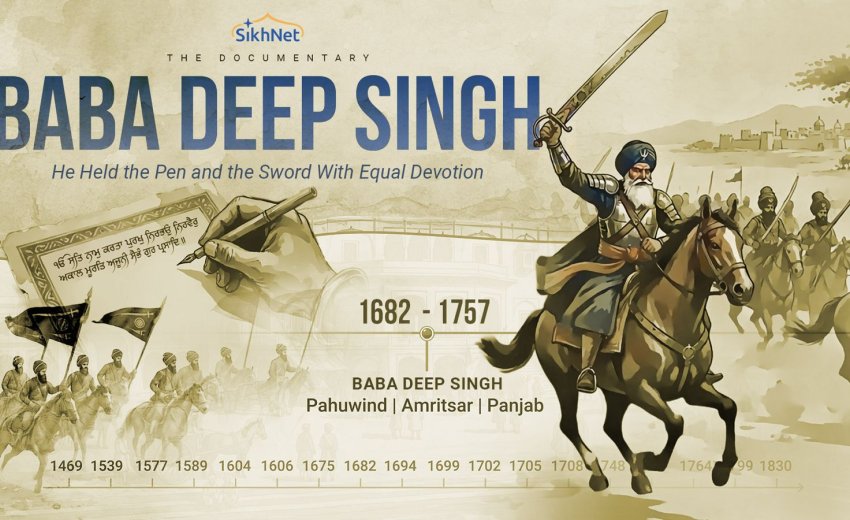
Baba Deep Singh Ji: A source of inspiration in Sikh history
At Damdama Sahib, Guru Gobind Singh Ji entrusted Baba Deep Singh Ji with one of the most sacred responsibilities in Sikh history
* Source material for Baba Deep Singh Video from the History series
In Sikhism, Baba Deep Singh Ji is remembered as a pillar of faith and courage. His importance does not rest on a single event or act of martyrdom, but on a life shaped by learning, service, discipline, and unwavering loyalty to the Guru. He lived at a time when Sikh identity faced constant threats, and faith demanded courage at every step. Throughout his life and conduct, Baba Deep Singh Ji showed how a Sikh could remain grounded in knowledge while standing firm against injustice. He lived exactly as the Gurus instructed, never separating devotion from duty, or learning from action. For this reason, his life continues to guide the Sikh Panth, not only as a story of sacrifice, but as a complete way of living.
Punjab in Turmoil and the Rise of the Khalsa
The Punjab of the late seventeenth and early eighteenth centuries lived under constant strain. Mughal authority had begun to weaken, yet persecution of religious communities continued with force. Sikh centres faced repeated attacks, and Sikhs themselves were often hunted for refusing to abandon their faith. The destruction of gurdwaras, restrictions on religious practice, and acts of violence formed part of daily life. In such an environment, quiet devotion alone could not protect the community.
Guru Gobind Singh Ji recognised the urgency of this moment. He understood that the Sikh Panth needed structure, discipline, and readiness. Through the creation of the Khalsa, he gave the Sikhs a clear identity rooted in faith, courage, and responsibility. The Khalsa was not formed as a fighting force alone, but as a community guided by spiritual awareness and moral duty. A Sikh had to study the Guru’s teachings deeply and remain prepared to defend justice when required.
This environment shaped Baba Deep Singh Ji from a young age. He did not grow into his role by chance. He absorbed the Khalsa spirit through close service to the Guru and direct involvement in Sikh life during one of its most difficult periods. The values of discipline, humility, and readiness formed the foundation of his character.
Early Life: Years at Anandpur Sahib
Baba Deep Singh Ji was born in 1682 in the village of Pahuwind, near present-day Tarn Taran in Punjab. His parents, Bhai Bhagtu Ji and Mata Jeonee Ji, were devoted Sikhs who lived simple and hardworking lives as farmers. For many years, they had no children. Sikh tradition speaks of a saint who once told them that they would be blessed with a son who would serve a greater purpose and guide others through his actions. When the child was born, they named him Deep, meaning a lamp.
From early childhood, Baba Deep Singh Ji displayed a sense of discipline and seriousness. He showed curiosity toward matters of faith and remained attentive to the teachings he heard within the Sangat. At the age of twelve, he travelled with his parents to Anandpur Sahib to seek the darshan of Guru Gobind Singh Ji. The family stayed there for several days, taking part in seva and listening to the Guru’s teachings along with the larger Sikh congregation.
When the time came for the family to return home, Guru Gobind Singh Ji asked the young boy to remain with him. Baba Deep Singh Ji accepted the Guru’s command with humility and calm resolve. This decision marked a turning point in his life. By choosing to stay at Anandpur Sahib, he placed himself fully under the Guru’s guidance, leaving behind the familiarity of home to walk a more demanding path.
He remained at Anandpur Sahib for nearly eight years. These years formed the foundation of his intellectual and spiritual development. Under the guidance of Bhai Mani Singh Ji, he learned to read and write Gurmukhi and studied Gurbani with great care. He paid close attention to pronunciation and meaning, understanding that accuracy in the Guru’s word carried deep responsibility. He trained in santhiya, developing a disciplined approach to learning that would later define his role as a scholar.
Alongside scriptural education, Guru Gobind Singh Ji trained him in horsemanship, hunting, and the use of weapons. This training went beyond physical skill. It taught alertness, restraint, and discipline. Baba Deep Singh Ji learned that the sword served righteousness only when guided by wisdom. These years shaped him into the ideal Khalsa Sikh, one who balanced knowledge with readiness.
On the Vaisakhi of 1700, Baba Deep Singh Ji received Khande-di-Pahul from the Panj Pyare. He was just eighteen years old at that time. With this initiation, he committed himself fully to the Khalsa way of life. He pledged to serve Akaal Purakh, support the weak, and oppose injustice. From that moment onward, his life followed a clear direction. His conduct, humility, and steady devotion earned him the trust of Guru Gobind Singh Ji, who regarded him as one of his devoted Sikhs.
Early Battles with Guru Gobind Singh Ji
While at Anandpur Sahib, Baba Deep Singh Ji began his journey as a warrior, fighting alongside Guru Gobind Singh Ji, the Guru’s elder sons, and the Khalsa whenever the fort was threatened by the Hill Rajas, who had allied with the Mughal Empire. His first battle came when Mughal generals Painda Khan and Dina Beg, each commanding five thousand soldiers, joined forces with Raja Ajmer Chand of Kalhur and other hill rulers to attack Anandpur. Despite being heavily outnumbered, the Khalsa fought fiercely, dealing crushing losses to the enemy. Guru Gobind Singh Ji personally engaged Painda Khan in hand-to-hand combat and killed him, while Dina Beg, badly wounded, retreated. The Hill Rajas, alarmed by these setbacks, fled as the Khalsa pursued them all the way to Rupar.
Soon after, the Hill Rajas attempted a second assault, this time targeting Lohgarh Fort with a plan to use a drunken armored elephant to break the gates. The Guru armed Bhai Bachittar Singh with a long Nagni spear, which he used to pierce the elephant’s forehead. The enraged elephant swung a heavy sword attached to its trunk, trampling enemy soldiers. Bhai Udai rallied the Khalsa, decapitated Raja Kesri Chand, and held his head aloft, terrifying the opposing army into retreat. Other Khalsa warriors pursued the fleeing troops, while the elephant was finally subdued by Bhai Mokham Singh and Bhai Sher Singh. Many brave warriors, including Bhai Sukha Singh, Udai Singh, Bhai Alam Singh, and Bhai Kushal Singh, attained martyrdom in this battle.
Witnessing the immense courage, loyalty, and sacrifice of his fellow Khalsa, Baba Deep Singh Ji recognized the enormity of the struggle against tyranny. These early battles left a deep impression on him, solidifying his commitment to serve Guru Gobind Singh Ji and uphold justice. From this moment, he dedicated himself fully to the path of a saint-soldier, ready to defend his faith and community against all threats.
Returning Home
After years of service at Anandpur Sahib, Guru Gobind Singh Ji instructed Baba Deep Singh Ji to return to his village and care for his ageing parents. Baba Ji accepted this instruction without hesitation, showing that obedience to the Guru also meant fulfilling family responsibilities. He returned to Pahuwind, married, and supported his parents, living the life of a householder while remaining deeply connected to Sikh affairs.
This phase of his life reflects an important Sikh principle. Spiritual commitment does not demand withdrawal from worldly duties. Instead, it calls for balance. Baba Deep Singh Ji demonstrated this balance through his conduct, remaining attentive to the Panth while honouring his responsibilities at home.
In 1704, news reached Pahuwind that Guru Gobind Singh Ji had left Anandpur Sahib after prolonged conflict with the hill rulers. Soon after, Baba Deep Singh Ji received a message to meet the Guru at Damdama Sahib in Talwandi Sabo. When he arrived, he encountered news that shook the Sikh community deeply. Baba Ajit Singh Ji and Baba Jujhar Singh Ji had attained martyrdom at Chamkaur Sahib. The younger Sahibzadas, Baba Zorawar Singh Ji and Baba Fateh Singh Ji, had been bricked alive at Sirhind on the orders of Wazir Khan. Mata Gujri Ji had also passed away.
These losses brought immense grief to the Panth. For Baba Deep Singh Ji, they reinforced the seriousness of the path he had chosen. Rather than breaking his spirit, these events strengthened his commitment to the Guru’s mission and to the protection of Sikh principles. From this point onward, his role within the Panth became increasingly central.
Renunciation of Family Life
After returning to his family home in Pahuwind, Baba Deep Singh Ji received heartbreaking news. Guru Gobind Singh Ji’s elder sons had been martyred along with forty brave Khalsa warriors at the Battle of Chamkaur. The Guru himself had narrowly escaped, only to fight once more at Muktsar, where another forty warriors laid down their lives. Soon after, the Sikh community learned that Mata Gujri and the Guru’s two younger sons had been captured and executed in Sirhind by Mughal authorities. Witnessing the enormous suffering of the Khalsa Panth, Baba Deep Singh Ji realized that the time had come to renounce his family life. With a heavy heart, he decided to dedicate himself fully to the service of Guru Gobind Singh Ji and the Panth, committing his life to protecting the faith and aiding those in need.
Duties as a Scribe
Following these events, Guru Gobind Singh Ji summoned Baba Deep Singh Ji and Bhai Mani Singh Ji to Damdama Sahib at Talwandi Sabo. There, the Guru entrusted them with the sacred duty of scribing the Guru Granth Sahib as he dictated it by heart. The task was not only a matter of devotion but also a necessity to preserve the authentic scripture, since the only other original copy was held by Dhir Mal, who hoped to claim it for himself. While completing this monumental work, the Guru incorporated two lines from a letter written to him by his father, Guru Tegh Bahadur Ji, along with his own lines, into the Dohra of Slok Mahalla Nauva (Slok 54). These lines, found in the original Birs of both Bhai Mani Singh Ji and Baba Deep Singh Ji, emphasize the total reliance on God’s support and the liberation of the soul:
ਬਲੁ ਹੋਆ ਬੰਧਨ ਛੁਟੇ ਸਭੁ ਕਿਛੁ ਹੋਤ ਉਪਾਇ ॥
Bal hoaa bandhan chhutae sabh kichh hot upaa-e ||
My strength has been restored, and my bonds have been broken; now, I can do everything.
ਨਾਨਕ ਸਭੁ ਕਿਛੁ ਤੁਮਰੈ ਹਾਥ ਮੈ ਤੁਮ ਹੀ ਹੋਤ ਸਹਾਇ ॥੫੪॥
Naanak sabh kichh tumarai haath mai tum hee hot sahaa-e ||54||
Nanak: everything is in Your hands, Lord; You are my Helper and Support. ||54||SGGS 1412||
Scholar, Teacher, and Leader of Damdama Sahib
At Damdama Sahib, Guru Gobind Singh Ji entrusted Baba Deep Singh Ji with one of the most sacred responsibilities in Sikh history. Alongside Bhai Mani Singh Ji, he helped prepare the final recension of Sri Guru Granth Sahib Ji. The Guru recited the entire scripture while they carefully wrote it down, ensuring that every word matched the Guru’s recitation. This task demanded immense focus, humility, and devotion.
After completing this work, Baba Deep Singh Ji prepared several handwritten copies of Sri Guru Granth Sahib Ji. Four copies were sent to major Sikh Takhts, strengthening unity across the Panth. Another copy, written in Arabic script, travelled to the Middle East, reflecting the reach of Sikh teachings beyond Punjab.
In 1706, Guru Gobind Singh Ji appointed Baba Deep Singh Ji as the head of Damdama Sahib. Under his leadership, the site developed into a major centre of Sikh learning and preparation. Sikhs from different regions gathered there to study Gurbani, learn correct pronunciation, and deepen their understanding of Sikh philosophy. Alongside this learning, they trained in arms, preparing themselves to defend the community when required.
This unique combination of education and readiness gave rise to the institution known as Damdami Taksal. Baba Deep Singh Ji also wrote gutkas and guided students patiently, ensuring that Sikh teachings remained accessible and accurate. His leadership rested on example rather than authority. He lived simply, served consistently, and placed the needs of the Sangat above his own comfort.
Standing with Banda Singh Bahadur and the Khalsa Army
As Mughal oppression intensified, Baba Deep Singh Ji moved from teaching to active resistance when duty demanded it. In 1709, he joined Banda Singh Bahadur in campaigns against tyrannical rulers. Banda Singh Bahadur emerged as the leader of the movement that challenged Mughal authority, while Baba Deep Singh Ji stood beside him as a seasoned warrior whose actions remained guided by Sikh discipline.
Together, they fought at Sadhaura and Chappar Chiri, striking at centres of oppression. The campaign reached Sirhind, the city where Guru Gobind Singh Ji’s younger sons had been killed. Despite being heavily outnumbered, the Sikh forces defeated the Mughal army. This victory carried deep emotional and moral significance for the Panth.
Although Banda Singh Bahadur held leadership of the movement, Baba Deep Singh Ji never sought prominence. He served with restraint, experience, and loyalty, guided by duty rather than ambition. In later years, he continued to serve in leadership roles. In 1733, Nawab Kapur Singh Ji appointed him as the leader of a jatha within the Dal Khalsa. In 1748, when the Sikh forces reorganised into twelve misls, Baba Deep Singh Ji assumed leadership of the Shaheedan di Misl.
This misl carried the responsibility of protecting Sikh shrines and upholding the tradition of sacrifice. Baba Deep Singh Ji also played a role in maintaining unity within the Panth during periods of internal disagreement, working with Bhai Mani Singh Ji to preserve the sanctity of Sri Harmandir Sahib.
The March to Amritsar and Final Sacrifice
By the middle of the eighteenth century, Ahmad Shah Abdali’s invasions brought renewed suffering to Punjab. Cities were looted, and thousands of people were taken captive. In 1755, Baba Deep Singh Ji led a Sikh group that intercepted Abdali’s returning army, freed many prisoners, and recovered stolen goods, returning them to their rightful owners.
In 1757, news reached Damdama Sahib that Abdali’s forces had desecrated Sri Harmandir Sahib, filling the sarovar with debris and closing the shrine to Sikhs. Baba Deep Singh Ji gathered the Sangat and declared that Diwali would be celebrated in Amritsar that year. He offered an ardaas and vowed that his head might fall, but his Sikhi would remain untouched.
Despite being seventy-five years old, Baba Deep Singh Ji led the march toward Amritsar. Along the way, Sikh numbers grew to nearly five thousand. Near Tarn Taran, he drew a line on the ground with his khanda and asked only those prepared to give their lives to cross it. Every Singh stepped forward. He then recited the shabad calling those who wished to walk the Guru’s path to come with their heads in their palms. Those willing to die for the Guru and give up their attachment for their homes and families crossed the line eagerly. Baba Deep Singh Ji then recited the shabad:
ਜਉ ਤਉ ਪ੍ਰੇਮ ਖੇਲਣ ਕਾ ਚਾਉ ॥ ਸਿਰੁ ਧਰਿ ਤਲੀ ਗਲੀ ਮੇਰੀ ਆਉ ॥
ਇਤੁ ਮਾਰਗਿ ਪੈਰੁ ਧਰੀਜੈ ॥ ਸਿਰੁ ਦੀਜੈ ਕਾਣਿ ਨ ਕੀਜੈ ॥20॥
"Those who wish to play the game of love (follow the Guru's path), come to me with your head in your palm. If you wish your feet to travel this path, don't delay in accepting to give your head." (Ang 1412, SGGS)
The Mughal governor responded by sending an army of nearly twenty thousand soldiers. The two sides clashed near Gohalwar in November 1757. Baba Deep Singh Ji fought at the front. During the battle, a powerful blow severed his head from his body. As he faltered, a Sikh reminded him of his vow to reach Sri Harmandir Sahib. Holding his head in one hand and his khanda in the other, Baba Deep Singh Ji continued forward as enemy soldiers retreated in fear.
He reached the parikrama of Sri Harmandir Sahib, bowed, and attained martyrdom. The Sikhs reclaimed the shrine and celebrated Diwali in Amritsar that year. Today, Gurudwara Baba Deep Singh Shaheed near Chattiwind Gate and the shrine within the Harmandir Sahib complex are reminders of his sacrifice.
The place where Baba Deep Singh Ji’s head fell remains marked. Gurudwara Baba Deep Singh, also known as Shahidan Sahib, stands near Chattiwind Gate in Amritsar. Built initially by Sardar Jassa Singh Ramgarhia and later developed by the Shiromani Gurudwara Parbandhak Committee, it honours his sacrifice.
Baba Deep Singh Ji’s life teaches that faith carries responsibility, learning demands discipline, and devotion finds meaning through service. His journey continues to guide the Sikh Panth with clarity, courage, and purpose.
Reference Links:
Sikhnet : Baba Deep Singh Shaheed
https://www.sikhnet.com/news/baba-deep-singh-shaheed
An overview of Baba Deep Singh’s life as a Sikh scholar, warrior, and leader who helped structure the Shaheed Misl and gave his life defending the faith and sacred institutions of the Panth.
Sikhdharma - The life of Baba Deep Singh Ji
https://www.sikhdharma.org/the-life-of-baba-deep-singh-ji/
It gives a detail account of Baba Deep Singh Ji’s life as a Sikh warrior and scholar, highlighting his service to Guru Gobind Singh Ji, leadership in battles, preservation of Sikh teachings, and ultimate sacrifice at Harmandir Sahib.
Sikh expo - BABA DEEP SINGH JI STORY
Showcases Baba Deep Singh Ji’s life, his faith, leadership, dedication to Sikh teachings, and brave sacrifice at Harmandir Sahib.
SikhiWiki. Baba Deep Singh.
https://www.sikhiwiki.org/index.php/Baba_Deep_Singh
A detailed account of Baba Deep Singh’s life as a revered Sikh martyr, scholar, and warrior. It highlights his leadership of the Shaheed Misl, his role in preserving Sikh scriptures, and his legendary sacrifice in battle near the Golden Temple.
Discover Sikhism. Gurdwara Burj Baba Deep Singh.
https://www.discoversikhism.com/sikh_gurdwaras/gurdwara_burj_baba_deep_singh.html
Describes the 20-metre high tower he constructed at Takht Sri Damdama Sahib to support the transcription and distribution of the Guru Granth Sahib.
Wikipedia - Baba Deep Singh
https://en.wikipedia.org/wiki/Baba_Deep_Singh
A comprehensive biography of the revered Sikh martyr, detailing his early life and spiritual training under Guru Gobind Singh. It also gives insight into his leadership roles in Sikh military orders and his legendary sacrifice during the Battle of Amritsar in 1757.