
Adi Guru Granth Sahib as an Oecumenical Scripture
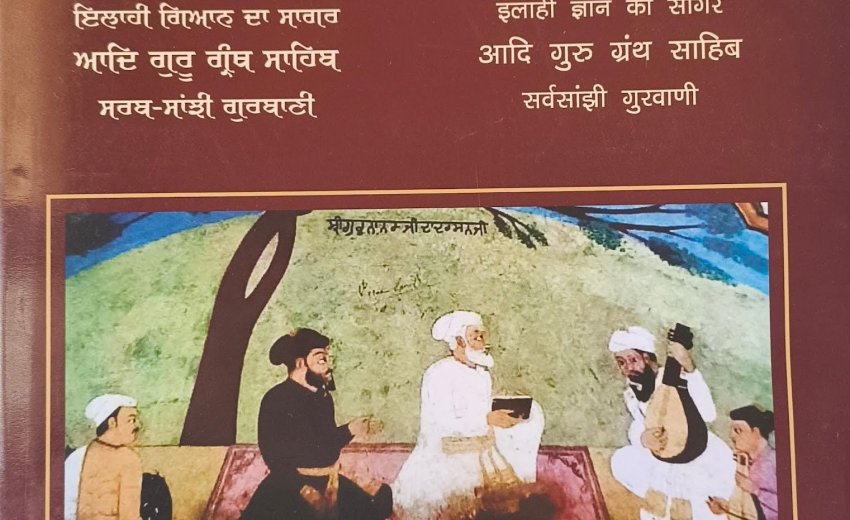
Wisdom of Adi Guru Granth Sahib: An Oecumenical Scripture by Anurag Singh is a coffee table book,profound and intellectually ambitious work that seeks to interpret the universal and integrative vision of the Guru Granth Sahib within the broader framework of world spirituality, comparative religion, and civilizational dialogue. Elegantly produced in English, Gurmukhi, and Hindi, and enriched with illustrations, the volume stands not merely as a devotional presentation but as a reflective theological and philosophical study of the Sikh scriptural tradition.
Published by the Baba Banda Singh Bahadur Charitable Trust at the Shabad Prakash Museum, the book is remarkable for its attempt to present the Sikh canon as a genuinely oecumenical scripture — a sacred text that transcends sectarian boundaries while preserving its own revealed distinctiveness. The work underscores that the Sikh Gurus did not establish a faith based on exclusivism or confrontation, but on spiritual synthesis, ethical universality, and the recognition of the divine presence in all humanity.
The structure of the book itself reflects the pluralistic architecture of the Adi Guru Granth Sahib. Divided into four thematic parts, it introduces the reader first to the Sikh Gurus, then to the pre-Guru Nanak bhaktas and Sufi saints, followed by contemporary mystics and finally the devoted servitors and Bhatt bards associated with the Guru’s court. Such an arrangement is not merely historical; it becomes hermeneutical. The author demonstrates how the Sikh scripture evolved into a spiritual republic of voices — incorporating saints, faqirs, poets, minstrels, and mystics from diverse castes, regions, languages, and religious traditions.
One of the most compelling dimensions of the book is its exposition of the universality of the Sikh scriptural canon. The discussion on the inclusion of compositions by figures such as Kabir, Sheikh Farid, Ravidas, Namdev, and Jaidev reveals the fundamentally inclusive and dialogical nature of Sikh spirituality. The author insightfully argues that the Gurus elevated the inspired utterance (Shabad) above considerations of caste, creed, ethnicity, or institutional affiliation. In doing so, the Adi Guru Granth Sahib emerges as perhaps the only major world scripture that consciously integrates the revealed utterances of multiple religious traditions into a unified theological vision.
The treatment of language and scriptural plurality is equally noteworthy. The author carefully explains how the sacred text incorporates Sant Bhāṣā, Punjabi, Persian, Sanskrit, Braj, Marathi, Sindhi, Avadhi, Arabic and other linguistic streams into the unifying medium of Gurmukhi script. This multilingual sacred synthesis becomes symbolic of the Sikh doctrine of unity in diversity. Particularly significant is the observation that the mystical idioms of diverse saints become so organically integrated within the scripture that distinctions of authorship often dissolve into a shared spiritual consciousness.
A major intellectual contribution of the volume lies in its analysis of Sikh reinterpretations of inherited philosophical vocabulary. Concepts emerging from Vedic, Yogic, Buddhist, Nath, and Islamic traditions — such as sahaj, samadhi, nirvana, mukti, hukam, zikr, and haqiqat — are shown to have been transformed within the revelatory experience of the Sikh Gurus. The author convincingly demonstrates that Sikh theology neither rejected older traditions nor merely borrowed from them; rather, it redefined and reoriented them within the experiential framework of Gurmat. This hermeneutic continuity combined with doctrinal originality is one of the defining strengths of Sikh philosophy, and the book articulates this with clarity and scholarly sensitivity.
The extended discussion on the Mūlmantra and the metaphysical significance of Ik Oankar constitutes perhaps the philosophical heart of the work. The interpretation of Oankar not merely as a linguistic expression but as a metaphysical symbol of the Absolute and Immanent Divine reflects the author’s engagement with Upanishadic, Vedantic, and Sikh exegetical traditions. Particularly illuminating is the explanation of Guru Nanak’s use of the numeral “1” before Oankar as a radical affirmation of divine unity against theological fragmentation and ritual polytheism. The author’s comparative treatment of Vedic and Sikh understandings of Om and Oankar reveals substantial depth of study and theological reflection.
At the same time, the work is not confined to metaphysical speculation. It continually returns to the ethical and civilizational role of the Sikh scripture as a guide for humanity in the age of conflict, division, and spiritual dislocation. The author repeatedly emphasizes that the Sikh Gurus envisioned a society grounded in moral responsibility, spiritual equality, and universal fraternity. In this sense, the book speaks not only to scholars of Sikh studies but also to contemporary discussions on interfaith dialogue, religious pluralism, and global ethics.
Stylistically, the prose bears the imprint of traditional Sikh theological scholarship, often echoing the cadence and vocabulary of earlier exegetes. The narrative occasionally moves into devotional exaltation, yet it retains a strong intellectual framework grounded in comparative religion and scriptural philosophy. Readers trained in academic Sikh studies may at times desire more critical engagement with modern historiography or textual scholarship; nevertheless, the work’s primary strength lies in its civilizational vision rather than purely academic formalism.
In its totality, Wisdom of Adi Guru Granth Sahib: An Oecumenical Scripture is a significant contribution to contemporary Sikh thought. It presents the Guru Granth Sahib not merely as the sacred scripture of a particular community, but as a universal treasury of mystical wisdom and spiritual humanism. The volume reaffirms the enduring relevance of the Sikh Gurus’ message in an age fractured by ideological, cultural, and religious polarities. Through its emphasis on unity, divine immanence, and reverence for all enlightened traditions, the book succeeds in portraying the Adi Guru Granth Sahib as a luminous meeting ground of civilizations and a timeless scripture for humanity.