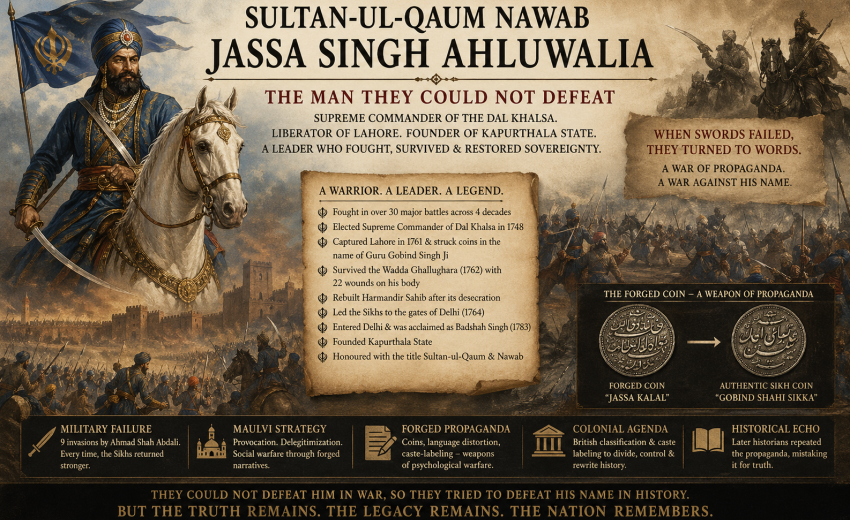

A Multi-Front Examination of British Colonial, Afghan, and Maulvi Strategies to Decimate an Unconquerable Leader An Integrated Historical Analysis of Military Defeat, Psychological Warfare, Coin Forgery, Linguistic Distortion, Colonial Caste-Classification, and the Deliberate Dismantling of a Sikh Sovereign's Legacy
SECTION IV: THE SECOND FRONT — BRITISH COLONIAL WARFARE AGAINST SIKH IDENTITY
A. The British Assessment of the Sikh Threat
The British East India Company — and later the British Crown — arrived in Punjab not as scholars or philanthropists but as conquerors. Their interest in the Sikhs was not academic; it was strategic. And from the earliest period of British engagement with Sikh polity, they identified one institution above all others as the greatest obstacle to their conquest: the Akali Nihang order.
The Nihangs — the "Crocodiles of the Faith," the warrior-ascetics of the Khalsa — were the shock troops, the vanguard, the unbreakable core of Sikh military power. They answered to no temporal authority except the Akal Takht. They were trained from childhood in the arts of war. They fought with a ferocity that astonished and terrified European observers. And their institutional structure — the Buddha Dal and the Taruna Dal — provided the organizational framework for the entire Sikh military confederacy.
Sir John Malcolm, one of the most perceptive early British observers of the Sikhs, wrote in 1812 a passage that reveals the depth of British understanding — and British concern:
"The Acalis have a great interest in maintaining both the religion and government of the Sikhs, as established by Guru Govind; as, on its continuance in that shape, their religious and political influence must depend."
— Sir John Malcolm,
Sketch of the Sikhs (1812)
Malcolm understood — with the clarity of a strategic analyst — that the Akali Nihang order was the institutional backbone of Sikh sovereignty. If the Nihangs could be neutralized, Sikh power would collapse. The religion, the governance structure, the military capacity — all of it depended on the Nihang order's continued vitality.
And so the British set about destroying them.
After the Anglo-Sikh Wars (1845–46 and 1848–49), the British specifically targeted the Akali Nihangs for elimination. The campaign was methodical and brutal:
● Nihang warriors were slaughtered at Lahore.
● They were attacked at Amritsar.
● The British attacked the Akal Takht itself — the supreme seat of Sikh temporal authority.
● Surviving Nihangs were driven into the jungles of central India.
●"Shoot-on-sight" orders were issued against Nihang warriors.
● Nihang leaders were murdered through collaborators and agents.
This was not peacekeeping. This was the systematic destruction of the single institution that the British had identified as the greatest threat to colonial rule in Punjab.
B. The Colonial Caste-Classification Machine
The physical destruction of the Nihang order was accompanied by a second, more insidious campaign: the systematic project of caste-classification that would reshape Indian society — and Indian self-understanding — for generations.
The British began decennial census operations in India from 1871 onward. The census required every person to identify with a specific caste — a process that had profound and often devastating consequences. What had been fluid, locally defined, and context dependent identities were forced into rigid official categories. As modern scholarship has conclusively demonstrated, this process was "more telling of the administrative needs of the British than of the social reality for the people of British India." The census did not record Indian society as it was; it remade Indian society according to the requirements of colonial governance.
The apparatus of classification extended far beyond the census. Herbert Risley and the Ethnographic Survey of India created a vast system of racial and caste taxonomy, measuring skulls, recording occupational designations, and assigning every community in India to a specific rung on a hierarchical ladder. This was presented as science — as disinterested anthropological inquiry. It was, in reality, an instrument of imperial control.
In Punjab specifically, the colonial classification project took a particularly consequential form with the Punjab Alienation of Land Act of 1901. This law created an "agricultural tribe" category — and membership in this category was almost compulsory for anyone who wished to buy or sell agricultural land. Research has demonstrated that caste groups across Punjab actively manipulated their declared identity in response to this legislation, proving beyond any doubt that colonial categories were artificial constructs imposed for administrative purposes, not accurate records of historical social reality.
The strategic purposes of British caste-classification were multiple and interconnected:
| Strategic Purpose | Method | Effect |
| Divide and Rule | Rigidify caste identities into f ixed, mutually exclusive categories | Prevented inter-caste solidarity that could threaten colonial rule; turned communities against each other along caste lines |
| Diminish Warrior Classes | Assign "low" caste labels to f ierce warrior communities | Psychologically undermined the martial identity, self-respect, and collective pride of communities that had most fiercely resisted British conquest |
| Historical Revision | Rewrite the histories of Indian leaders through the lens of caste classification | Diminished the legacy of the very warriors and sovereigns who had challenged imperial power, making their achievements appear anomalous rather than natural |
| Administrative Control | Create legible, manageable categories for taxation, recruitment, and land management | Made Indian society "readable" by foreign administrators who had no understanding of its actual social complexity |
This was not scholarship. This was statecraft. And every classification, every label, every category in the British gazetteers and census records must be understood as what it was: an instrument of imperial governance, not a disinterested record of social reality.
C. Lepel Griffin — The Colonial Agent as "Historian"
No discussion of the colonial assault on Sikh identity is complete without an examination of Lepel Henry Griffin (1838–1908) — the British administrator whose work has been cited by generations of historians as though it were authoritative scholarship.
Griffin was not a historian. He was a colonial administrator — an agent of the British imperial state. He arrived in India in 1860, was posted to Lahore, and eventually became Chief Secretary of the Punjab. His career was spent in the service of empire, and his writings were produced in the service of imperial governance.
His 1865 work The Panjab Chiefs — later expanded and revised as Chiefs and Families of Note in the Punjab — is the source most frequently cited for the classification of the Ahluwalia family. In this work, Griffin dismissed the Bhatti Rajput origin tradition of the Ahluwalia family as "fictitious." He classified the family according to the occupational categories that served the administrative needs of the colonial state.
Let us be precise about what Griffin was and what he was not:
● He was not trained in Indian genealogy, in Persian manuscript analysis, in Punjabi oral tradition, or in Sikh history.
● He was not a disinterested scholar. He was an official of the colonial government, writing for the colonial government, to serve the purposes of the colonial government.
● He had neither the cultural understanding, the linguistic depth, nor the motivation to accurately trace Indian genealogies that had been maintained through oral traditions spanning centuries.
● His classifications were administrative tools for colonial governance — designed to make Punjabi society legible and manageable for foreign rulers.
● He dismissed the Bhatti Rajput genealogy of the Ahluwalia’s without providing any counter-evidence — merely asserting it to be fictitious, as though the assertion of a colonial administrator constituted proof.
Yet later historians — including some Sikh historians — uncritically repeated Griffin's classifications as though they were established fact. The colonial administrator became the authority. The imperial classification became the historical record. And the damage — the slow, patient corruption of an identity that had been forged in battle and sustained through generations of sacrifice — was done.
"The British did not come to Punjab to study history — they came to conquer it. Every classification, every label, every categorisation in their gazetteers and census records served one purpose: to make Indian society legible and manageable for foreign rule. To cite Lepel Griffin as an authority on Sikh pg. 19 genealogy is to mistake a colonial weapon for a scholarly instrument. Griffin did not discover the 'Kalal' identity of the Ahluwalia family — he imposed it, in the same way that the British imposed caste categories on every community in India, for the same strategic purposes, with the same disregard for historical truth."
D. The Nihang Connection — Why Jassa Singh's Legacy Was Specifically Targeted We must now draw the connection that ties the British campaign against the Nihang order to the British campaign against Jassa Singh Ahluwalia's legacy — because these were not separate campaigns. They were two faces of the same strategic coin.
Jassa Singh Ahluwalia was the fourth Jathedar of the Buddha Dal — the supreme leader of the Nihang order. He held this position from 1753 until his death in 1783. The Buddha Dal was not merely a military unit; it was the institutional embodiment of Sikh sovereignty, the guardian of the Akal Takht, the keeper of the martial traditions of the Khalsa. To be its Jathedar was to occupy the highest position in the Sikh military hierarchy — higher than any Misaldar, higher than any territorial chief.
The British identified the Nihang order as the single greatest threat to colonial rule in Punjab. They set about its physical destruction with systematic efficiency. But physical destruction alone was insufficient — because the Nihang order derived its legitimacy from its history, from its traditions, from the memory of its great leaders. And the greatest of those leaders — the one whose memory most powerfully sustained the Nihang identity — was Jassa Singh Ahluwalia.
By diminishing the legacy of the Nihang order's greatest historical leader, the British struck at the very foundation of Nihang identity and legitimacy. If Jassa Singh — the Sultan-ulQaum himself — could be reduced to a "poor Kalal," then the entire Nihang tradition could be diminished. The warriors who traced their lineage and their institutional memory to Jassa Singh's leadership would find their heritage degraded, their pride undermined, their sense of historical destiny diminished.
This was not an accident. This was not a scholarly disagreement about genealogy. This was strategic psychological warfare against an enemy the British feared more than any other in Punjab — an enemy they had been forced to destroy by force of arms, and whose memory they now sought to destroy by force of classification.
SECTION V: THE THIRD FRONT — THE TRAP THAT CAUGHT HISTORIANS
A. The Echo Chamber Effect
We have now examined two fronts of the war against Jassa Singh Ahluwalia's legacy: the Maulvi propaganda campaign of the 1760s and the British colonial classification project of the nineteenth century. We must now examine the third front — the one that proved, in many ways, the most damaging of all: the trap that caught later historians.
This trap operates through a mechanism that students of propaganda will immediately recognise: the echo chamber effect. It works as follows:
The forged coin of 1761 created a physical artifact — a "documentary source" — bearing the label "Jassa Kalal." The Maulvi propaganda campaign disseminated this label through correspondence, through oral transmission, through the networks of religious authority that connected Lahore to the Afghan court. The British colonial census and gazetteers then picked up this label and fixed it in official records — giving it the imprimatur of state authority. And once the label appeared in British records, it acquired an aura of documentary reliability that it had never possessed when it was merely an enemy's slander.
Later historians — including some Sikh historians — encountered these sources and repeated them. Each repetition gave the false narrative more apparent authority. The more it was repeated, the more it appeared to be "established fact." A historian writing in 1900 could cite the British gazetteers. A historian writing in 1950 could cite the historian who had cited the gazetteers. A historian writing in 2000 could cite the historian who had cited the historian who had cited the gazetteers. With each layer of citation, the original source — the forged coin, the Maulvi propaganda, the colonial classification — receded further from view, while the "established fact" of the "Kalal" identity appeared more and more secure.
This is how propaganda becomes history: through uncritical repetition across generations. It is one of the most insidious mechanisms of historical distortion, because it does not require active malice from the later historians. It requires only a failure of source criticism — a failure to ask the most basic questions about where a piece of information originated and whose interests it served.
B. The Failure of Source Criticism
Historians who repeated the "Kalal" label failed to ask questions that any competent researcher would ask of any controversial historical claim. The failure is not one of intelligence; it is one of method. Let us state these questions plainly, and note the answers:
| Question a Competent Historian Should Have Asked | Answer |
| Did Jassa Singh or his family ever use the label "Kalal" for themselves? | No. The family identified as Ahluwalia — "of Ahluwal" — derived from their ancestral village |
| Question a Competent Historian Should Have Asked | Answer |
| Does the earliest Sikh biographical source — Jassa Singh Binod by Sri Ram Sukh Rao — use the label "Kalal"? | No. It identifies his lineage as Rajput Bhatti. |
| Question a Competent Historian Should Have Asked | Answer |
| Was the coin bearing "Jassa Kalal" authenticated as a Sikh-issued coin? | No. The Sikh Encyclopedia itself states it was likely "arranged to be struck by some religious leaders of Lahore." |
| Is the coin consistent with the established Sikh numismatic tradition? | No. All authentic Sikh coins were dedicated to the Gurus, not to individual leaders. |
| Did the maternal uncle use the label "Kalal"? | No. He was known as Bagh Singh Hallowalia. |
| Is the label "poor Kalal" consistent with the family's documented economic status? | No. The family owned four villages — Ahlo, Hallo, Toor, and Chak. |
| Does the word "Kalal" match the actual community name? | No. The ancestral connection was to the Kalial community — a Jat farming family — not "Kalal." |
| Who first used the label in historical documents, and what were their interests? | The earliest documented use appears in the forged coin — arranged by adversaries of the Sikhs. |
Not a single one of these questions yields an answer that supports the "Kalal" identification. Every question, without exception, points in the same direction: the label was imposed by adversaries and repeated by historians who did not interrogate their sources. The failure of source criticism is complete and comprehensive.
C. The Convergence of Enemy Interests
There is one final structural argument that must be made — and it is perhaps the most powerful argument of all.
Consider the three forces that independently promoted the "Kalal" label:
● The Maulvis of Lahore wanted to provoke Abdali into returning to Punjab and to diminish Sikh legitimacy. They had every reason to create a derogatory label for the Sikh commander.
● Ahmad Shah Abdali wanted to destroy Sikh power in Punjab. He had every reason to demean the leader who had captured his provincial capital and struck coins declaring Sikh sovereignty over his territory.
● The British colonial administration wanted to conquer Punjab and neutralise Sikh resistance — specifically, the Nihang order of which Jassa Singh had been the supreme chief. They had every reason to diminish the legacy of the single most important Nihang leader in history.
Three enemies. Three independent strategic motivations. Three separate fronts of psychological warfare. And all three converged on the same weapon: a caste label designed to reduce a sovereign to a stereotype.
When three enemies — enemies who were themselves in conflict with each other, enemies who operated in different centuries and from different civilisational positions — independently arrive at the same narrative about a historical figure, the honest historian must ask: whose interest does this narrative serve?
The answer is clear. It serves the interest of every force that opposed Sikh sovereignty in the Punjab. And it serves no other interest. Not truth. Not history. Not scholarship. Only the strategic objectives of enemies who could not defeat Jassa Singh Ahluwalia on the battlefield and who therefore sought to defeat him in the historical record. "Three enemies — the Maulvis, Abdali, and the British — each with their own strategic reasons to diminish the unconquerable Sikh commander.
Three separate fronts of psychological warfare, all converging on the same weapon: a caste label designed to reduce a sovereign to a stereotype. When three enemies agree on a narrative, the honest historian must ask: whose interest does this narrative serve? The answer reveals the truth that the narrative was designed to conceal."