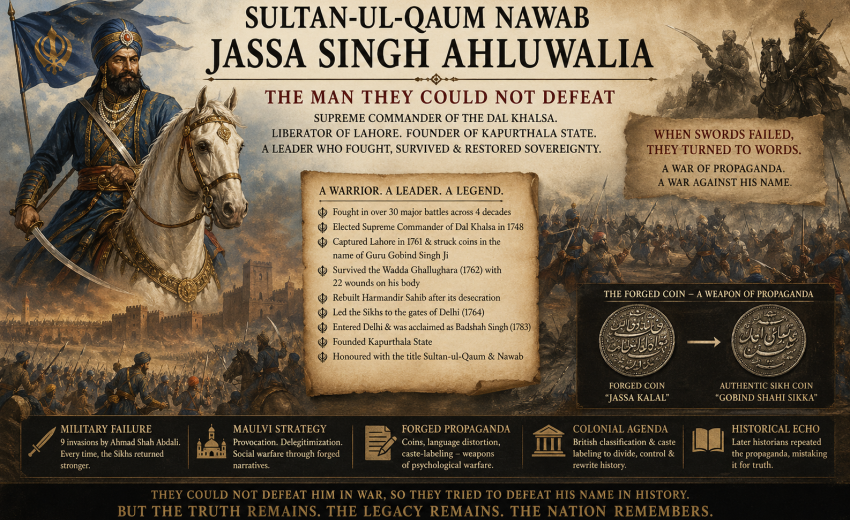

A Multi-Front Examination of British Colonial, Afghan, and Maulvi Strategies to Decimate an Unconquerable Leader An Integrated Historical Analysis of Military Defeat, Psychological Warfare, Coin Forgery, Linguistic Distortion, Colonial Caste-Classification, and the Deliberate Dismantling of a Sikh Sovereign's Legacy
How the Enemies of Sultan-ul-Qaum Nawab Jassa Singh Ahluwalia Fought With Words When Their Swords Failed.
SECTION I: INTRODUCTION — THE MAN THEY COULD NOT DEFEAT
When an enemy cannot defeat a leader on the battlefield, they attack his reputation, his identity, his lineage. This is the oldest strategy of warfare — older than empires, older than written history itself. The general who cannot be slain must be slandered. The sovereign who cannot be conquered must be classified. The warrior who will not fall must be diminished by other means — through words, through labels, through the slow and patient corruption of the historical record. This is not a theory. This is a documented pattern that recurs across civilizations, across centuries, across every continent where an unconquerable leader has stood against overwhelming force and refused to be destroyed.
And it is precisely what happened to Sultan-ul-Qaum Nawab Jassa Singh Ahluwalia (1718– 1783) — the supreme commander of the Dal Khalsa, the liberator of Lahore, the founder of Kapurthala State, the survivor of the Wadda Ghallughara, the rebuilder of Harmandir Sahib, and perhaps the single most consequential Sikh military and political leader of the eighteenth century.
Let us state plainly who this man was, so that the magnitude of what his enemies attempted — and the depth of their failure — can be fully understood.
Jassa Singh Ahluwalia was born on 3 May 1718 in the village of Ahlu, near Lahore, in the heart of the Punjab. His father, Sardar Badar Singh, passed away when Jassa Singh was only four years old. His mother, Mata Jeevan Kaur — an accomplished raag-based kirtaniya of extraordinary spiritual depth — took the young child to Delhi, where they came under the personal care and protection of Mata Sundri Ji, the revered wife of Guru Gobind Singh Ji. For seven formative years, young Jassa Singh received an education of remarkable breadth: Gurbani, kirtan, Rabab mastery, languages, administration, diplomacy, martial arts. Mata Sundri Ji is said to have prophesied that the boy would one day become a ruler of men.
That prophecy was fulfilled beyond any measure that could have been imagined. Consider the record:
| Year | Achievement |
| 1748 | Democratically elected Supreme Commander (Jathedar) of the Dal Khalsa at the Sarbat Khalsa on Baisakhi — the highest military honour bestowed upon any Sikh in the eighteenth century |
| 1753 | Succeeded Nawab Kapur Singh as Jathedar of Akal Takht and fourth Jathedar of Buddha Dal — the supreme leadership of the Nihang warrior order |
| 1757-1759 | Led sustained resistance against Ahmad Shah Abdali's invasions; systematically harassed Afghan supply lines using devastating guerrilla tactics |
| 1761 | Captured Lahore and struck coins in the name of the Khalsa — the supreme act of sovereignty, declaring Sikh dominion over the capital of Punjab |
| Year | Achievement |
| 1762 | Survived the Wadda Ghallughara (the Great Holocaust) with twenty two wounds on his body — when an estimated 25,000 to 30,000 Sikhs were massacred by Abdali's forces |
| 1762 | Within months of the Ghallughara, led the Sikhs back to reclaim and rebuild the Harmandir Sahib, which Abdali had desecrated and destroyed |
| 1764 | Captured Sirhind, the seat of Afghan-Mughal power in eastern Punjab; killed the Afghan governor Zain Khan Sirhindi |
| 1764 | Led Sikh forces to the gates of Delhi itself — a feat that sent shockwaves through the collapsing Mughal Empire |
| 1772 | Founded Kapurthala State, establishing a sovereign Sikh domain that would endure for nearly two centuries |
| Year | Achievement |
| 1783 | Died at Bandala near Amritsar on 23 October, aged 65; cremated at Dera Baba Attal in Amritsar with the honour befitting the greatest Sikh leader of his age |
This is not the record of an ordinary man. This is the record of a leader who fought in over thirty major battles across four decades, who was democratically elected by his peers to supreme command, who captured the capital of Punjab, who survived a genocide that killed tens of thousands, who bore twenty-two wounds on his body and refused to fall, who rebuilt the holiest shrine of his faith after it was desecrated, who struck coins declaring sovereignty, and who founded a state. He was Chief of the Nihang order — the Buddha Dal — the most feared warrior class in the history of Punjab. His contemporaries honoured him with the title SultanulQaum — "King of the Nation" — and with the rank of Nawab, the supreme political title of the age.
This is the man whom his enemies attempted to diminish. And the central thesis of this article is as follows:
Central Thesis: Three separate but interconnected forces — (1) Ahmad Shah Abdali’s Afghan empire and its Maulvi allies in Lahore, (2) the British colonial administration and its apparatus of caste-classification, and (3) later uncritical historians trapped by the echo chamber of enemy propaganda — each had independent strategic reasons to diminish Sultan-ul-Qaum Nawab Jassa Singh Ahluwalia. When military force failed to destroy him on the battlefield, they turned to psychological warfare, coin forgery, linguistic distortion, and caste-labeling. This article examines each strategy from every angle — military, political, linguistic, numismatic, sociological, pg. 3 and historiographical — to settle this matter permanently, comprehensively, and from every conceivable direction
What follows is the integrated evidence — assembled across multiple disciplines, tested against multiple sources, and presented with the rigour that this subject demands and has too long been denied.
SECTION II: THE MILITARY RECORD — WHY ENEMIES NEEDED AN ALTERNATIVE STRATEGY
Before we examine the weapons of words, coins, and classifications, we must first understand why these weapons were deployed. The answer lies in the military record — a record so extraordinary, so relentless, so marked by resilience in the face of annihilation, that it left every adversary of the Khalsa with a single inescapable conclusion: this man cannot be defeated on the battlefield.
The Four Decades of War
Jassa Singh Ahluwalia's military career spans the entirety of the most violent period in Sikh history — from the aftermath of Banda Singh Bahadur's martyrdom in 1716 to the consolidation of Sikh sovereignty in the 1780s. He was not a commander who fought a single decisive battle and retired to his estates. He fought continuously, across four decades, against the most powerful military forces in the region: the dying Mughal Empire, the Afghan Durrani Empire at the height of its power, and the allied Muslim governors and chieftains of northern India.
The young Jassa Singh survived the Chhota Ghallughara of 1746 — the "Lesser Holocaust" — in which approximately 15,000 Sikhs were killed in the Kahnuwan area of Gurdaspur by Mughal forces. He emerged from that catastrophe not broken but hardened, and was elected Supreme Commander of the entire Dal Khalsa just two years later, in 1748, at the Sarbat Khalsa gathering on Baisakhi. He was thirty years old.
From that moment forward, Jassa Singh Ahluwalia led the Sikh Confederacy through an unbroken series of engagements. The scale and frequency of these battles are almost without parallel in military history. Consider: between 1748 and 1767 alone — a span of just nineteen years — the Dal Khalsa under his overall leadership fought in campaigns at Manupur, Khanpur, Hoshiarpur, Amritsar, Ram Rauni, Multan, Nadaun, Anandpur, Mahilpur, Jalandhar, Sirhind, Lahore (multiple times), Sialkot, Gujranwala, Kup, Harnaulgarh, Pipli Sahib, Urmar Tanda, Chamkaur, Sirhind again, Delhi, Kasur, Malerkotla, and numerous smaller engagements.
This was not a conventional army fighting set-piece battles. The Sikhs under Jassa Singh perfected a form of guerrilla warfare — dhai phatt, the strategy of striking and withdrawing, of harassing supply lines, of appearing where the enemy least expected them and vanishing before he could respond — that rendered the conventional armies of the Mughal and Afghan empires almost completely ineffective. The Sikh cavalry could cover vast distances at extraordinary speed, attack with devastating force, and melt into the forests and marshlands of the Punjab before the enemy could organize a response.
The Capture of Lahore — 1761
The capture of Lahore in October-November 1761 was the single most symbolically powerful act of Sikh sovereignty in the eighteenth century. Lahore was the capital of the Punjab — the seat of Mughal and then Afghan power in the region. When the Sikhs under Jassa Singh Ahluwalia besieged and captured the city, they did not merely win a battle. They declared, in the most unambiguous terms possible, that the Punjab now belonged to the Khalsa.
The act that sealed this declaration was the striking of coins in the name of Guru Gobind Singh— the supreme symbol of sovereignty in the political culture of the subcontinent. To strike a coin was to declare oneself the ruler. And Jassa Singh, as supreme commander, presided over this act. The significance of this moment cannot be overstated: a community that had been outlawed, hunted, massacred, and driven into the jungles and swamps of the Punjab had risen to capture the capital and mint its own currency. It was the triumph of an idea — the idea of the Khalsa — over the most powerful military forces in the region.
The Wadda Ghallughara — February 1762 .
Just months after the capture of Lahore, Ahmad Shah Abdali returned to Punjab with a massive army, determined to crush the Sikhs once and for all. What followed, on 5–6 February 1762, was the Wadda Ghallughara — the "Great Holocaust" — one of the most devastating massacres in the history of the Indian subcontinent.
The Sikh column, which included women, children, and elderly noncombatants, was moving through the area between Kup-Rahira and Barnala in what is now Ludhiana district. Abdali's forces, combined with troops from Malerkotla and other allied states, attacked with overwhelming numerical superiority. The fighting was savage. Estimates of the Sikh dead range from 10,000 to as many as 50,000, with the most commonly cited figure being 25,000 to 30,000 — up to one-third or even one-half of the entire Sikh population at the time.
Jassa Singh Ahluwalia fought in the midst of the Ghallughara. He did not flee. He did not retreat to safety. He stood and fought — and he sustained twenty two wounds on his body. Twenty-two wounds. And he did not fall. He survived. This single fact — that the supreme commander of the Sikhs absorbed twenty-two wounds in the worst massacre in Sikh history and refused to die — tells us everything we need to know about why his enemies eventually turned to other weapons.
And here is what makes the Wadda Ghallughara the ultimate proof of Abdali's failure: within months of the massacre, Jassa Singh Ahluwalia led the Sikhs back to Amritsar. He presided over the reclamation and rebuilding of the Harmandir Sahib — the Golden Temple — which Abdali had desecrated, filled with refuse, and destroyed. The Sikhs rebuilt it. They came back. After every massacre, after every invasion, after every attempt at extermination — they came back. Stronger. More determined. More unified.
The Fall of Sirhind and the March on Delhi — 1764
Two years after the Ghallughara, Jassa Singh led the Dal Khalsa to the capture of Sirhind — the administrative seat of Afghan-Mughal power in eastern Punjab. The Afghan governor, Zain Khan Sirhindi, was killed. Sirhind — the city that had witnessed the martyrdom of the younger sons of Guru Gobind Singh Ji — was now in Sikh hands.
In 1764, Jassa Singh Ahluwalia led Sikh forces to the very gates of Delhi, marking the first major Sikh military projection toward the Mughal capital. This was not yet a full capture of the city, but it shattered the psychological barrier that had protected Delhi for centuries. The Mughal court, already weakened by internal collapse, now faced a rising Sikh power that could strike the imperial capital at will.
Nearly two decades later, in March 1783, the Sikhs returned — this time not merely to threaten Delhi, but to take it. Under the leadership of Jassa Singh Ahluwalia, the Khalsa forces entered the Red Fort, defeated Prince Mirza Shikoh, and raised the Nishan Sahib over the seat of Mughal power. Contemporary accounts record that Jassa Singh Ahluwalia was briefly seated on the throne of Delhi as Badshah Singh.
The Sikhs secured construction rights for Gurdwara Bangla Sahib, Gurdwara Rakab Ganj Sahib, and Gurdwara Sis Ganj Sahib — permanent markers of Sikh sovereignty in the heart of the Mughal capital.
The Unconquerable Commander
Let us now draw the strategic conclusion that Jassa Singh's enemies themselves were forced to draw.
Ahmad Shah Abdali invaded Punjab nine times between 1748 and 1767. He commanded one of the most powerful military forces in the world — a massive Afghan army that had defeated the Marathas at the Third Battle of Panipat in 1761 and had crushed every other force in northern India. And yet he could not permanently subdue the Sikhs. Every time he withdrew from Punjab, the Sikhs recaptured territory. Every time he massacred them, they rebuilt. Every time he destroyed their sacred sites, they reconstructed them. Even the Wadda Ghallughara — his most devastating blow — failed to break Sikh resistance.
After nine invasions, after the Great Holocaust, after the desecration of the Harmandir Sahib, after deploying every weapon in the arsenal of conventional military power — Abdali could not destroy the Sikhs. And the reason he could not destroy them had a name: Jassa Singh Ahluwalia.
" When swords fail, enemies turn to words. When armies cannot conquer a leader, they attempt to conquer his reputation. This is the oldest strategy of pg. 7 warfare — and it is precisely what was deployed against Sultan-ul-Qaum Nawab Jassa Singh Ahluwalia. Not because the strategy was honorable, but because there was no other option left. Every sword had been tried. Every army had been sent. Every massacre had been committed. And still, he stood."
It is this military context — this record of absolute unconquerability — that explains everything that follows in this article. The coin forgery, the linguistic distortion, the colonial classification, the echo chamber of historians — none of these would have been necessary if Jassa Singh Ahluwalia could have been defeated on the battlefield. They were deployed precisely because he could not be defeated on the battlefield. The weapons of words were the weapons of last resort — the weapons of enemies who had exhausted every other option.
SECTION III: THE FIRST FRONT — ABDALI'S FORCES AND THE MAULVI STRATEGY
A. Ahmad Shah Abdali's Repeated Failures Against the Sikhs Ahmad Shah Abdali — also known as Ahmad Shah Durrani — was the founder of the Durrani Empire and one of the most formidable military commanders of the eighteenth century. His invasion record in Punjab is staggering in its scale: nine major invasions between 1748 and 1767, each backed by a massive Afghan army, each intended to establish permanent Afghan sovereignty over the Punjab. His victory at the Third Battle of Panipat in January 1761 — in which the Maratha Confederacy was decisively defeated — appeared to make him the supreme power in the Indian subcontinent.
And yet the Sikhs defeated his strategic objectives at every turn.
The pattern was always the same. Abdali would invade with overwhelming force. He would devastate the countryside. He would attack Sikh positions, destroy their forts, desecrate their shrines. And then he would withdraw — because his lines of supply and communication stretched back over the Khyber Pass to Kabul, and he could not maintain a permanent occupation force in Punjab. The moment he withdrew, the Sikhs returned. They recaptured territory. They rebuilt their forts. They reconstructed their shrines. They struck coins. They administered the land. And they waited for the next invasion — which they would resist with the same ferocity, the same guerrilla tactics, and the same refusal to be permanently conquered.
This cycle — invasion, devastation, withdrawal, Sikh resurgence — repeated itself nine times over two decades. It was a military stalemate that Abdali could not break. The conventional military doctrine of the age — conquer the capital, destroy the army, occupy the territory — could not work against the Sikhs, because the Sikhs did not operate according to conventional military doctrine. They had no single capital that could be captured and held. They had no single army that could be destroyed in a decisive battle. Their leadership was democratically constituted and could be replaced. Their territorial base was dispersed across the Punjab. And their motivation — rooted in the deepest convictions of faith, community, and sovereign dignity — could not be broken by any force of arms.
Abdali realised, eventually, that military force alone could not destroy the Sikhs. He needed allies within Punjab's civilian population — particularly the religious leaders of Lahore — to wage a different kind of war.
B. The Maulvi Strategy — Psychological Warfare from Within
The Maulvis and Muslim religious leaders of Lahore occupied a position of considerable influence in eighteenth-century Punjab. They were the custodians of religious authority, the interpreters of Islamic law, the educators of the Muslim elite, and — critically — the correspondents and advisors who maintained communication with the Afghan court in Kabul. They served as the conduit between the local administration and the distant sovereign.
The rising power of the Sikh Confederacy represented an existential threat to this establishment. As the Sikhs captured territory, levied revenues, and established their own administrative structures, the political and economic position of the Muslim religious leadership was directly undermined. The Maulvis could not defeat the Sikhs militarily — they had no armies, no cavalry, no artillery. But they possessed two weapons that armies do not carry: the written word and the power to provoke. Their strategy was threefold, and it was deployed with the deliberation and precision of a military campaign:
1. Provocation: To provoke Abdali into returning to Punjab by enraging him against the Sikhs — by presenting the Sikh capture of Lahore as an intolerable affront to Afghan sovereignty and Islamic dignity.
2. Delegitimization: To undermine Sikh legitimacy by attacking the identity and reputation of their supreme leader — by reducing the Sultan-ul-Qaum to a caricature, a man of low birth unworthy of the sovereignty he had claimed.
3. Social Warfare: To use derogatory language and caste labels to diminish the stature of Jassa Singh in the eyes of both Muslim and Hindu society — to turn the social prejudices of the age into weapons against the Khalsa's leadership.
This was not spontaneous hatred. This was a calculated strategy of psychological warfare, designed to accomplish what nine Afghan invasions had failed to achieve.
C. THE FORGED COIN — The Smoking Gun of Maulvi Propaganda
We come now to what may be the single most critical piece of evidence in this entire examination — the coin that appeared after the Sikh capture of Lahore in 1761.
After the Sikhs under Jassa Singh Ahluwalia captured Lahore and seized the royal mint, a coin was circulated bearing the following Persian inscription:
“Sikka zad dar jahan bafazal-i-Akal, mulk-i-Ahmad garift Jassa Kalal.”
“The coin struck in the world by the Grace of the Immortal; the country of Ahmad captured by Jassa Kalal.”
This coin has been cited by generations of historians as documentary proof that Jassa Singh either identified himself — or was identified by his contemporaries — as “Kalal.” It has become one of the principal foundations for the caste-based narrative attached to his name.
Yet before any external comparison, numismatic tradition, or scholarly verdict is consulted, the inscription itself fails a far more fundamental test.
The problem is not merely what the inscription says — it is what it omits. The coin reads “Jassa,” not Jassa Singh. From 1699 onward, “Singh” was not optional; it was the non-negotiable identity of the Khalsa. No Khalsa leader — and certainly not the democratically elected Supreme Commander of the Dal Khalsa — would strike a sovereign coin omitting “Singh” from his own name.
This single omission is fatal to the coin’s authenticity. No Sikh-issued coin would:
• Identify an individual instead of the Guru
• Omit the Khalsa designation “Singh”
• Use a caste-coded slur
• Violate Sikh numismatic tradition
All four violations converge on this object. The inscription is not Sikh sovereignty speaking in its own voice — it is enemy propaganda crafted for Afghan and Mughal consumption.
The Sikh Encyclopedia confirms this directly:
“This coin was soon withdrawn because it bore the name not of the Guru but of a Sikh and that too in a truncated form. It is also considered that this coin was not issued by the Sikhs but was arranged to be struck by some religious leaders of Lahore for dispatching it to Ahmad Shah Durrani with the intention of rousing his ire.”
This is the smoking gun: a forged coin designed to provoke Abdali into genocide and to stain Jassa Singh’s name with a caste label he never used.
First: The Sikh Coin Tradition. Every authentic Sikh coin in the historical record was dedicated to the Gurus — not to individual leaders. This was not an incidental convention; it was a fundamental principle of Sikh sovereignty. The very first Sikh coin, issued by Banda Singh Bahadur after the conquest of Sirhind in 1710, bore the inscription: "Victory is of Gobind Singh, the king of kings, by the grace of the True Master." No Sikh leader — not Banda Singh, not Nawab Kapur Singh, not any Misaldar — ever placed his personal name on a coin. To do so would have violated the foundational principle that Sikh sovereignty was collective, vested in the Khalsa and the Guru, not in any individual. The "Jassa Kalal" coin violates this principle. It is an anomaly in the numismatic record — and anomalies demand explanation.
Second: The "Kalal" Label. No Sikh leader would place a derogatory caste label on an official coin of sovereignty. A coin is a declaration to the world — it is the most public, most permanent, most authoritative statement a sovereign can make. If Jassa Singh himself had ordered this coin, why would he use a term that his family never used for themselves? His family identified as Ahluwalia — "of Ahluwal" — a geographic identity derived from their ancestral village of Ahlu. The presence of the word "Kalal" on the coin is not merely inconsistent with the family's selfidentification — it is strategically damaging to the very sovereignty the coin purports to declare.
No competent sovereign stamps himself with a slur on his own currency.
Third: The Sikh Encyclopedia's Verdict. The authoritative Sikh Encyclopedia — the most comprehensive reference work on Sikh history and tradition — addresses this coin directly. Its verdict is unambiguous: "This coin was soon withdrawn because it bore the name not of the Guru but of a Sikh and that too in a truncated form. It is also considered that this coin was not issued by the Sikhs but was arranged to be struck by some religious leaders of Lahore for dispatching it to Ahmad Shah Durrani with the intention of rousing his ire and early suppression of the Sikhs." — The Sikh Encyclopedia, entry on "Sikh Coins or Numismatics" This passage is worth reading again, slowly. The authoritative Sikh reference work states that the coin was "arranged to be struck by some religious leaders of Lahore" — that is, by the Maulvis — "for despatching it to Ahmad Shah Durrani with the intention of rousing his ire." The coin was not an act of Sikh sovereignty. It was an act of enemy provocation.
Fourth: The Strategic Purpose. The coin served two purposes simultaneously, and this dual function reveals its true origin:
It was created to be sent to Abdali — to enrage him, to goad him into returning to Punjab with his army, to provoke another devastating invasion. The inscription was deliberately crafted to maximize insult: here is a "Kalal" — a man of the lowest occupation — who has captured the country of the great Ahmad Shah. The provocation was calculated to exploit Abdali's pride and his sense of sovereign dignity.
It simultaneously attached a derogatory caste label to Jassa Singh's name, creating a "documentary record" — a physical, permanent artifact — that later historians would encounter and uncritically cite as evidence of his "caste identity." The Maulvis of Lahore were not merely provoking a military response; they were planting a historical land mine that would detonate across centuries.
Fifth: The Replacement Coin. The authentic Sikh coin struck after the conquest of Sirhind in 1764 — the "Gobind Shahi Sikka" (coin of Guru Gobind Singh) — bore no individual's name. It was dedicated to Guru Gobind Singh Ji, in accordance with the established Sikh tradition of collective sovereignty. This was a silver coin that continued to be issued from the Lahore mint up to 1777. This was the genuine Sikh coin tradition. The "Jassa Kalal" coin was an anomaly — because it was not a Sikh coin at all.
" The forged coin bearing 'Jassa Kalal' was not an act of Sikh sovereignty — it was an act of enemy propaganda. The Maulvis of Lahore created a weapon disguised as a coin: one that would simultaneously provoke Abdali into genocide and permanently stain the name of the unconquerable Sikh commander. It is the smoking gun of psychological warfare — a single object pg. 13 that served two strategic purposes with devastating efficiency. And it has been cited, uncritically, by generations of historians who mistook enemy propaganda for documentary evidence."
D. The Kalial-to-Kalal Linguistic Distortion
Beyond the coin, there is a second, equally deliberate act of linguistic manipulation that must be exposed.
Historical records indicate that one of Jassa Singh's ancestors married into a Kalial family. The Kalials were a Jat farming community in Punjab — respectable, landowning, agriculturalist people. The word "Kalial" carries no occupational stigma. It is a community identity associated with the land — with farming, with settled agricultural life.
The word "Kalal," however, is an entirely different matter. "Kalal" refers specifically to the occupation of liquor distillation — a trade that carried significant social stigma in the casteconscious society of eighteenth-century Punjab. In the hierarchical social system of the t ime, liquor distillation was regarded as a degraded occupation. To be labelled "Kalal" was to be assigned to one of the lowest rungs of the social ladder.
The shift from "Kalial" to "Kalal" was not accidental. A single syllable — the transposition of a vowel, the substitution of one word for another — transformed a respectable farming community into a stigmatized occupation. This was a deliberate linguistic distortion, a calculated act of social warfare designed to achieve maximum damage with minimum effort. It was designed to:
6. Associate Jassa Singh with a stigmatized occupation, thereby diminishing his social standing in the eyes of both Hindu caste conscious society and Muslim society.
7. Undermine the legitimacy of his leadership — because in the social logic of the age, a man of "low" occupation was not worthy of sovereignty. pg. 14
8. Create internal divisions within the Sikh community itself; by importing the poison of caste hierarchy into a community whose founding principles explicitly rejected it.
But there is a further, crucial point that destroys this entire construction. Even the marriage connection to the Kalial family was maternal — one ancestor married into a Kalial family. In no known system of Indian genealogy does marriage into a family change one's own surname, lineage, or identity — especially not across multiple generations. The family's own identity was and remained Ahluwalia, derived from their village Ahlu. The maternal connection to the Kalial family — a connection that has been distorted into "Kalal" — was precisely that: a maternal connection, not a patrilineal identity.
And here is the evidence that seals this argument: Jassa Singh's maternal uncle (mamma) was known as Bagh Singh Hallowalia — not "Bagh Singh Kalal." If the maternal family identified as "Kalal," why would the maternal uncle carry the name Hallowalia? The uncle's own name proves that the maternal family did not identify by the occupation-based label. The "Kalal" designation was imposed from outside — by adversaries, not by the family itself.
“Thus, before the British ever arrived, the first and most aggressive campaign to diminish Jassa Singh Ahluwalia was already underway — forged in the courts of Lahore, sharpened by the Maulvis, and deployed as psychological warfare when military force had failed.”
“This completed the first front of the war against Jassa Singh’s identity — a war fought not with swords, but with words.”