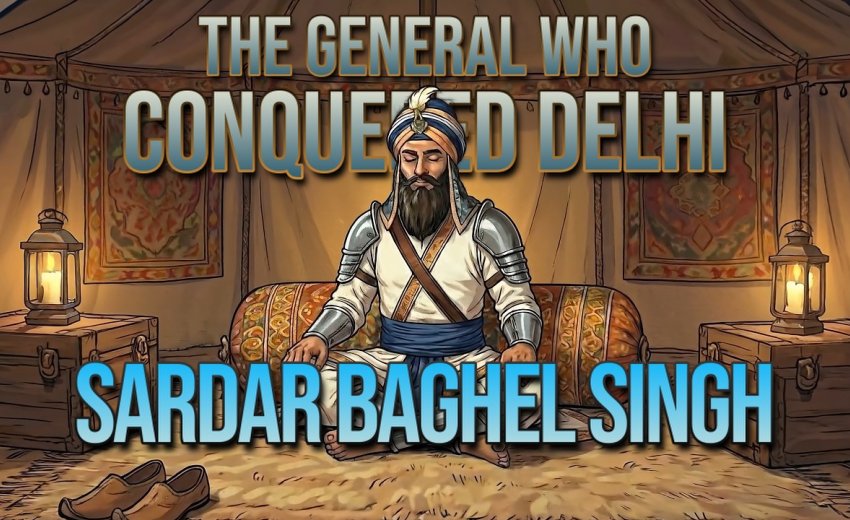

Sardar Baghel Singh is a prominent figure in Sikh history. He was a warrior leader in the 18th century who played an important role in strengthening the foothold of Sikhs beyond Punjab, especially in Delhi. Bhagel Singh was a powerful figure of the Sikh Confederacy and later left a lasting imprint on Delhi through the establishment of key Sikh shrines.
Early life
Baghel Singh was born around the 1730s in Jhabal Kalan (also known as Chabhal Kalan), in the present-day Tarn Taran district of Punjab. He belonged to a Jat Sikh family of the Dhillon/Dhaliwal lineage, a community with a strong martial tradition. His family had deep Sikh roots and traced its ancestry to Chaudhary Bhai Langaha Dhillon, who was a respected Sikh chief who had embraced Sikhism during the time of Guru Arjan Dev Ji. Growing up in such an environment, Baghel Singh absorbed Sikh teachings early and developed a strong sense of responsibility towards the community.
During his early years, the Mughal empire started waning with repeated invasions by Ahmad Shah Durrani, which caused destruction and instability across the region. In response, the Sikh Misls, aka autonomous military group rose to protect Sikh territories and challenge external domination. Baghel Singh was shaped by both his upbringing and the political conditions of the time, and joined this armed resistance.
Rise of the Karor Singhia Misl under Baghel Singh
Gradually, Baghel Singh became a member of the Karor Singhia Misl, one of the twelve major Sikh Misls, led by Sardar Karora Singh. The Misl had a reputation for disciplined cavalry and aggressive campaigns. Baghel Singh’s courage, tactical skill, and leadership earned him recognition within the ranks, and he steadily rose in influence.
In 1765, following the sudden death of Sardar Karora Singh, Baghel Singh assumed leadership of the Karor Singhia Misl. With the confidence and support of Sikh leadership, he was elevated to the position of Jathedar. At the time, he commanded nearly 12,000 soldiers. As leader, he focused on strengthening Sikh control in the region between the Sutlej and Yamuna rivers and confronting Mughal authority wherever it still claimed power.
Baghel Singh’s leadership marked a turning point for the Misl. Under his command, it expanded its territorial reach and became a major force in northern India. His military campaigns eventually carried Sikh power into Delhi, where he compelled the Mughal administration to concede significant authority. Beyond military success, he also ensured the construction of important Sikh gurdwaras in Delhi at sites connected with the lives of the Sikh Gurus, giving the Sikh presence in the city a permanent religious and historical foundation.
From a young warrior in Punjab to a leader who asserted Sikh authority in the imperial capital, Baghel Singh’s career stands as a significant chapter in Sikh military and political history.
Prominent military career
Sardar Baghel Singh’s military career unfolded during a period of rapid political change in North India. After the death of Adina Beg Khan in September 1758 and during Ahmad Shah Durrani’s campaigns against the Marathas between 1759 and 1761, Mughal authority weakened sharply. Sikh sardars took advantage of this power vacuum and began asserting control over large territories.
Baghel Singh was one of the most successful among them. He secured a substantial part of the Hoshiarpur district and nearly one-fourth of the Jalandhar Doab. He established his main headquarters at Hariana, about twelve kilometres west of Hoshiarpur. Unlike many contemporary chiefs, Baghel Singh developed a stable administrative system. He entrusted governance to his wife, Rup Kanwar, who managed civil affairs efficiently while he concentrated on military expansion.
Following the partition of the Sirhind province in January 1764, Baghel Singh extended his authority further south. His new possessions included Chhalondi, Jamaitgarh, Khurdin, and Kinori. He set up a second headquarters at Chhalondi, located on the Jagadhri–Karnal road, and placed its administration under his wife Ram Kanwar. His third wife, Ratan Kaur, managed Kalawar. This arrangement allowed Baghel Singh to remain constantly engaged in campaigns beyond Punjab.
Campaigns in the Ganga–Yamuna Doab
After the fall of Sirhind, the Sikh forces reorganised. While the Taruna Dal returned to West Punjab, the Budha Dal, which was nearly forty thousand strong, advanced into the upper Ganga Doab under the leadership of Jassa Singh Ahluwalia and Baghel Singh. In February 1764, they attacked Saharanpur and devastated the surrounding districts of Muzaffarnagar and Meerut.
Crossing the Ganga, the Sikh forces entered Rohilkhand and struck key towns including Najibabad, Moradabad, and Anupshahar. Najib ad-Dawlah, who exercised real authority in Delhi at the time, lacked the strength to resist. He chose negotiation over conflict and paid a ransom of eleven lakh rupees, securing the safety of his estates.
In 1775, Sikh leaders regrouped near Karnal and divided their forces into three columns led by Rai Singh Bhangi, Tara Singh Ghaiba, and Baghel Singh. On 22 April 1775, they crossed the Yamuna near Kunjpura and began a systematic campaign across the region. Towns such as Lakhnauti, Gangoh, Ambehta, Nanauta, and Deoband fell with minimal resistance. Zabita Khan of Ghausgarh avoided destruction by offering a bribe of fifty thousand rupees and agreeing to accompany the Sikh forces. The Sikhs extracted tribute from Shamli, Kairana, Kandhla, Meerut, and the Barah Sadat villages, advancing as far as Khurja.
During their return in July 1775, Sikh forces entered Delhi’s outskirts and destroyed Paharganj and Jaisinghpura. They then crossed back over the Yamuna, marking a successful deep incursion into imperial territory.
Baghel Singh returned to the region in alliance with Rai Singh Bhangi and Tara Singh Ghaiba. Zabita Khan, now ruling his father Najib ad-Dawlah’s territories, proposed cooperation and supplied funds in exchange for protection. Sikh and Rohilla forces jointly overran villages around present-day Delhi. In March 1776, they defeated Mughal troops near Muzaffarnagar, leaving the entire Yamuna–Ganga Doab exposed to Sikh control.
On 11 March 1776, Baghel Singh led a major assault on the Meerut district. At the battle of Amrinagar, Abu’l Qasim, the imperial commander and brother of the deputy prime minister Abdul Ahad Khan, died fighting the Sikh forces. This victory effectively ended organised Mughal resistance in the region and paved the way for Baghel Singh’s later assertion of Sikh authority in Delhi.
Battle of Ghanaur
By the late 1770s, Sikh power had expanded deep into North India. It posed a direct challenge to Mughal authority. Alarmed by repeated Sikh incursions, Emperor Shah Alam II decided to reassert imperial control. In 1778, he dispatched an army estimated at nearly 100,000 soldiers under the command of Wazir Nawab Majad-ud-Daula, acting in the name of the crown prince. The imperial force advanced towards the Cis-Satluj region, where Sikh influence remained strong.
Baghel Singh emerged as the key figure in resisting this campaign. Known not only for his courage but also for strategic skill, he confronted the Mughal army at Ghanaur, near present-day Patiala. Rather than engage in a direct clash, he outmanoeuvred the vastly larger force by cutting off its mobility and supplies. The encounter ended with the surrender of the Mughal army. It was a major setback for imperial authority and confirming Sikh dominance in the region.
Power struggles and tribute politics
In 1779, the Mughal court made another attempt to extract revenue from the Cis-Satluj Sikhs. Deputy Prime Minister Abdul Ahad Khan led an expedition from Delhi on 18 June, accompanied by Prince Mirza Jahan and Sial Farkhundah Bakht. Upon reaching Karnal, he opened negotiations with several Sikh chiefs, including Baghel Singh.
Baghel Singh used the opportunity to settle old rivalries and strengthen his position. Holding a long-standing grievance against Raja Gajpat Singh of Jind, he advised the Nawab to demand a heavy tribute and threaten imprisonment in case of delay. Facing detention, Gajpat Singh agreed to pay two lakh rupees to secure his release.
Later that year, Baghel Singh influenced Abdul Ahad Khan to proceed against Dasu Singh of Kaithal. On 9 September 1779, he escorted Dasu Singh to the Mughal camp at Thanesar. Dasu Singh sought the return of territories taken by Raja Amar Singh of Patiala, but Abdul Ahad demanded three lakh rupees as tribute. When Dasu Singh offered only two lakhs, the Nawab ordered his imprisonment. He gained release only after paying four lakh rupees. Out of this, one-fourth went to Baghel Singh and other Sikh intermediaries.
Collapse of the Mughal Expedition
By late September 1779, Abdul Ahad Khan struggled to bring Raja Amar Singh of Patiala to submission. After repeated summons failed, he asked Baghel Singh to produce Amar Singh at his camp in Ghuram on 29 September. Amar Singh instead sought support from the Majha Sikhs. Sensing danger, Baghel Singh warned the Nawab that an attack was imminent. He advised Abdul Ahad to bribe the Trans-Satluj Sikh chiefs and withdraw safely towards Delhi.
Abdul Ahad handed over three lakh rupees, which was collected from Dasu Singh Baghel Singh. He distributed most of it among the Majha sardars and retained a portion for himself. The Mughal camp began its retreat on 14 October and reached Panipat on 18 October. During the withdrawal, Cis-Satluj Sikh forces repeatedly attacked the column. They plundered its baggage and equipment. Baghel Singh stayed away from the looting, having already secured his share through negotiation.
Dispute with Raja Amar Singh of Patiala
In 1780, Raja Amar Singh exploited divisions among Sikh chiefs and seized several villages belonging to Cis-Satluj leaders. Baghel Singh lost Bhuni, Lalru, and Mullanpur, prompting a confrontation. During that time, Amar Singh formed alliances with other sardars and the Raja of Nahan. It led to a clash at Ghuram, about twenty-five kilometres south of Patiala. The battle ended without a clear result.
Baghel Singh then launched an attack on Patiala city but failed to breach its fortifications. He shifted tactics and devastated Amar Singh’s countryside holdings, forcing him to seek reconciliation. Amar Singh’s lawyer, Chain Singh, approached Baghel Singh’s camp at Lahal and appealed for peace in the name of the Guru. Baghel Singh agreed to the negotiations.
Amar Singh arrived with his five-year-old son, Sahib Singh, who formally saluted Baghel Singh. Baghel Singh lifted the child onto his lap and, at Amar Singh’s request, initiated him into the Khalsa. By becoming the boy’s protector, Baghel Singh ended the conflict and established a bond that carried both political and religious significance.
March towards Delhi during the Chalisa famine
In early 1783, North India reeled under the effects of the Chalisa famine. The collapse of administration and widespread distress created conditions that Sikh forces exploited to assert their authority. In February 1783, the Budha Dal, nearly 60,000 strong and led by Jassa Singh Ahluwalia and Baghel Singh, set out on a major campaign that would culminate in the occupation of Delhi.
The Sikh army began its advance near Delhi by attacking Ghaziabad, which was about twenty kilometres south of the city. From there, it moved to Bulandshahr and then to Khurja, an important centre for grain and clarified butter. The sudden arrival of Sikh forces triggered panic among the population, with many residents fleeing. Wealthy inhabitants were detained and compelled to surrender hidden valuables. After securing Khurja, Baghel Singh and Jassa Singh called upon Sikh chiefs to contribute one-tenth of their spoils in the name of the Guru. The collection amounted to one lakh rupees, later sent for the improvement of Sri Harmandir Sahib at Amritsar.
Expedition to Farrukhabad
The Sikh army continued southward, striking Aligarh, Hathras, Tundla, and Shikohabad in quick succession. Each town yielded substantial wealth. From Shikohabad, the forces advanced towards Farrukhabad, which fell without prolonged resistance. The Nawab’s palace was thoroughly plundered. Baghel Singh secured valuable treasures, including gold, jewellery, diamonds, pearls, a golden huqqa, and a diamond-studded staff. With this campaign complete, the Sikh leaders turned back towards Delhi.
Battle of Delhi and Occupation
On 8 March 1783, Sikh forces returned to Delhi and divided their army of about 50,000 men. Baghel Singh led 30,000 troops and established his camp at Tis Hazari. The Sikhs immediately launched raids on Maika Ganj, Sabzi Mandi, and Mughalpura. On 9 March, they attacked Pahari Dhiraj, where Rao Dhiraj Ram’s son was killed. At the same time, Jassa Singh Ahluwalia forced entry through Ajmeri Gate and overran Hauz Qazi, driving civilians to seek refuge inside the Red Fort.
Emperor Shah Alam II, unable to resist, sought help from Begum Samru of Sardhana. Around the same time, Jassa Singh Ramgarhia arrived from Hisar with 10,000 troops. His arrival altered the situation within the Red Fort, where Ahluwalia’s followers briefly placed him on the imperial throne and proclaimed him “Badshah Singh.” Ramgarhia objected strongly and demanded Ahluwalia’s withdrawal. To prevent a clash between Sikh factions, Ahluwalia stepped down, and both sides returned to their camps. Negotiations followed soon after.
Agreement with the Mughal Court
On 12 March 1783, Begum Samru met Baghel Singh at his Tis Hazari camp. Jassa Singh Ahluwalia declined to represent the Budha Dal and authorised Baghel Singh to negotiate on behalf of the Sikh leadership. The agreement was later approved by the Emperor and required the Sikh army to withdraw from Delhi while allowing Baghel Singh to retain a garrison of 4,000 men. He also received the right to collect taxes and octroi duties, ensure disciplined conduct of Sikh troops, and construct seven gurdwaras at sites sacred to Sikh history within one year.
This settlement marked the effective conquest of Delhi by the Sikhs. Under Baghel Singh’s supervision, historic shrines such as Gurdwara Sis Ganj, Rakab Ganj, and Bangla Sahib took shape, securing a permanent Sikh presence in the imperial city.
Gurdwaras constructed in Delhi
After the Sikh occupation of Delhi in 1783 under the command of Sardar Baghel Singh, Sikh forces remained in the city to secure religious and administrative gains. One of Baghel Singh’s foremost priorities involved identifying sites linked to key events in Sikh history and marking them with permanent shrines.
A Sikh force of about 4,000 men stayed in Delhi to support this effort. Under Baghel Singh’s supervision, ten gurdwaras were constructed within a short span. By November 1783, the work stood complete. The major gurdwaras established during this period included Gurdwara Sis Ganj, Rakab Ganj, Bangla Sahib, Bala Sahib, Mata Sundri, Moti Bagh, and Majnu Ka Tilla. These constructions secured a lasting Sikh presence in Delhi and achieved their purpose without further fighting.
Impressed by Baghel Singh’s control over the city, Emperor Shah Alam II expressed a desire to meet him. Baghel Singh agreed only on the condition that he would not bow before the Emperor and would arrive with an armed escort. The Mughal court accepted these terms. During the meeting, the Emperor presented Baghel Singh with a khilat, an elephant, and a pearl necklace. He also sanctioned an annual payment of 12.5 percent of Delhi’s octroi duties to be remitted to Baghel Singh at Chhalondi.
Treaty with Mahadji Sindhia
In March 1785, Mahadji Sindhia, the Mughal regent, sought to curb Sikh raids in Delhi and the Ganga Doab. His agent, Ambaji Ingle, negotiated a treaty with Baghel Singh and other Sikh sardars on 30 March 1785. Under its terms, the Sikhs agreed to stop collecting rakhi from crown lands, while the Mughal–Maratha administration promised an annual payment of ten lakh rupees. Sindhia ratified the agreement on 9 May 1785 with a provision that the Sikhs would receive one-third of the revenue from Maratha-controlled territories.
The agreement proved short-lived. Early in 1785, Baghel Singh and Jassa Singh Ramgarhia crossed the Ganga and swept through the upper Ganga Doab, including areas under British protection. They captured Moradabad and nearby villages. After that, they advanced towards Chandausi and returned with booty estimated at one crore rupees. This rapid expansion alarmed British authorities.
As Sikh raids continued, Ambaji Ingle launched an expedition into the Cis-Satluj region in June 1787. During this phase, Baghel Singh, who had received parganas yielding four lakh rupees annually, joined Ingle’s campaign. At the same time, Mahadji Sindhia remained engaged in a conflict with Jaipur. An agent of the Jaipur ruler approached Baghel Singh at Thanesar with an offer of money. Baghel Singh accepted it and persuaded Ingle to withdraw, even escorting him safely during the retreat.
Through a combination of military strength, negotiation, and calculated alliances, Baghel Singh preserved Sikh influence across North India while securing lasting religious and political gains in Delhi.
Sack of Chandausi
In early January 1785, Sikh military activity resumed east of the Yamuna. Jassa Singh Ramgarhia, Baghel Singh, and Gurdit Singh of Ladwa crossed the river and began operations in the Bara Sadat region. They plundered several towns and villages, while Zabita Khan remained confined within his fort at Ghausgarh, unwilling to confront them. The Sikh forces then crossed the Ganga and entered Rohilkhand. On 13 January, they devastated the villages of Barsi and Mahmudpur. The following day, they attacked Chandausi, a major commercial centre with nearly two thousand bankers, merchants, and jewellers. Over two days and nights, the town was stripped of wealth amounting to nearly one crore rupees.
Shah Alam II and the Ghulam Kadir Crisis
Despite earlier agreements with the Sikhs, Emperor Shah Alam II found himself increasingly powerless. In 1787, he appealed repeatedly to Baghel Singh for military assistance against growing threats around Delhi. These appeals proved ineffective. In August 1787, Ghulam Kadir advanced on Delhi with the support of several Sikh chiefs. Shah Alam wrote to Baghel Singh on 25, 30, and 31 August, seeking urgent help. Baghel Singh’s representative at court secured a royal order on 1 September, authorising him to seize Ghulam Kadir’s territories. Baghel Singh, however, chose not to act against him and instead aligned himself with Ghulam Kadir.
Ghulam Kadir’s occupation of Delhi turned brutal. From July 1788, his forces subjected the royal family to extreme violence. On 10 August 1788, he blinded Shah Alam II, assaulted him publicly, and imprisoned members of the imperial household. Princes and princesses suffered physical abuse, while women faced humiliation and violence. During this period, Bhanga Singh of Thanesar remained loyal to the Emperor and worked with Begum Samru, who also refused to abandon Shah Alam. The crisis ended only when Mahadji Shinde led a Maratha army into Delhi. Ghulam Kadir was captured and executed on 3 March 1789.
Alliance with the Marathas
Following the restoration of Mughal authority under Maratha protection, Baghel Singh shifted his alignment. In 1788, Mahadji Shinde sent Rane Khan and Ali Bahadur to collect tribute from Sikh chiefs. Baghel Singh joined them at Batra village near Karnal, marking the beginning of sustained cooperation with the Marathas. To secure Sikh support and limit raids on imperial territory, Mahadji granted Baghel Singh a large jagir in April 1789.
Later that year, Dhar Rao led a Maratha expedition into the Cis-Satluj region, with Baghel Singh participating actively. The campaign focused on Patiala, where Diwan Nanun Mal promised two lakh rupees for recovering lands seized by neighbouring chiefs. The expedition succeeded in reclaiming territory from Kaithal and Jalandhar chiefs, and Baghel Singh received payments from both sides for his role.
In 1794, another Maratha campaign led by Anta Rao and Lachhman Rao advanced into the region, with Baghel Singh acting as guide. Chiefs of Jind, Kaithal, Thanesar, and Radaur submitted. The Maratha army then moved towards Patiala, prompting Tara Singh Ghaiba of the Trans-Satluj region to intervene. The conflict culminated in the Battle of Murdanpur near Ambala, forcing the Marathas to retreat towards Karnal.
Conflict with George Thomas and Perron
By the late 1790s, new power centres emerged in northern India. In 1797, George Thomas, an Irish adventurer, established control over Haryana. With eight infantry regiments, a thousand cavalry, and fifty guns, he declared himself Raja of Haryana and made Hansi his base. His rise alarmed Sikh chiefs in the region.
At the same time, Pierre Cuillier-Perron, a French general serving Daulat Rao Sindhia, captured Delhi. Baghel Singh and other Sikh chiefs from the Sirhind province allied with Perron to counter George Thomas. Despite Thomas’s strong army, the combined Sikh forces defeated him. By 1801, Thomas was driven out. It ended his brief rule.
Through shifting alliances, calculated campaigns, and firm control over Delhi after 1783, Sardar Baghel Singh remained a decisive figure in North Indian politics. His actions ensured Sikh military influence endured well beyond the occupation of Delhi, shaping the balance of power in the region for decades.
Final years
While the exact date of Sardar Baghel Singh’s death remains uncertain, most historical accounts place it around 1802. It marked the end of an era that shaped Sikh power in North India. A samadh in his honour still stands in the town associated with his later years, preserving the memory of one of the prominent leaders of the Sikh Misls.
Historians differ on the details of his final years. Raghubir Verma states that Baghel Singh died in 1800 at Amritsar, while Gian Singh supports the view that he lived until 1802. Sir Lepel Griffin presents a different account, claiming that Baghel Singh joined the British army alongside Bhag Singh of Jind in January 1805. If this claim holds, his death may have occurred at the end of 1805 or in early 1806. The lack of firm contemporary records makes a definitive conclusion difficult.
Regardless of the uncertainty surrounding his death, Baghel Singh’s influence remained undeniable. His military campaigns weakened Mughal authority, and his political judgement allowed him to navigate shifting alliances. Also, his leadership in Delhi secured permanent Sikh religious institutions in the imperial city. The gurdwaras established under his supervision continue to stand as reminders of Sikh presence and authority in Delhi
Baghel Singh’s life left a lasting mark on Sikh history. His actions reshaped the balance of power in North India and ensured that Sikh religious and political interests found enduring expression well beyond his lifetime.
References:
Wikipedia - Baghel Singh
https://en.wikipedia.org/wiki/Baghel_Singh
It showcases Sardar Baghel Singh’s conquest of Delhi and explores how the Sikh general led his forces to capture the Mughal capital in 1783. It also gives an overview of how he established key Sikh gurdwaras in the city as lasting marks of Sikh presence and authority.
Sikhnet - Vanquisher of Mughal Delhi ~ S. Baghel Singh
https://www.sikhnet.com/news/vanquisher-mughal-delhi-s-baghel-singh
Details how S. Baghel Singh led the campaign that compelled the Mughal emperor to negotiate and established Sikh authority in Delhi.
DV Network - Sardar Baghel Singh
https://dvnetwork.org/page/sardar-baghel-singh
Explores Sardar Baghel Singh’s military leadership and strategic diplomacy in the late 18th century.
SikhiWiki - Bhai Baghel Singh
https://www.sikhiwiki.org/index.php/Bhai_Baghel_Singh
Explores the life and achievements of Bhai Baghel Singh and his role in the Sikh conquest of Delhi.
Discover Sikhism - Bhai Baghel Singh
https://www.discoversikhism.com/sikhs/bhai_baghel_singh.html
Examines how Bhai Baghel Singh emerged as a leading Sikh general and secured permanent Sikh religious sites in the city.