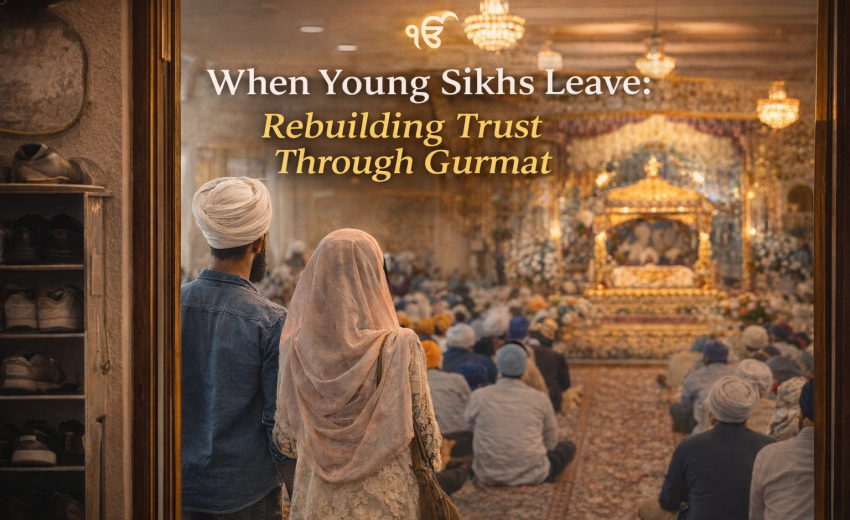

When Young Sikhs Leave: Rebuilding Trust Through Gurmat
One Sunday in the UK, after divan, I watched a scene that should trouble us all. A small group of young Sikhs—students and early-career professionals—stood near the shoes, quietly deciding whether to stay for langar. Not because they had anywhere else to be, but because they were weary. They had come seeking kirtan, peace, and spiritual nourishment. Instead, they overheard sharp arguments about committees, factional loyalties, and politics.
Nearby, a young woman was corrected abruptly about her chunni (headscarf/dupatta) “not covering properly.” Another young Sikh was spoken to sharply for asking a simple question, and someone else was mocked for not knowing Punjabi well enough. None of this felt like Gurmat discipline. It felt like public policing without compassion—rules without wisdom, and correction without care.
One young man said, almost apologetically: “I love Sikhi, but I don’t love the atmosphere.” Then they left.
This article is a short, accessible introduction. Readers who want the fuller governance argument and supporting notes can find the working paper archived online (Zenodo DOI: https://doi.org/10.5281/zenodo.18299815).
You Are Not Alone—And You Are Not Wrong
If you are a young Sikh who has felt this weariness, know this: you are not turning away from the Guru. You are reacting to an atmosphere that, in many places, has drifted from Gurmat. Your
instinct is sound. The gurdwara should be a sanctuary of Shabad and seva, not a battleground of ego.
But there is also a hard truth: when thoughtful Sikhs disengage, the space is increasingly shaped by the loudest voices. When you step back, others may claim to speak for the whole sangat— including you.
The question is not whether you have the right to leave. The question is: will you help build something better?
What Went Wrong—And Why It Matters
Many young Sikhs say they feel powerless: “Everything is political. Nothing will change.” To change anything, we first need clarity about what broke. The deeper problem is not personalities. It is confusion about authority in Sikh life—two different responsibilities becoming dangerously mixed.
Administrative seva (trusteeship) involves managing the practical life of the gurdwara: maintaining buildings, managing finances, ensuring safety, organising langar. This is necessary and honourable work.
Spiritual responsibility (Gurmat authority) involves questions of Sikh principle, discipline, and Sikh-wide direction. These are not merely administrative matters; they touch the Sikh collective conscience and must be approached with deep humility and a Guru-centred method. When these roles blur, a damaging illusion appears: whoever controls committees and budgets begins to behave as if they control the Sikh voice. Every administrative contest becomes a test of spiritual loyalty. Every management disagreement becomes a fight “for the soul” of the
community. That is why conflicts escalate so quickly—and why the atmosphere can become spiritually draining.
What the Youth Intuitively Understand
Young Sikhs often have sharper Gurmat instincts than they realise. You may not state it in academic language, but you sense something essential: in Sikhi, authority must match its source. The Gurus did not build a faith centred on personality cults. Sikh authority does not flow from charisma, wealth, or the ability to mobilise a crowd. True Sikh authority must be answerable to the Guru—through a method the sangat can recognise as Gurmat: humility, truthfulness, restraint, fairness, and accountability.
This is why you hesitate when “announcements” appear without visible process. You want to see how decisions are made. You want to know whether Gurbani-based vichaar shaped the outcome—or whether factional advantage did.
Your scepticism is not cynicism. It is a healthy Sikh instinct: decisions claimed to represent the Sikh collective should reflect the Guru’s way.
Sikh tradition has long treated serious Sikh-wide direction with seriousness of method. When authority is claimed in the Guru’s name, the method must visibly reflect Gurmat—especially humility, restraint, fairness, and accountability in the Guru’s presence. Where process is hidden or stacked, even a decision that might be right in substance can still ignite division, because the sangat cannot trust how it was reached. If the method is distrusted, the outcome becomes another spark.
Five Ways You Can Help Rebuild—Starting Today
Sikh renewal has never depended only on distant institutions. It begins wherever Sikhs choose to live by Gurmat with integrity—right where you are, in your local sangat.
Here are five practical steps that require no one’s permission:
1) Make learning central again
The antidote to political noise is spiritual depth. Support Gurbani vichaar, serious kirtan, and learning that strengthens the mind and deepens love for the Guru. When you understand Gurbani better, slogans have less power over you.
Start youth study circles. Invite speakers known for humility and knowledge—not factional loyalty. Create spaces where sincere questions are welcomed.
2) Insist on dignity in disagreement
Refuse gossip, character assassination, and humiliation—even when “your side” is doing it. Choose speech that is truthful, restrained, and constructive.
When you hear slander, ask: “Do we know this firsthand?” When social-media warfare erupts, do not amplify it. Restraint can be seva when it starves destructive speech.
3) Ask for clarity, not conflict
Good stewardship is a Gurmat value. Encourage transparent accounts and clear minutes for major decisions. This is not disrespect. It honours the sangat’s right to understand how their offerings are used.
Frame it positively: “This reduces suspicion. It protects honest seva. It helps future committees.”
4) Respect trusteeship—but keep it in its place
Honour those doing administrative seva. Thank them. Support them. But do not confuse committee position with spiritual authority.
If a committee decides repairs or programmes, that is appropriate. But if anyone claims to speak for all Sikhs on matters of principle—without broad consultation, without written reasoning the sangat can examine, without a visible Guru-centred method—then the claim exceeds the foundation.
You can respectfully ask: “Who was consulted? What Gurbani and precedent guided this? Where can we read the reasoning? How can concerns be raised with dignity?”
5) Build what you want to see
You don’t need a grand summit to begin restoring trust. One family, one local gurdwara, one youth group can begin practising transparent governance and Shabad-centred vichaar immediately—starting with expectations that are simple, fair, and Gurmat-consistent. Create a monthly divan focused purely on Shabad and reflection—no campaigning, no factional heat. Organise seva projects that bring people together in humble service. When youth become builders rather than only critics, something shifts. You create spaces where people feel safe to learn, serve, and grow—and slowly the gurdwara begins to feel like home again.
The Practice, Not Just the Slogan
Sri Guru Granth Sahib Ji calls us to a life where the Shabad governs the mind and ego is disciplined. When the Shabad is not central within, talk becomes noise—and noise becomes conflict.
Putting the Guru back at the centre is not a slogan. It is a practice. You do not need anyone’s permission to begin that practice: in how you speak, how you serve, how you study, and how you encourage accountability with both respect and courage.
The path forward is not only to hope for better leaders. The path forward is for each of us— especially the youth who see the problems clearly—to help cultivate a better moral culture: transparency where possible, restraint in speech, dignity in disagreement, and Guru-centred method when serious claims are made.
History shows us that physical damage can be repaired—but moral authority, once lost to politicization, is far harder to restore. That is why the method matters—not as bureaucracy, but as Gurmat in action.
When enough of us live this way, patiently and consistently, trust can return. Unity can deepen. And our gurdwaras can again become what they were always meant to be: sanctuaries where the Guru’s peace lifts every heart that enters.
A Final Word to Those Considering Leaving
If you are standing near the shoes, deciding whether to stay, I understand your weariness. You do not have to tolerate spiritually draining behaviour. But consider this: if everyone who values Gurmat simply withdraws, the atmosphere will be shaped by those least restrained by Gurmat. There is a third path: stay—but stay differently. Stay as a builder of the atmosphere you want to see. Stay as someone who brings Gurmat culture into the room by how you conduct yourself. Stay as part of a quiet, patient community that refuses to let ego-driven politics define Sikh life. The Guru’s gurdwara belongs to the Guru—and the Guru’s sangat. Help restore it to its purpose—not through warfare, but through witness. Start this week: humble, steady, and Guru-centred.