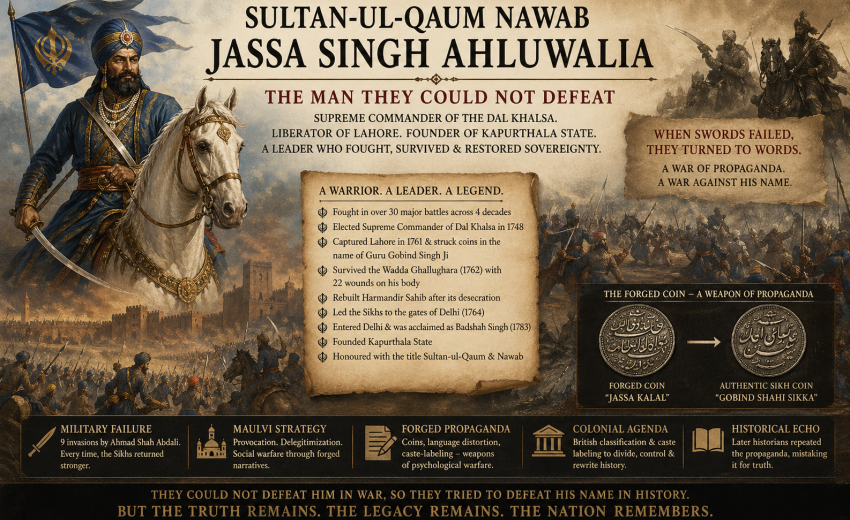

A Multi-Front Examination of British Colonial, Afghan, and Maulvi Strategies to Decimate an Unconquerable Leader An Integrated Historical Analysis of Military Defeat, Psychological Warfare, Coin Forgery, Linguistic Distortion, Colonial Caste-Classification, and the Deliberate Dismantling of a Sikh Sovereign's Legacy
SECTION VII: THE PSYCHOLOGY OF DECIMATION — WHEN WARRIORS CANNOT BE CONQUERED
A. The Universal Pattern
The strategy deployed against Jassa Singh Ahluwalia is not unique to him. It is a universal pattern — a recurring feature of human conflict that appears wherever an unconquerable leader stands against powerful enemies. Throughout world history, when military force cannot defeat a leader, enemies resort to character assassination, identity attacks, and social degradation.
Alexander the Great's enemies questioned the legitimacy of his succession. Hannibal Barca's enemies — particularly the Roman senators who could never match him on the battlefield — attacked his character, portraying him as treacherous and barbaric. Shivaji Maharaj's enemies used caste to diminish his claim to sovereignty, challenging his right to the royal title because of his social origins. Toussaint L'Ouverture, the Haitian revolutionary who defeated Napoleon's armies, was captured through treachery when force of arms failed — and then systematically degraded in French captivity.
The pattern is always the same: when you cannot defeat the body, attack the name. When you cannot destroy the army, destroy the reputation. When you cannot conquer the leader, conquer the historical record.
B. The Specific Tactics Used Against Jassa Singh
The psychological warfare campaign against Jassa Singh Ahluwalia was not a single attack but a multi-layered strategy employing five distinct but interconnected tactics. Each tactic reinforced the others, creating a web of falsehood that became increasingly difficult to disentangle as the decades and centuries passed.
9. LINGUISTIC WARFARE: The deliberate alteration of "Kalial" to "Kalal" — a single syllable shift that transformed a respectable community connection into a stigmatized occupational label. This was linguistic precision weaponized: a minimal change in sound that produced a maximum change in social meaning. The architects of this distortion understood the caste conscious society they operated in, and they crafted their weapon accordingly.
10. COIN WARFARE: The creation of a forged coin that simultaneously served two strategic objectives — provoking Abdali into another genocidal invasion and creating a physical "documentary record" that would embed the false label in the numismatic and historical archive. The coin was a masterpiece of dual-purpose propaganda: a single object that was both a letter to an Afghan emperor and a forgery designed to fool future historians.
11. CLASSIFICATION WARFARE: The British census and gazetteers seized upon the existing Maulvi propaganda and fixed a fluid, contested, enemy imposed label into a rigid official category — giving it the authority of state documentation. The colonial classification machine did not create the "Kalal" label, but it preserved and institutionalized it, transforming enemy slander into administrative "fact."
12. REPETITION WARFARE: The echo chamber of historians repeating the false label across generations, each repetition adding apparent authority, each citation making the original source harder to trace and the falsehood harder to challenge. This is the most insidious tactic of all, because it requires no active malice from the later participants — only a failure of critical thinking.
13. DIVISION WARFARE: The use of caste labels to create internal divisions within the Sikh community itself — to import the poison of hierarchical thinking into a community whose founding principles explicitly rejected all hierarchy of birth. By labeling the supreme Sikh commander as "Kalal," enemies sought not only to diminish him personally but to fracture the unity of the Khalsa along caste lines.
C. Why This Strategy Was Chosen for Jassa Singh Specifically
The question must be asked: why was this particular strategy — this multilayered, multifront campaign of psychological warfare — deployed specifically against Jassa Singh Ahluwalia? Why him, out of all the Sikh commanders of the eighteenth century? The answer lies in the unique convergence of factors that made Jassa Singh the single most dangerous leader the Khalsa's enemies had ever faced:
● He was the Supreme Commander — the single most important Sikh leader, democratically elected by the entire Khalsa to lead them.
● He was the Jathedar of Buddha Dal — the head of the most feared warrior order in Punjab, the institutional backbone of Sikh military power.
● He survived every military attempt to destroy him — including twenty-two wounds at the Wadda Ghallughara, the most devastating massacre in Sikh history.
● He captured Lahore, struck coins in Guru’s name, and declared Sikh sovereignty — the ultimate humiliation for both the Afghans and the Mughal remnants.
● He rebuilt the Harmandir Sahib after desecration — a spiritual triumph that renewed Sikh resolve after the darkest hour.
● He marched on Delhi — demonstrating that Sikh power could project force far beyond Punjab.
● He founded a state — creating a permanent, sovereign Sikh domain that would endure for generations.
There was literally no military solution to Jassa Singh Ahluwalia. He could not be killed in battle — he survived twenty-two wounds. He could not be broken by massacre — he rebuilt after the Ghallughara. He could not be contained within Punjab — he marched on Delhi. He could not be denied sovereignty — he struck coins and founded a state. He was, in every measurable dimension, unconquerable.
And therefore, every enemy — Maulvi, Afghan, and British — independently concluded that the only way to diminish him was through non-military means. The weapons of words were deployed precisely because the weapons of war had failed.
"No sword could fell him. No army could break him. No massacre could stop him. So his enemies chose a different weapon — a word. A single, deliberately chosen, strategically deployed word: 'Kalal.' pg. 34 And with that word, they attempted to accomplish what nine Afghan invasions, the Wadda Ghallughara, and two Anglo-Sikh Wars could not: the decimation of Sultanul-Qaum Nawab Jassa Singh Ahluwalia. They failed then, and they fail now
— because truth, like the Khalsa itself, cannot be permanently conquered."
A. The Commitment to Truth (Sat)
Sikh philosophy begins with Ik Onkar Sat Naam — the One Creator, whose Name is Truth. Truth is not merely a value in Sikhi; it is the very nature of the Divine. The entire Sikh ethical system rests on the foundation of truthful living — "Truth is the highest virtue, but higher still is truthful living" (Sri Guru Granth Sahib Ji).
Correcting a false historical narrative is an act of truthfulness — an obligation of truthful living. It is not caste pride. It is not social ambition. It is the refusal to accept a lie as history. A Sikh is duty-bound to challenge falsehood wherever it is found — in society, in politics, in religion, and in the historical record. When a false label has been deliberately manufactured by adversaries, weaponized for strategic purposes, and uncritically repeated by historians, the commitment to truth demands that it be corrected.
The genealogical argument presented in this article is therefore a defensive correction of deliberate historical distortion. It is not an offensive claim of superiority. It is the restoration of truth against a campaign of lies.
B. The Commitment to Equality
And here we arrive at the second principle — one that must be stated with equal force and equal clarity.
Even if the "Kalal" label were true, it would change nothing about Jassa Singh Ahluwalia's achievements.
Not one thing.
The Khalsa recognizes no hierarchy of birth. Guru Nanak Dev Ji rejected the sacred thread — the symbol of caste privilege — when he was a child. Guru Angad Dev Ji was born into a Trehan family; Guru Amar Das Ji into a Bhalla family; Guru Ram Das Ji into a Sodhi family of modest means. The selection of Gurus crossed family lines, proving that spiritual authority in Sikhi has nothing to do with lineage. Guru Gobind Singh Ji created the Khalsa in 1699 precisely to destroy caste — to create a new identity in which the accident of birth was irrelevant, and only devotion to truth, righteousness, and the community mattered.
"Recognize ye all the Human Race as One." — Guru Gobind Singh Ji, Akal Ustat
It is not "recognize some of the human race as one." It is absolute: all — without exception. A Sikh who accepts this principle cannot, by definition, regard any human being as inferior on the basis of birth, occupation, or ancestry
C. The Critical Distinction
Historical genealogy and the caste system are fundamentally different things. They must not be confused.
Genealogy is the tracing of ancestry — the pursuit of historical truth about one's family origins. Every culture in human history has practiced genealogy. It is a legitimate field of historical inquiry. It makes no claims about the worth of different lineages; it merely seeks to establish what actually happened.
The caste system is a hierarchical system of oppression — a social structure that assigns worth, dignity, opportunity, and status on the basis of birth. It is the antithesis of the Sikh principle that all human beings are equal before the Creator.
We correct the false "Kalal" label because lies are unacceptable — not because ancestry determines worth. We reject the enemy's fabrication because a Sikh cannot accept falsehood — not because we regard any occupation as inferior. We insist on historical accuracy because truth is the Name of God — not because one genealogical line is "higher" than another. And here is the acid test — the test that separates the commitment to truth from the embrace of caste:
And here is the acid test — the test that separates the commitment to truth from the embrace of caste:
The Acid Test:
If someone declared that Jassa Singh Ahluwalia was descended from the community that the caste system labels the "lowest" — would that change anything about his capture of Lahore? Would it diminish his twenty-two wounds at the Wadda Ghallughara? Would it invalidate his unanimous election as Sultan-ul-Qaum? Would it reduce the significance of his rebuilding the Harmandir Sahib? Would it negate his founding of Kapurthala State? Would it make his four decades of service to the Khalsa any less heroic, any less consequential, any less worthy of eternal remembrance?
Of course not.
The answer is as clear as the Guru's teaching: no one is high and no one is low. Jassa Singh's greatness stands on the granite foundation of his deeds — and no label, whether true or false, can diminish it by a single grain.
Platforms Requiring Correction
Several widely consulted platforms — including but not limited to SikhiWiki, Wikipedia, and other community-edited encyclopedic sites — currently repeat the "Kalal" label in their entries on Jassa Singh Ahluwalia. These entries, however well-intentioned, are the products of the echo chamber effect described in Section V. They cite later sources that themselves cite colonial classifications and enemy propaganda, creating a circular chain of references that traces back not to evidence but to adversarial fabrication.
These platforms are community-edited precisely because they value accuracy over tradition. Any informed researcher can submit corrections, provided they are well-sourced and properly documented. The correction of the Jassa Singh Ahluwalia entry on these platforms should include the following elements:
14. The absence of early evidence: The earliest biographical source — Jassa Singh Binod by Sri Ram Sukh Rao — identifies the family as Rajput Bhatti. The "Kalal" label does not appear in early Sikh sources.
15. The undisputed landownership: The family owned four villages — Ahlo, Hallo, Toor, and Chak — a fact incompatible with the "poor Kalal" characterization.
16. The maternal lineage: The maternal uncle was Bagh Singh Hallowalia, not "Kalal," proving the maternal family did not use this occupational label.
10.The coin forgery evidence: The Sikh Encyclopedia itself states that the "Jassa Kalal" coin was likely "arranged to be struck by some religious leaders of Lahore" — not issued by the Sikhs. 11.The historical context of adversarial propaganda: Three separate adversarial forces — the Maulvis, the Afghans, and the British — each had independent strategic reasons to diminish Jassa Singh's legacy through caste-labeling.
12.The Sikh philosophical position: The Khalsa recognizes no hierarchy of birth. Caste is irrelevant to spiritual or social worth. The correction is motivated by the commitment to truth, not by any claim of caste superiority.
A Standard of Evidence
Any future discussion of Jassa Singh Ahluwalia's family origins should be held to the same standard of evidence that is applied to any historical claim:
● What is the earliest source for the claim?
● Did the subject or his family ever use this identification?
● Who first introduced the label, and what were their interests?
● Is the claim consistent with independently verified facts (landownership, family names, education, social standing)?
● Has the claim been subjected to rigorous source criticism, or has it been passively repeated from earlier secondary sources?
By these standards — the standards of responsible historical inquiry — the "Kalal" label fails at every point. It should be removed from authoritative entries and replaced with what the evidence actually supports: the Ahluwalia identity, derived from the village of Ahlu, with a genealogical tradition tracing the family to Rajput Bhatti origins.
SECTION X: CONCLUSION — SETTLING THE MATTER FOREVER
This article has conducted a comprehensive, multi-front examination of the false "Kalal" label that has been attached to the name of Sultan-ul-Qaum Nawab Jassa Singh Ahluwalia — an examination that has drawn upon military history, numismatic evidence, linguistic analysis, colonial studies, historiographical method, social theory, and Sikh philosophy. The examination has been thorough because the subject demands thoroughness.
It has been rigorous because the historical record demands rigor. And it has been passionate because truth demands passion — the same passion that drove Jassa Singh Ahluwalia across forty years of warfare, through twenty two wounds at the Ghallughara, and into the gates of Lahore, Sirhind, and Delhi.
Let us summaries what this analysis has established.
The Multi-Front Campaign
The Maulvis of Lahore — the Muslim religious leaders who saw rising Sikh power as an existential threat — forged a coin in 1761 that bore the derogatory label "Jassa Kalal." This coin served a dual strategic purpose: it provoked Ahmad Shah Abdali into returning to Punjab for another genocidal campaign, and it planted a false "documentary record" that would mislead historians for centuries. The Sikh Encyclopedia itself identifies this coin as enemy propaganda — "arranged to be struck by some religious leaders of Lahore for despatching it to Ahmad Shah Durrani with the intention of rousing his ire."
Ahmad Shah Abdali and his Afghan forces deployed psychological warfare when military genocide failed. After nine invasions, after the Wadda Ghallughara, after the desecration of the Harmandir Sahib — Abdali could not permanently subdue the Sikhs. The Maulvi propaganda served his strategic interests by maintaining a narrative of Sikh illegitimacy.
The British colonial administration created a vast apparatus of caste classification that served the strategic needs of imperial governance — dividing Indian society into rigid categories, diminishing warrior classes, and rewriting the histories of the leaders who had most fiercely resisted colonial conquest. Lepel Griffin — a colonial administrator, not a historian — dismissed the Bhatti Rajput genealogy of the Ahluwalia family without evidence and imposed a colonial classification that later historians would uncritically repeat. The British specifically targeted the Nihang order — of which Jassa Singh had been the supreme chief — for physical destruction, and the diminishment of Jassa Singh's legacy was part of the larger campaign to destroy the institutional memory of the Nihang tradition.
Later historians were trapped by the echo chamber effect — repeating the false label from colonial sources without interrogating its origins, its consistency with other evidence, or its strategic context. Each repetition gave the falsehood more apparent authority, until it appeared to be "established fact" — when it was, in reality, enemy propaganda preserved by colonial classification and amplified by uncritical repetition.
The Evidence Is Conclusive
Against this campaign of falsehood stands the evidence — clear, comprehensive, and unanswerable:
● No early Sikh source uses the label "Kalal." The earliest biographical work identifies the family as Rajput Bhatti.
● The family owned four villages — Ahlo, Hallo, Toor, and Chak. The characterisation of this family as "poor" is historically impossible.
● The maternal uncle was Hallowalia — not Kalal. The maternal family did not use this label.
● The coin was forged by Lahore's religious leaders — not issued by the Sikhs. The Sikh Encyclopedia itself says so.
● The family never identified as Kalal. Their identity was Ahluwalia — "of Ahluwal" — derived from their ancestral village.
● The ancestral marriage into the Kalial (not Kalal) family was based on Gursikhi — devotion to the Guru's path — not on caste identity.
● The mother's spiritual eminence and the seven years of education under Mata Sundri Ji's personal household speak to a family of established standing, not a marginal occupational group. ● The convergence of three enemy interests — Maulvi, Afghan, and British — explains the persistence of the false label far better than any historical evidence.
The Final Word
This article stands as the final, integrated, multi-angle examination of this matter. The false label originated from adversaries. It was amplified by colonial agents. It was repeated by uncritical historians. And it is now dismantled — permanently, comprehensively, and from every conceivable angle — by the evidence, the logic, and the truth.
Sultan-ul-Qaum Nawab Jassa Singh Ahluwalia does not need our defense. His record speaks for itself — in the coins he struck, in the cities he captured, in the shrines he rebuilt, in the wounds he bore, and in the state he founded. His legacy is written not in the gazetteers of colonial administrators or the forged coins of Maulvi propagandists, but in the living memory of the Khalsa Panth, in the stones of Harmandir Sahib, and in the sovereign history of the Punjab.
But truth needs defenders. Lies do not correct themselves. And a Sikh — bound by the Guru's command to live truthfully — cannot remain silent when falsehood masquerades as history.