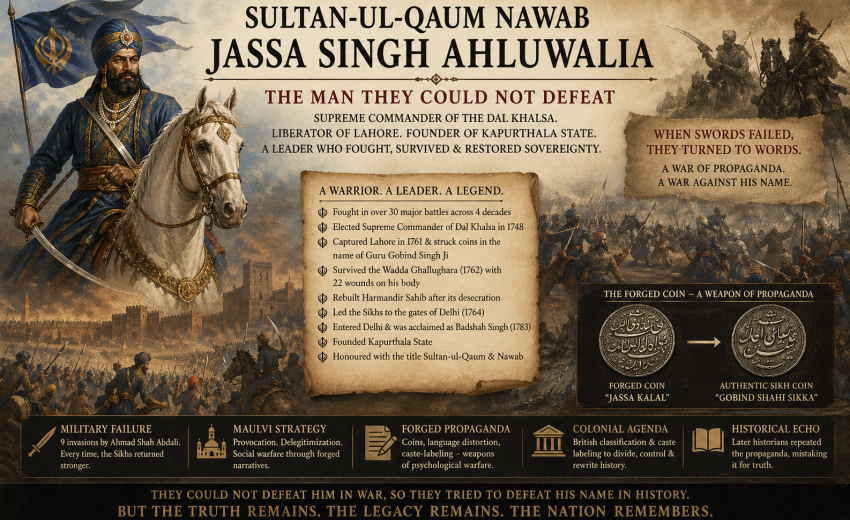

A Multi-Front Examination of British Colonial, Afghan, and Maulvi Strategies to Decimate an Unconquerable Leader An Integrated Historical Analysis of Military Defeat, Psychological Warfare, Coin Forgery, Linguistic Distortion, Colonial Caste-Classification, and the Deliberate Dismantling of a Sikh Sovereign's Legacy
SECTION VI: THE EVIDENCE THAT DESTROYS THE FALSE NARRATIVE
Let us now assemble the complete evidentiary case — integrating all the strands of analysis from the preceding sections — into a single, comprehensive, unanswerable catalogue of evidence that demolishes the false "Kalal" narrative. This evidence comes from multiple independent sources and multiple disciplines. Each piece alone raises serious doubt. Taken together, they are conclusive.
Evidence 1: The Earliest Source
The earliest biographical work on Jassa Singh Ahluwalia is Jassa Singh Binod, written by Sri Ram Sukh Rao. This work identifies his lineage as Rajput Bhatti — the same Bhatti Rajput lineage that ruled Jaisalmer. According to this tradition, one of the Bhatti Rajputs, Rana Har Rai, left the throne of Jaisalmer rather than submit to the Mughal emperor's demands, and migrated to Punjab, where his descendants settled and eventually founded the village of Ahlu. There is no mention of "Kalal" in this earliest source. The label appears only in later sources — sources that can be traced, directly or indirectly, to the forged coin and to colonial classifications.
Evidence 2: The Landownership Argument
Jassa Singh's family owned four villages: Ahlo, Hallo, Toor, and Chak. This is an established, undisputed fact in the historical record. A family that owns four villages is a landowning family — a family of established position, of resources, of standing in the community. The characterisation of this family as "poor Kalal" — poor liquor distillers — is not merely false; it is historically, socially, and logically impossible. Families engaged in liquor distillation did not own four villages. Landowning families of four villages were not classified among the lowest occupational groups. The two descriptions are mutually exclusive, and the documented landownership is the one that is independently verified.
Evidence 3: The Maternal Uncle
Jassa Singh's maternal uncle was known as Bagh Singh Hallowalia — not "Bagh Singh Kalal." If the maternal family identified as "Kalal," the maternal uncle's designation would reflect that identity. It does not. The maternal uncle's name — Hallowalia — proves that the maternal family identified by a geographic designation (from the village of Hallo), not by an occupational caste label. The "Kalal" designation was not used by the family. It was imposed from outside.
Evidence 4: The Mother's Spiritual Eminence
Mata Jeevan Kaur was not an obscure woman from a marginal family. She was an accomplished raag-based kirtaniya — a musician of the highest order who had mastered the complex system of classical Indian music as applied to Sikh devotional practice. She trained young Jassa Singh in Asa Di Vaar at the age of four. After his father's passing, she took him to Delhi, where Mata Sundri Ji — the revered wife of Guru Gobind Singh Ji — kept them in her personal care and household for seven years. This speaks to a family of considerable standing. Mata Sundri Ji was the most revered woman in the Sikh community of the early eighteenth century. She did not take into her personal household families of no standing. The seven years of education that young Jassa Singh received — literacy, Gurbani, kirtan, Rabab mastery, languages, administration, diplomacy, martial arts — were the education of a future leader, provided to a child from a family of recognised merit and position.
Evidence 5: The Education Argument
Seven years of education under Mata Sundri Ji's personal household in Delhi represents an extraordinary investment in a child's future. The breadth of this education — spiritual, musical, martial, administrative, linguistic, and diplomatic — is the education of someone who was expected to lead. Only a family of established lineage, of recognised spiritual devotion, and of substantial social connections would have had the access, the resources, and the standing to place their child in the personal household of the most revered woman in the Sikh community for seven years. The "poor Kalal" narrative is completely incompatible with this documented history.
Evidence 6: The Coin Evidence
The Sikh Encyclopedia — the most authoritative reference work on Sikh history — states explicitly that the coin bearing "Jassa Kalal" was likely "arranged to be struck by some religious leaders of Lahore for despatching it to Ahmad Shah Durrani with the intention of rousing his ire and early suppression of the Sikhs." The coin was not a Sikh coin. It was an enemy weapon. Every historical argument that rests on this coin as evidence of Jassa Singh's "identity" rests on a foundation of enemy propaganda.
Evidence 7: The Self-Identification Test
Neither Jassa Singh, nor his ancestors, nor his descendants, nor his maternal uncle, nor any early Sikh source ever used the label "Kalal" for this family. The family's self-identification was Ahluwalia — "of Ahluwal" — a geographic identity derived from their ancestral village. In any system of identity — legal, cultural, genealogical, or social — self-identification carries more weight than labels imposed by adversaries. The "Kalal" label fails the self-identification test completely.
Evidence 8: The Marriage Was Based on Gursikhi, Not Caste
Even the ancestral marriage connection to the Kalial family (note: Kalial, not Kalal) was contracted on the basis of Gursikhi — devotion to the Guru's path — not on the basis of caste or occupational identity. In the Sikh tradition of the seventeenth and eighteenth centuries, marriages were arranged between families on the basis of spiritual devotion, character, and service to the Panth. The marriage into a Kalial family was a recognition of that family's Gursikhi, not an adoption of an occupational identity. To reduce this spiritual bond to a caste classification is to fundamentally misunderstand the social world of early Sikh Punjab.
Furthermore, the question of whether the ancestral marriage was into the Kalial community or a community later mislabelled as “Kalal” remains a disputed historical point — but it is ultimately immaterial to the identity of the Ahluwalia family. Whether the connection was to the Kalial — a substantial Jat community with a significant presence across multiple regions of the Punjab and in nearly every province of present-day Pakistan, numbering in the tens of thousands — or to a family that later came to be called by the corrupted label “Kalal,” the nature of the marriage remains the same. It was contracted on the basis of the girl’s personal merits and the family’s standing as devoted Gursikhs — not on the basis of caste identity, which Sikh philosophy rejects as a criterion for human relationships. To reduce a marriage grounded in spiritual devotion and family merit to a caste classification is to impose a Hindu social framework upon a community that had explicitly and deliberately transcended it.
The evidence, taken as a whole, is not merely suggestive. It is conclusive. From every direction — numismatic, genealogical, linguistic, biographical, sociological, and historiographical — the "Kalal" narrative collapses. There is no early evidence for it. The physical artifact that appears to support it (the coin) has been identified as enemy propaganda by the most authoritative Sikh reference work. The family's documented landownership, maternal lineage, self-identification, spiritual standing, and educational history are all incompatible with it. And the forces that promoted it — the Maulvis, the Afghans, and the British — each had independent strategic reasons to fabricate it.
Evidence 9: The Ahluwalia Katra — Not “Kalal Katra”
One of the most powerful pieces of institutional evidence that demolishes the “Kalal” narrative is the Katra Ahluwalia in Amritsar — a planned and secured residential locality developed by Sardar Jassa Singh Ahluwalia himself, circa 1760, in the immediate vicinity of Sri Harmandir Sahib. This was not a minor settlement. It was a strategically designed urban quarter, built under the direct patronage and authority of Jassa Singh, intended to house his community, his soldiers, and the families connected to the Ahluwalia misl.
The name is Katra Ahluwalia. Not Katra Kalal. Not Katra Kalial. It was called Ahluwalia then, and it is called Ahluwalia now — more than two and a half centuries later. The locality still stands to this day, and its name has never once been recorded as anything other than Ahluwalia in any historical map, any revenue record, any British survey, or any administrative document. If the family’s true identity had been “Kalal,” then the residential quarter built under the personal authority of the man himself would have borne that name. It did not. It bore the name Ahluwalia — because that was who they were.
This is not a matter of interpretation. It is a matter of bricks, mortar, and the recorded name of a living locality that has endured for over 260 years. The Katra Ahluwalia is a physical monument to the identity that Jassa Singh chose, that his contemporaries recognised, and that history has preserved — undisturbed by the fabrications of later adversaries.
Evidence 10: The Ahluwalia Bunga — Not “Kalal Bunga”
During the eighteenth century, the Sikh misl chiefs and prominent Sikh leaders constructed Bungas — fortified dwelling structures — around Sri Harmandir Sahib in Amritsar. These Bungas served as rest houses for pilgrims, treasuries, military outposts, and centres of learning. Over seventy such Bungas of different shapes and forms were built around the Golden Temple complex during this period. Each Bunga bore the name of the misl or leader who constructed it: the Ramgarhia Bunga, the Akal Bunga, the Shaheed Bunga — and the Ahluwalia Bunga.
The Bunga constructed under the authority and patronage of the Ahluwalia misl was called the Ahluwalia Bunga — not the “Kalal Bunga.” This is a critical piece of evidence, and its significance cannot be overstated. The Bungas around Sri Harmandir Sahib were not named casually. They were named with deliberate institutional authority, recorded in contemporary accounts, and recognized by the entire Panth. If the family’s identity had truly been “Kalal,” the Bunga would have been known by that name. It was not. It was built, known, and recorded as the Ahluwalia Bunga — well before the “Kalal” label was manufactured by the family’s enemies.
Every single institution built by this family — every Katra, every Bunga, every fortification — bore the name Ahluwalia. The “Kalal” label was not part of the family’s institutional vocabulary, because it was not part of the family’s identity. It was introduced later, by adversaries, for strategic purposes — and unfortunately adopted by later historians who failed to question its origins.
Evidence 11: The Ahluwalia Misl — Not “Kalal Misl”
The Sikh confederacy led by Jassa Singh has been known throughout history as the Ahluwalia Misl — never as the “Kalal Misl.” This is not a marginal point. The twelve misls of the Sikh Confederacy were the fundamental political and military units of Sikh sovereignty in the eighteenth century. Each misl was named with precision, and those names carried sovereign weight. The Sukerchakia Misl, the Ramgarhia Misl, the Bhangi Misl, the Kanhaiya Misl — every misl bore a name that reflected its identity and origin. The misl led by Jassa Singh was called Ahluwalia, deriving its name from Ahlu, the ancestral village of the misl leaders.
No contemporary source — Sikh, Mughal, Afghan, Maratha, or British — ever referred to this confederacy as the “Kalal Misl.” The name Ahluwalia was the sovereign designation used in all treaties, all territorial records, all political correspondence, and all military engagements. If the “Kalal” identity had been genuine, it is inconceivable that a sovereign misl — recognised across the entire Punjab and beyond — would have been universally known by a different name. The misl was Ahluwalia because its leaders were Ahluwalia. The “Kalal” designation was a later fabrication that found no place in the political vocabulary of the eighteenth-century Punjab.
Evidence 12: All Correspondence — Signed as Ahluwalia, Never Kalal
Every piece of diplomatic and political correspondence involving Jassa Singh — whether with the British East India Company, with Afghan intermediaries, with Mughal officials, with Maratha allies, or with other Sikh misls — was conducted under the name Ahluwalia. There is no known letter, treaty, farmaan, or official communication in which Jassa Singh identified himself as “Kalal,” or in which any foreign power addressed him by that label.
This is a decisive evidentiary point. In the world of eighteenth-century diplomacy, names carried sovereign authority. A leader’s self-identification in official correspondence was the definitive statement of his political and personal identity. Jassa Singh signed as Ahluwalia. His successors signed as Ahluwalia. The British, who were meticulous record-keepers and who had every strategic reason to diminish Sikh leaders, nevertheless recorded his name as Ahluwalia in their official correspondence and administrative records. The “Kalal” label appears nowhere in the diplomatic record — because it was not part of the historical reality. It was introduced later, through channels that had nothing to do with the family’s own self representation.
Evidence 13: The Caste-Hypocrisy Argument — Liquor Distillation Was Universal, and the Hindu Varna System Did Not Distinguish Between Jats and Kalals
The entire foundation of the “Kalal” slander rests upon an association with liquor distillation — the implication being that Jassa Singh’s ancestors were engaged in the production of distilled spirits and therefore belonged to a community defined by that occupation. This argument collapses under even the most basic scrutiny, for two independent and equally devastating reasons.
First, the practice of home distillation of liquor — known locally as desi sharab or ghar di kaddi — was not confined to any single community in the Punjab. It was practised widely across the region, in virtually every village, by families of every background. Jat families, in particular, were extensively involved in the home distillation of liquor across Punjab for generations. This was not an occasional or marginal practice: it was a deeply embedded part of rural Punjabi life, referenced in folk culture, in music, and in the social customs of the countryside. If the label “Kalal” is to be applied to anyone who distilled liquor, then it must logically be applied to a vast number of Jat families as well — and indeed to much of rural Punjab. The selective application of this label to one family alone, while ignoring its universal practice across the region, reveals the label for what it truly is: not a description of occupation, but a weapon of targeted defamation.
Second — and this point must be stated with scholarly precision and without disrespect to any community — the attempt to use the “Kalal” label as a means of lowering Jassa Singh’s social standing depends upon a particular reading of the Hindu caste hierarchy. But that very hierarchy, when examined honestly, does not support the intended conclusion. Within the traditional Hindu varna system, the Jat community itself was never classified among the “twice-born” (dvija) varnas — that is, the Brahmins, Kshatriyas, and Vaishyas who undergo the sacred thread ceremony. The classical Hindu texts did not place Jats in the Kshatriya varna; various British colonial census records and Hindu legal texts classified Jats alongside the Shudra varna — the same broad category to which Kalals were assigned. In the rigid framework of the Hindu caste hierarchy, Jats and Kalals occupied broadly comparable positions — neither community held the exalted RajputBhatti or Kshatriya status.
This is not stated to diminish any community. It is stated to expose the logical absurdity of the “Kalal” slander. The enemies of Jassa Singh attempted to lower his standing by associating him with a “Kalal” identity — but the very caste framework they invoked to achieve this purpose would have classified Jats in a comparable position. The entire argument is self-defeating. It only succeeds if one accepts the Hindu caste hierarchy as a valid measure of human worth — which Sikh philosophy emphatically and categorically rejects.
This brings us to the deepest irony of the entire “Kalal” narrative. The Sikh Gurus, from Guru Nanak Dev Ji onwards, rejected the caste system in its entirety. Guru Gobind Singh Ji’s creation of the Khalsa in 1699 was a revolutionary act precisely because it abolished caste distinctions. A Sikh leader’s worth was measured by devotion, courage, and service to the Panth — not by the occupation of a distant ancestor. The very attempt to classify Jassa Singh by caste — any caste — is a violation of the foundational principles of Sikhi. And the fact that the communities being invoked for comparison occupy similar positions within the Hindu hierarchy only underscores the intellectual bankruptcy of the entire enterprise.