
Voices of Shabad: An Introduction by GAAVANI
In honor of the 350th commemorative year of Guru Tegh Bahadur, GAAVANI is presenting a special essay series on SikhNet featuring reflections from Sikh women on their journeys with Sikh spirituality and the living presence of the Guru’s Shabad.
Following the first reflection in this series, we now share the second essay, continuing the exploration of how Gurbani becomes more than something to revere from afar, it becomes a companion, guide, and source of wisdom in everyday life.
Launched on International Women's Day (March 8), a new essay from this collection will be shared every two days, inviting the Sangat to reflect on a living relationship with the Guru’s Shabad.
The Thirst That Remains
The Journey
There were years of disconnection. Years of wandering. I had learned how to live with a quiet emptiness and not name it. And then something shifted. Longing entered.
When I heard the Sabad, perhaps truly heard it for the first time, I cried. Not because I understood it. Not because I could explain it. It was the first line:
ਮੇਰਾ ਮਨੁਲੋਚੈਗੁਰ ਦਰਸਨ ਤਾਈ ॥
My mind pines for Guru’s vision.
I did not receive it as a metaphor. It felt literal. The yearning carried weight. It unsettled my days and followed me into the night. I was searching then across traditions and practices because, somewhere within, I knew that the One was not an idea to be studied but a Presence to be experienced.
It was an ache that unsettled the life I had carefully constructed. Nothing outward was collapsing, yet everything felt rearranged inwardly. It was not something I chose. It arrived. It interrupted. It asked for everything. There are moments in life when you do not reason your way forward. You leave what feels familiar and begin walking toward something you cannot yet name. And that walking costs. There is always a price. I did not understand it. I only knew I could not ignore it.
Slowly, relationships shifted. Priorities rearranged themselves quietly but unmistakably. What once felt urgent loosened its hold. What I wanted to read, where I wanted to sit, how I wanted to spend my hours, all of it began bending in one direction. I would not have named it devotion then. I only knew that my axis had changed.
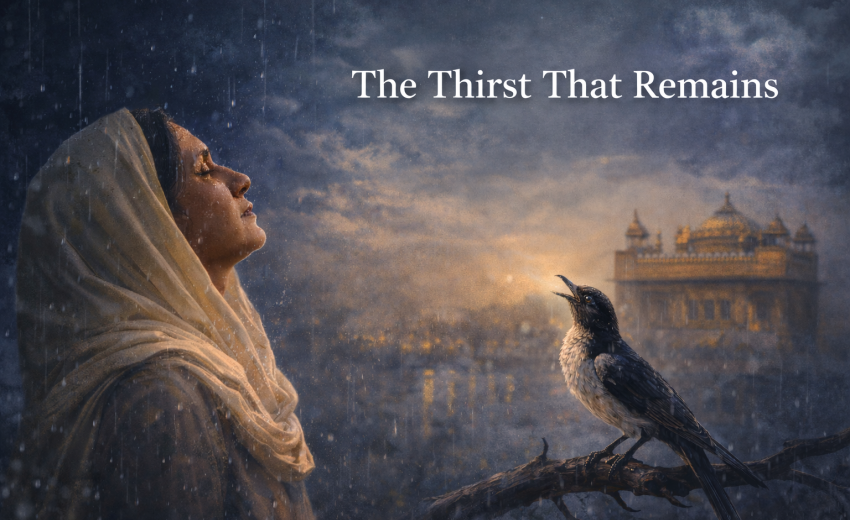
When I encountered the image of the chatrik, I did not analyze it. I saw it. I have always been a visualizer, and that bird became real to me. A small creature refusing the water pooled on earth, waiting only for that particular raindrop as it falls from the sky. There was something fierce in that refusal. I recognized the danger in it. Once the heart tastes that kind of longing, nothing else truly satisfies. I was no longer willing to sip from whatever was available simply to quiet the thirst. The bird, and the woman I was becoming, wanted the real thing. Even if that meant waiting. Even if that meant remaining thirsty.
I feel the agony of, “One moment without meeting You becomes like the age of ignorance.” At first, I thought this must be an exaggeration. How could a single moment stretch into an age? But longing changes the measure of time. There are times when the Presence feels near, when breath and remembrance move together naturally and without effort. In those moments, something within settles. Nothing feels torn. Nothing feels out of place.
And then there are times when something feels displaced. Nothing dramatic announces it. No crisis declares itself. Yet inwardly something is missing. I move through the day as usual, speaking, working, responding. Beneath it all, I sense the absence. I find myself asking, Why do I not feel alive in the same way? What has shifted? Where did that nearness go?
It is then that the longing deepens.
Discovering the Immortal within the home-heart is what I yearn for, what I continue to long for. I cannot claim it as something achieved. And yet there have been moments when something within grows still, and the nearness feels unmistakable. I do not hold on to those moments. They come, and they pass. What remains is the longing itself. The sweetness lies not in possession, but in turning. Again and again, the heart turns toward what it knows is already near.
Perhaps this is what the journey has been teaching me: that the longing itself becomes the path. The turning now happens quietly within, often without words. I do not know what it means to never part, even for an instant. I only know that when the heart turns, the nearness is felt again.
The thirst remains.
And perhaps that is grace. Not that it has been quenched, but that it continues.