
Sultan-ul-Qaum: Nawab Jassa Singh Ahluwalia
The Warrior-Saint Who Forged a Nation from the Ashes of Genocide"
A Special Birthday Tribute — 3 May 2026 — 308th Birth Anniversary
"As the Harmandir Sahib was blown to pieces by the Durranis, So Jassa Singh had it rebuilt again. Destroying the Afghans, he threw them out from Punjab. Countless captive men and women, he freed."
— Giani Gian Singh, Panth Prakash (1880)
Section I
The Architect of Khalsa Sovereignty
In the blood-soaked annals of the eighteenth century, no landscape endured more sustained and savage violence than the Punjab. The once-mighty Mughal Empire was collapsing like a rotten edifice, its provinces gnawed at by warlords, its treasury emptied by corruption, its throne a revolving door of fratricide. Into this vacuum of power stepped Ahmad Shah Abdali — later styled Durrani — the Afghan conqueror who would launch no fewer than nine devastating invasions of India between 1747 and 1769. Each incursion left behind a trail of razed cities, plundered temples, and enslaved populations. The Punjab, gateway to the subcontinent, absorbed the full fury of these campaigns. Lahore was sacked repeatedly. The great cities of Sirhind and Jalandhar were burned. Sacred shrines — Hindu and Sikh alike — were desecrated with calculated cruelty. Bounties were placed on Sikh heads: a price for every scalp, every braid of unshorn hair brought before a Mughal or Afghan governor. The Sikhs were hunted like animals through the forests and marshes of central Punjab.
It was in this crucible of annihilation that the Sikh people coined a word previously unknown to human language: Ghallughara — Holocaust. Not once but twice in a single generation, the Khalsa endured systematic campaigns of extermination — the Chhota Ghallughara of 1746, in which seven to ten thousand Sikhs perished, and the Vadda Ghallughara of February 1762, in which twenty to fifty thousand men, women, and children were butchered across a forty-five-kilometer stretch of countryside. The intention was genocide — the total and permanent erasure of Sikhism from the face of the earth.
And yet the Khalsa did not perish. It rose again. It rose because of one man above all others — a man born in the small village of Ahlu near Lahore on the third of May 1718, orphaned at the age of four, raised on devotional music in the household of Mata Sundri Ji, the wife of Guru Gobind Singh himself. His name was Jassa Singh. History would know him by many titles: Sultan-ul-Qaum — King of the Nation; Supreme Commander of the Dal Khalsa; Jathedar of the Akal Takht; 4th Jathedar of the Buddha Dal; and Founder of the Kapurthala State. But to the thousands of freed captive women he returned to their families, to the villagers who sheltered under his Rakhi system, to the warriors who followed his battle-cry across thirty major engagements — he was simply the man who refused to let the flame of the Khalsa be extinguished.
Over a career spanning more than five decades of continuous warfare, Jassa Singh Ahluwalia fought in over thirty major battles, survived two genocides, personally contributed nine lakhs of rupees toward the rebuilding of the Harmandir Sahib, liberated thousands of captive women irrespective of their faith, established the Rakhi revenue-protection system across four of Punjab's five doabs, captured Lahore and asserted Khalsa sovereignty, and constructed the political and military architecture upon which Maharaja Ranjit Singh would later build the Sikh Empire. His life was meticulously recorded by Ram Sukh Rao, a Brahman scholar in the Kapurthala household, in the Sri Jassa Singh Binod — a manuscript of 250 folios preserved in the Punjab State Archives at Patiala (MS M/772).
On the occasion of his 308th birth anniversary, we present this tribute — not merely as a recollection of dates and battles, but as a reckoning with the extraordinary moral vision that animated every act of this warrior-saint's life. This is the story of the orphaned boy who sang hymns at dawn and answered alone in the storm — and who, by the grace of the Almighty, became the king of a nation that refused to die.
❖ ❖ ❖
Section II
Ancestral Roots and the Prophecy of Greatness
The story of the Ahluwalia family begins not in the corridors of power but in the fields of devotion. Sadda Singh — also known in various sources as Sadho or Sadao — was a devout disciple of Sri Guru Hargobind Sahib Ji, the sixth Sikh Guru, who transformed the Sikh community into a martial as well as a spiritual force. Sadda Singh founded the village of Ahlu near Lahore, and from this village the family derived its name: Ahluwalia, meaning "of Ahlu." His forefathers were landlords who were rewarded four villages — Ahlo, Hallo, Toor, and Chak — for their bravery in war. It was in Ahlu that the family settled and maintained the twin traditions of Sikh devotion and martial valor across generations.
The village of Ahlu lay near the great city of Lahore, in the heartland of the Punjab, where the five rivers braided through the alluvial plains and where the Sikh faith had taken its deepest root. For generations, the Ahluwalia family maintained the twin traditions of Sikh devotion and martial readiness that defined the Khalsa spirit. They were landlords and farmers, but they were also men of the sword — men who understood that in the Punjab of the seventeenth and eighteenth centuries, faith without the capacity for its defense was a candle in a hurricane.
It was into this lineage of warrior-devotees that Sardar Badar Singh was born. Badar Singh — also rendered as Bidar Singh in some sources — was a pious Sikh who yearned for a son to carry forward the family's traditions. According to the oral traditions preserved in the Sri Jassa Singh Binod and other accounts, Badar Singh sought the blessings of Guru Gobind Singh Ji — the tenth and final human Guru of the Sikhs — for the gift of a child. Whether this meeting occurred in person or through the agency of prayer and pilgrimage, the tradition is unanimous in its assertion: the child who was born to Badar Singh on the 3rd of May 1718 — the day of Baisakh Sudi Puranmashi, 1775 Bikrami — was a child of destiny.
The year of Jassa Singh's birth is itself significant. It fell just two years after the execution of Banda Singh Bahadur in 1716 — the warrior whom Guru Gobind Singh had dispatched to Punjab to establish Sikh sovereignty and avenge the martyrdom of his youngest sons. Banda Singh had briefly established a Sikh state, minted his own coins and administering justice from his capital at Lohgarh. But the combined might of the Mughal Empire had executed him in Delhi — along with hundreds of his followers, tortured and killed over several days — had plunged the Khalsa into its darkest hour. The infant born at Ahlu in 1718 would spend his entire life completing the work that Banda Singh had begun.
❖ ❖ ❖
Section III
Orphaned Childhood and the Blessings of Mata Sundri Ji
Tragedy struck the Ahluwalia family in 1723, when Sardar Badar Singh died, leaving behind a widow and a son barely four years of age. The Punjab of 1723 was no place for a fatherless Sikh family. The Mughal authorities, emboldened by the destruction of Banda Singh Bahadur's movement, had resumed their persecution of the Khalsa with renewed ferocity. Sikh men were hunted, Sikh women and children enslaved, and the very practice of the Sikh faith was a capital offence in the territories administered by the Mughal governors of Lahore and Sirhind.
Jassa Singh's mother Mata Jeevan Kaur— a woman of profound faith and extraordinary courage made a decision that would alter the course of Sikh history. She took her young son to Delhi, to the household of Mata Sundri Ji, the revered wife of Guru Gobind Singh Ji. Mata Sundri occupied a singular position in the Sikh world of the early eighteenth century: she was the living link to the Guru, the custodian of his legacy, and the spiritual mother of the entire Khalsa Panth. From her residence in Delhi, she issued Hukamnamas (edicts), resolved disputes, and guided the scattered and persecuted community through its darkest trials.
For seven years — from 1723 to approximately 1729 or 1730 — the young Jassa Singh lived and grew in the care of Mata Sundri Ji. These were the formative years that shaped the man he would become. In Mata Sundri's household, Jassa Singh was immersed in the recitation of Gurbani — the sacred scripture of the Sikhs. He learned Kirtan — devotional singing — of the highest order, and his voice and his mastery of the Rabab, the stringed instrument sacred to the Sikh tradition since the days of Bhai Mardana (companion of Guru Nanak), became renowned even in childhood. He also received education in Urdu and Persian — the languages of administration and diplomacy in Mughal India — skills that would serve him well in his later career as a statesman and military commander.
But the most consequential event of Jassa Singh's time in Delhi was the prophecy uttered by Mata Sundri Ji herself. Moved by the child's devotion, his intelligence, and his unmistakable aura of destiny, Mata Sundri declared: "Jassa Singh will become a ruler of men."
Before his departure from Delhi, Mata Sundri Ji bestowed upon the young Jassa Singh a full complement of weapons and accoutrements: a sword, a mace, a shield, a bow, a quiver of arrows, a dress of honour, and a silver staff. This was no by the spiritual authority of the Guru's household. ordinary gift — it was a symbolic investiture, a commissioning of a future sovereign by the spiritual authority of the Guru's household.
— Based on accounts in Sri Jassa Singh Binod and Sikh oral tradition
At the age of approximately twelve, Jassa Singh and his mother returned to Punjab at the urging of his maternal uncle, Bagh Singh. They settled in the vicinity of Jalandhar, in the Doaba region, where they resumed the practice of early-morning Kirtan. But the boy who returned from Delhi was no longer merely an orphan. He carried with him the blessing of Mata Sundri Ji, the weapons she had bestowed, and the unshakeable conviction that the Khalsa would prevail.
❖ ❖ ❖
Section IV
The Spiritual Foundation: Kirtania and Rabab Master
Before Jassa Singh Ahluwalia was a conqueror of cities, he was a singer of hymns. This fact, often overlooked in accounts that emphasize his military career, is essential to understanding the man and the tradition he embodied. In the Sikh conception of the ideal human being — the Sant-Sipahi, the saint-soldier — spiritual discipline and martial valour are not opposites to be reconciled but twin expressions of a single devotion. The same hand that lifts the sword in defense of the oppressed also lifts the voice in praise of the Creator. Jassa Singh was the supreme exemplar of this ideal.
His mastery of the Rabab — the sacred stringed instrument played by Bhai Mardana, the beloved companion of Guru Nanak Dev Ji — was legendary. The Rabab occupied a unique place in Sikh musical tradition: it was the instrument upon which the first Gurbani was set to music, and its sound was considered a direct echo of the divine Shabad (Word). To play the Rabab with mastery was not merely an artistic accomplishment; it was an act of devotion, a form of prayer in sound.
Jassa Singh performed Kirtan at Amrit Vela — the ambrosial hours before dawn, the time prescribed by Sikh tradition for meditation and devotional practice. Throughout his life, even during the most demanding military campaigns, he maintained this practice. Soldiers who fought under his command would speak of hearing the Rabab in the hours before battle, its melody drifting through the camp like a benediction.
The defining encounter of Jassa Singh's youth occurred at Kartarpur, where the young Kirtania, accompanied by his mother and uncle, stopped to pay their respects to Nawab Kapur Singh, the most revered Sikh leader of the age. It was during the early morning recitation of Asa di Var — the great hymn of Guru Nanak — that Jassa Singh's sublime melody moved Nawab Kapur Singh to tears. The old warrior, who had seen decades of battle and persecution, was so deeply moved by the spiritual power of the boy's Kirtan that he persuaded the family to stay for one month. During that month, Kapur Singh observed the young man closely and recognized in him the qualities of both a spiritual adept and a future leader. The Nawab adopted Jassa Singh, a decision that would shape the destiny of the entire Sikh nation.
It is also believed by several scholars that during his formative years, Jassa Singh may have received Gurbani education and spiritual guidance from Bhai Mani Singh Ji, the great Sikh scholar and martyr who served as the Granthi of the Harmandir Sahib. If this tradition is accurate, then Jassa Singh's spiritual lineage connected him directly to the inner circle of the Gurus — through Mata Sundri, through Bhai Mani Singh, and through the Rabab tradition of Bhai Mardana.
In later years, Jassa Singh would patronize the famous Kapurthala Rababi Gharana — a school of sacred music that preserved and transmitted the ancient melodies of the Gurbani Kirtan tradition. The warrior who conquered Lahore never ceased to be the Kirtankaar who sang at dawn. The singing and the sword-wielding were, for him, one and the same act of love.
❖ ❖ ❖
Section V
Mentorship Under Nawab Kapur Singh
The years of Jassa Singh's training under Nawab Kapur Singh — spanning approximately from 1729 to 1753 — constitute one of the great master-disciple relationships in Indian history. Kapur Singh was no ordinary mentor. He was the acknowledged leader of the Sikh Panth, elected by the Sarbat Khalsa (the assembly of the entire community) in 1733, after the Mughal governor Zakariya Khan attempted to pacify the Sikhs by offering them a jagir (land grant) and the title of Nawab. Kapur Singh accepted the title on behalf of the Panth — not for personal aggrandizement but as a recognition of Sikh sovereignty — and promptly used the resources to strengthen the Khalsa's military capability.
Under Kapur Singh's tutelage, Jassa Singh received comprehensive training in the arts of war and statecraft. He learned horseback riding from expert horsemen, swordsmanship from master fencers, and archery from the finest bowmen of the Punjab. But more importantly, he learned the guerrilla warfare tactics that were the Khalsa's primary military innovation — the dhai phat strategy of lightning strikes and rapid withdrawal, the use of forests and marshlands as natural fortresses, the exploitation of the enemy's supply lines, and the art of turning strategic retreat into tactical advantage. One anecdote from this period has been preserved in multiple sources and captures the essence of Jassa Singh's character. On a stormy night, when rain lashed the Sikh encampment and thunder shook the earth, Nawab Kapur Singh called out to the watch guards to confirm that the perimeter was secure. Voice after voice should have answered from the various sentry posts around the camp. But only one voice answered — Jassa Singh's. He was the sole sentinel who had not abandoned his post in the face of the storm. Every other guard had sought shelter. Jassa Singh alone stood in the rain, faithful to his duty.
In that single moment — a young man standing alone in a storm, answering his commander's call while every other sentinel had fled — Nawab Kapur Singh saw the future of the Khalsa. He recognized that this was the man to whom the entire Panth could be entrusted.
— Oral tradition, multiple sources
From that night forward, Kapur Singh increasingly designated Jassa Singh for positions of responsibility and command. He recognized in his adopted protégé not only physical courage and martial skill but also the rarer qualities of impartiality, selflessness, and the capacity for democratic leadership that the Khalsa's unique political structure demanded.
Nawab Kapur Singh died on either the 7th or 9th of October, 1753. Before his death, he formally transferred the leadership of the Khalsa to Jassa Singh Ahluwalia. The transfer was not a dynastic succession — the Khalsa recognized no hereditary authority — but a recommendation ratified by the will of the Sarbat Khalsa. Jassa Singh, at the age of thirty-five, became the Supreme Commander of the Dal Khalsa, the Jathedar of the Akal Takht, and the 4th Jathedar of the Buddha Dal. The orphan from Ahlu had become the king of a nation of warriors.
❖ ❖ ❖
Section VI
Formation of the Dal Khalsa: Architect of Sikh Unity
The political and military achievement that most clearly demonstrates Jassa Singh Ahluwalia's genius is the formation and consolidation of the Dal Khalsa — the Grand Army of the Sikh Commonwealth. On the auspicious occasion of Baisakhi 1748, a Sarbat Khalsa was convened at Amritsar, and the assembled representatives of the Sikh community took a decision of epoch-making significance: the sixty-five separate jathas (bands) of Sikh warriors scattered across the Punjab were consolidated into a single unified military force — the Dal Khalsa.
The organizational structure of the Dal Khalsa, conceived originally by Nawab Kapur Singh and perfected under Jassa Singh, was a masterpiece of military and political design. It was divided into two main wings: the Taruna Dal, composed of younger warriors under the age of forty, who formed the vanguard in battle and conducted the most aggressive offensive operations; and the Budha Dal, composed of veteran warriors over forty, who served as the strategic reserve, guarded the sacred shrines, and provided the institutional memory of the Khalsa.
Within this structure, eleven Misls were created — each with its own name, flag (Nishan Sahib), leader (Misldar), and designated territory. The Misls were simultaneously military units, administrative districts, and political constituencies. They operated with considerable autonomy in their own territories but submitted to the collective authority of the Sarbat Khalsa and the supreme command of the Dal's elected leader in times of war.
The Twelve Misls of the Sikh Confederacy
Misl : Misldar (Founder/Notable Leader)
Ahluwalia: Jassa Singh Ahluwalia
Sukerchakia: Charat Singh (grandfather of Maharaja Ranjit Singh)
Bhangi: Hari Singh Bhangi
Kanhaiya: Jai Singh Kanhaiya
Ramgarhia: Jassa Singh Ramgarhia Phulkian: Ala Singh (founder of Patiala)
Nakkai: Hira Singh Nakkai
Dallewalia: Gulab Singh Dallewalia
Singhpuria: Nawab Kapur Singh
Shaheed: Baba Deep Singh Shaheed
Nishanwalia: Dasaundha Singh
Kror Singhia (Faizullapuria): Nawab Kapoor Singh
At the Baisakhi assembly, Jassa Singh Ahluwalia was democratically elected as the Supreme Commander of the Dal Khalsa. Multiple historical sources attest that this appointment was "one of the greatest honours ever bestowed in the eighteenth century to any Sikh." The significance of this election cannot be overstated. In an age when sovereignty across Asia was determined by hereditary succession, military conquest, or divine-right claims, the Sikh Confederacy chose its supreme leader through a process of collective deliberation and democratic assent. This confederate structure, democratic in character and egalitarian in ethos, was revolutionary for eighteenth-century Asia and, in important respects, predated many of the democratic institutions that Europeans would establish only after the French Revolution of 1789.
In 1754, the Sikh Confederacy conferred upon Jassa Singh the title of "Nawab" at Amritsar, following the passing of Nawab Kapur Singh. This was not an imitation of Mughal aristocratic titles but a deliberate appropriation — a declaration that the Khalsa now exercised sovereign authority over its own territories and recognized no external overlord.
❖ ❖ ❖
Section VII
Sultan-ul-Qaum: King of the Nation
Of all the titles born by Jassa Singh Ahluwalia, none captures the essence of his leadership more profoundly than Sultan-ul-Qaum — King of the Nation. This title, composed of two words of Arabic origin, carries a double weight of meaning. Sultan signifies sovereign power — the legitimate exercise of political authority. Qaum signifies the nation, the people, the collective body of the community. Together, they declare that Jassa Singh's sovereignty derived not from conquest or birth but from the will of the nation he served.
The title was conferred by the democratic will of the Sarbat Khalsa — the general assembly of the Sikh community — and it carried with it both supreme authority and supreme responsibility. No other Sikh leader in the history of the Misl period held this distinction. Jassa Singh was primus inter pares — first among equals — a leader who commanded absolute loyalty in battle but who remained, in the Sikh political imagination, a servant of the Panth.
His exercise of this authority was marked by a quality rare among eighteenth-century rulers of any civilization: impartiality. When disputes arose between the various Misls — as they inevitably did, given the competitive energies of ambitious chieftains — it was Jassa Singh who adjudicated. His rulings were accepted because all parties recognized that he favored no Misl over another, sought no territorial advantage for himself, and judged every case on its merits according to the principles of the Khalsa.
The instrument of collective decision-making through which Jassa Singh governed was the Gurmata — a resolution passed by the Sarbat Khalsa, binding upon all members of the community, including the Supreme Commander himself. The Gurmata system was the Khalsa's parliament: issues of war and peace, taxation and revenue, territorial disputes and diplomatic relations were debated, decided, and codified through this process. Jassa Singh's genius lay not in overriding this system but in making pg. 12 it work — in building consensus among fiercely independent chieftains, in translating collective decisions into coordinated military action, and in subordinating his own considerable personal authority to the democratic will of the Panth.
He never called himself Badshah — emperor. He never sought to establish a dynasty. When the Khalsa captured Lahore, Jassa Singh attributed sovereignty not to himself but to the Guru and to the Khalsa Panth collectively. In an age of ego and empire, Jassa Singh Ahluwalia remains one of history's most extraordinary examples of power exercised in the service of a cause greater than the self.
❖ ❖ ❖
Section VIII
The Colossus: Physical Stature and Warrior Presence
The historical sources — both Sikh and hostile — concur in depicting Jassa Singh Ahluwalia as a man of extraordinary physical presence. Ram Sukh Rao, the author of the Sri Jassa Singh Binod, provides an account of his daily diet that borders on the mythic: one ser (approximately one kilogram) of ghee, four ser of brown sugar (shakar), and an entire goat consumed at breakfast. His weight, according to Ram Sukh Rao, was eight maunds — approximately three hundred kilograms. While this figure is clearly a literary exaggeration in the hagiographic tradition — intended to convey the hero's superhuman dimensions rather than a literal measurement — its very extravagance points to an underlying reality: Jassa Singh was a physically massive and imposing figure, a man whose presence on the battlefield was unmistakable and whose appearance struck awe into both friend and foe.
This impression is independently confirmed by one of the most remarkable documents of eighteenthcentury Punjabi history — the Jangnama written by Qazi Nur Muhammad in 1765. Nur Muhammad was an Afghan chronicler who accompanied Ahmad Shah Abdali's forces and who held the Sikhs in open contempt, referring to them consistently as "dogs" and worse. His testimony is therefore hostile, making his description of Jassa Singh all the more significant as an involuntary witness to the Sikh leader's grandeur:
"From the other side, the dogs [Sikhs] were also coming forward with their wellarrayed army, with Jassa [Singh] like a mountain in the middle."
— Qazi Nur Muhammad, Jangnama (1765)
The convergence of these two sources — one friendly, one hostile — in their depiction of Jassa Singh as a figure of mountainous physical presence provides strong evidence that his stature was indeed extraordinary. In an age when military leadership was exercised from the front, when a commander's physical visibility on the battlefield was essential to the morale of his troops, Jassa Singh's imposing frame and towering presence were weapons in their own right. When the warriors of the Dal Khalsa looked to the center of the battle line and saw their Sultan-ul-Qaum — immovable, unbreakable, "like a mountain" — they knew that the Khalsa would not fall that day.
❖ ❖ ❖
Section IX
The Crucible of Fire: Afghan Invasions and the Ghallughara
No account of Jassa Singh Ahluwalia's life can be understood apart from the catastrophic backdrop against which it unfolded: the nine invasions of Ahmad Shah Abdali between 1747 and 1769, and the two genocidal campaigns — the Ghallugharas — that represent the darkest chapters in Sikh history.
The Chhota Ghallughara (1746)
The first systematic campaign of extermination was launched not by the Afghans but by the Mughal authorities of Lahore. In 1746, Lakhpat Rai, the Diwan (chief minister) of the Mughal governor Yahiya Khan, launched a massive sweep against the Sikhs of the Punjab in retaliation for the killing of his brother Jaspat Rai by Sikh forces. Lakhpat Rai assembled an army of over thirty thousand men and drove the Sikhs into the marshy forests near Kahnuwan, where he surrounded them and unleashed a campaign of slaughter. Between seven and ten thousand Sikhs — men, women, and children — were massacred in what came to be known as the Chhota Ghallughara — the Lesser Holocaust. Hundreds more were captured and publicly executed in Lahore. Jassa Singh, by then a young warrior in his late twenties, fought through this catastrophe and survived.
The Persecution Under Mir Mannu (1748-1753)
The years that followed were scarcely less terrible. Mir Mannu (Muin-ul-Mulk), the Mughal governor of Lahore, conducted a sustained campaign of persecution against the Sikhs. He placed bounties on Sikh heads: any person who brought a Sikh scalp to the governor's court received a cash reward. Sikh women and children were imprisoned in the notorious Lahore jail, where infant children were murdered before their mothers' eyes. The Sikh women, with incomprehensible courage, turned even this horror into defiance, singing: "Mannu is our sickle, we are the grass; the more he mows us, the more we grow."
The Vadda Ghallughara (5 February 1762)
The greatest catastrophe came on the 5th of February 1762. Ahmad Shah Abdali, determined to annihilate the Sikhs once and for all, caught the moving vahir (column) of the Dal Khalsa — including thousands of non-combatants, women, children, and elderly — at Kup-Rahira, near Malerkotla. The Sikhs were encumbered by their baggage train and could not employ their usual guerrilla tactics. Abdali's forces, vastly superior in number and armament, fell upon the column with devastating force.
The carnage stretched across a forty-five-to-fifty-kilometre route, from Kup-Rahira through the villages of Kutba, Bahmania, Gehal, and Hathur, toward Barnala. Estimates of the Sikh dead range from twenty thousand to fifty thousand — perhaps one-third to one-half of the entire Sikh population. Jassa Singh Ahluwalia, commanding the fighting retreat, was wounded — some sources say he received as many as twenty-two wounds — but he never abandoned his post. He continued directing the defense, organizing the rearguard, and protecting the non-combatants even as the massacre unfolded around him.
"Fighting while moving and moving while fighting, they kept the vahir marching, covering it as a hen covers its chickens under its wings."
— Ratan Singh Bhangu, Prachin Panth Prakash
The Vadda Ghallughara was intended to be the final solution — the end of the Sikhs as a people and a faith. Ahmad Shah Abdali boasted that the Sikhs had been destroyed forever. He was catastrophically wrong. Within three months of the massacre, Jassa Singh Ahluwalia had regrouped the surviving warriors of the Dal Khalsa, launched attacks against Zain Khan (the Afghan governor of Sirhind), and resumed military operations across the Punjab. The speed and completeness of this recovery remains one of the most extraordinary feats of resilience in world military history.
A Nihang warrior, surveying the survivors after the Ghallughara, is reported to have declared with grim satisfaction: "The weak have been shed. The true Khalsa remains intact."
❖ ❖ ❖
Section X
Champion of Human Rights: Liberator of Captive Women
If Jassa Singh Ahluwalia's military campaigns secured the survival of the Khalsa, his rescue of captive women secured his place in the moral history of humanity. No aspect of his legacy speaks more powerfully to the Sikh ideal of Sarbat da Bhala — the welfare of all — than his repeated and systematic efforts to liberate enslaved women and return them to their families, regardless of their religious faith.
The Rescue from Nadir Shah's Columns (1739)
The first major rescue operation in which the young Jassa Singh participated occurred in 1739, during the retreat of the Persian conqueror Nadir Shah from Delhi. Nadir Shah had sacked Delhi with a pg. 16 savagery that shocked even the hardened sensibilities of the eighteenth century, and he was returning to Persia with an immense train of plunder that included thousands of captive Indian women. No Mughal army dared challenge him. No Rajput prince moved to intercept. No Maratha force rode out. No Jat chieftain raised a finger. Only the Khalsa — scattered, outlawed, hunted — dared to strike. Sikh raiding parties attacked Nadir Shah's retreating columns, freeing captive women and returning them to their families.
The Liberation after Panipat (1761)
The most dramatic and consequential rescue operation came in the aftermath of the Third Battle of Panipat on 14 January 1761, in which Ahmad Shah Abdali's Afghan forces annihilated the Maratha Confederacy's army. In the wake of this catastrophic Maratha defeat, Abdali's forces retreated toward Afghanistan carrying approximately 2,200 captive Hindu women — young girls, mothers, wives — destined for the slave markets of Kabul, Kandahar, and Ghazni, where Indian women fetched high prices.
Jassa Singh Ahluwalia struck "like lightning." Leading the Dal Khalsa in a series of rapid attacks on Abdali's retreating columns, he liberated all of the captive women. But what happened next is what elevates this act from military daring to moral greatness: every woman was returned to her family with full honour. Hindu women were returned to Hindu families. Muslim women were returned to Muslim families. No woman was retained, exploited, or dishonoured. No ransom was demanded. No conversion was attempted. The women were simply freed and sent home.
"When the Afghan invaders retreated with thousands of captive Hindu and Muslim women, no army in India dared to challenge them. It was the Khalsa alone — under the command of Jassa Singh Ahluwalia — that attacked the retreating columns, liberated the women, and restored them to their families with full honour. This was Sarbat da Bhala — the welfare of all humanity — translated from scripture into action."
— Based on accounts in multiple historical sources
In the entire eighteenth-century history of the Indian subcontinent, no comparable act of humanitarian intervention exists. The Sikhs, who were themselves the targets of genocide, risked their lives to free women of other faiths from enslavement. This was not opportunism — the Khalsa gained no territory, no revenue, and no political advantage from these rescues. It was the purest expression of the moral vision that Guru Nanak had articulated two centuries earlier: "Nanak naam charhdi kala, tere bhane sarbat da bhala" — in the Name of God, may the spirit forever soar high, and may all of creation be blessed by Your will.
❖ ❖ ❖
Section XI
The Capture of Lahore and the Assertion of Sovereignty (1761)
The Third Battle of Panipat, fought on 14 January 1761, shattered the Maratha Confederacy's power in northern India and left a vast political vacuum. Ahmad Shah Abdali, exhausted by his own victory and harassed by Sikh guerrilla attacks, could not consolidate his hold on the Punjab. His Afghan garrisons were isolated, demoralized, and vulnerable. Jassa Singh Ahluwalia perceived the strategic opportunity with the eye of a master statesman.
In the months following Panipat, the Dal Khalsa launched a systematic campaign to dismantle Afghan authority across the Punjab. Charat Singh Sukerchakia routed the Afghan commander Nuruddin at Sialkot. Combined Sikh forces surrounded and defeated Khwaja Obed Khan, the Afghan governor of Lahore, near Gujranwala. One by one, the pillars of Afghan control were knocked down.
The fateful decision came at the Sarbat Khalsa convened at Amritsar on the occasion of Diwali, 27 October 1761. By a Gurmata — a collective resolution binding upon all — the assembled Khalsa under the leadership of Jassa Singh Ahluwalia resolved to march on Lahore itself. The ancient capital of the Punjab, seat of Mughal governors and Afghan overlords for centuries, was to become the capital of a Sikh sovereign state.
Lahore fell to the Dal Khalsa. For the first time in approximately seven hundred and fifty years, the Punjab was governed by a non-Muslim sovereign power. The significance of this achievement — accomplished by a community that had been hunted nearly to extinction just months earlier — is almost impossible to overstate.
The capture of Lahore was the supreme assertion of Khalsa sovereignty — more definitive than any symbolic gesture. For the first time in approximately seven hundred and fifty years, the Punjab was governed by a non-Muslim sovereign power. The Khalsa had wrested control from the mighty Afghan Empire through sheer valour and collective determination.
The moral grandeur of this moment is breathtaking. Jassa Singh — who had conquered a capital, defeated an empire, and stood at the zenith of his power — never claimed personal kingship or sovereign authority for himself. He attributed sovereignty to the Timeless Creator (Akal) and to the Gurus. He carried no royal title, no pretension to divinity, no claim of personal greatness. The liberation of Lahore was a declaration that the Khalsa's sovereignty belonged not to any individual but to the Guru and, through the Guru, to the Almighty.
It was at this moment that the title Sultan-ul-Qaum — King of the Nation — was formally conferred upon Jassa Singh Ahluwalia by the grateful and triumphant Khalsa.
❖ ❖ ❖
Section XII
The Conquest of Sirhind and Rebuilding of the Harmandir Sahib (1764)
If the capture of Lahore in 1761 announced Sikh sovereignty to the world, the Battle of Sirhind on 14 January 1764 consolidated it irrevocably. Sirhind was not merely a strategic target — it was a place of profound emotional and spiritual significance for the Sikh community. It was at Sirhind, on 26 December 1704, that the two youngest sons of Guru Gobind Singh Ji — Sahibzada Zorawar Singh, aged nine, and Sahibzada Fateh Singh, aged six — had been bricked up alive in a wall on the orders pg. 19 of Wazir Khan, the Mughal faujdar, for refusing to convert to Islam. This act of unspeakable cruelty against innocent children had seared itself into the collective memory of the Khalsa, and Sirhind remained a symbol of everything the Sikhs had endured and everything they were determined to overcome.
Jassa Singh assembled a massive coalition for the assault on Sirhind: warriors of the Ahluwalia, Sukerchakia, Ramgarhia, Dhillon, and Kanhaiya Misls, reinforced by the forces of Baghel Singh, Tara Singh Ghaiba, and Ala Singh of Patiala. The Afghan governor of Sirhind, Zain Khan, attempted a desperate pre-emptive night attack but was defeated and killed while fleeing. Ten thousand Afghan horsemen perished in the engagement. Sirhind fell, and with it the entire cis-Sutlej tract — a vast territory stretching approximately 350 kilometers from east to west and 250 kilometers from north to south — came under Khalsa control. The territory was divided among the participating Misls through a Gurmata at Amritsar, in accordance with the Khalsa's democratic traditions.
The Rebuilding of the Harmandir Sahib
But Jassa Singh's greatest achievement of 1764 was not a military conquest — it was an act of civilizational restoration. The Harmandir Sahib at Amritsar — the holiest shrine in the Sikh faith, the House of God built by Guru Arjan Dev Ji — had been desecrated by the Afghans with a cruelty designed not merely to destroy a building but to annihilate a faith. The sacred sarovar (pool of nectar) had been filled with blood and cow entrails. The buildings had been systematically blown up with gunpowder. The very foundations had been defiled.
Jassa Singh Ahluwalia undertook the rebuilding not as a personal project but as a collective act of the Khalsa. He spread his chaddar (sheet) before the assembled Misldars and warriors and called for contributions. He himself donated an extraordinary sum — nine lakhs of rupees — from the revenues of his own territories. The scale of this personal contribution, in an era when the annual revenue of a substantial principality might amount to only a few lakhs, testifies to the priority that the restoration of the Harmandir Sahib held in Jassa Singh's vision.
The rebuilding of the Harmandir Sahib was not merely a religious act — it was a civilizational statement. By restoring the shrine that the invaders had tried to erase from the face of the earth, Jassa Singh was declaring that the Sikh faith, the Sikh people, and the Sikh vision of a just society were indestructible. What guns and gunpowder had brought down, devotion and determination would raise again — more beautiful, more enduring, more radiant than before.
The Sarbat Khalsa entrusted the management of these funds to Bhai Des Raj Bidhichandia whose integrity was beyond question. Sultan-ul-Quom- Jassa Singh invited the Misldars of all the major Sikh confederacy bands to build bungas — residential lodges — around the sacred tank, transforming the Harmandir Sahib from a solitary shrine into a living city of faith. He appointed Granthis (scripture readers) for continuous recitation of the Guru Granth Sahib. He established the infrastructure for the Langar — the communal kitchen that feeds all visitors, regardless of caste, creed, or social station — ensuring that Guru Nanak's vision of radical equality would be practiced daily at the very heart of the Sikh world.
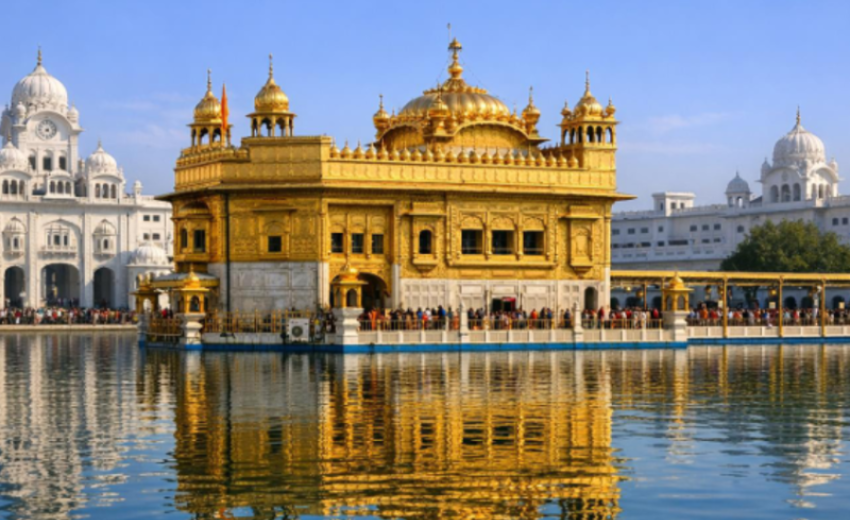
The Harmandir Sahib that Jassa Singh rebuilt would later be adorned with gold leaf by Maharaja Ranjit Singh, becoming the resplendent "Golden Temple" that stands today as one of the most visited and beloved sacred sites on earth. But the foundations — physical, institutional, and spiritual — were laid by Jassa Singh Ahluwalia.
 T
T
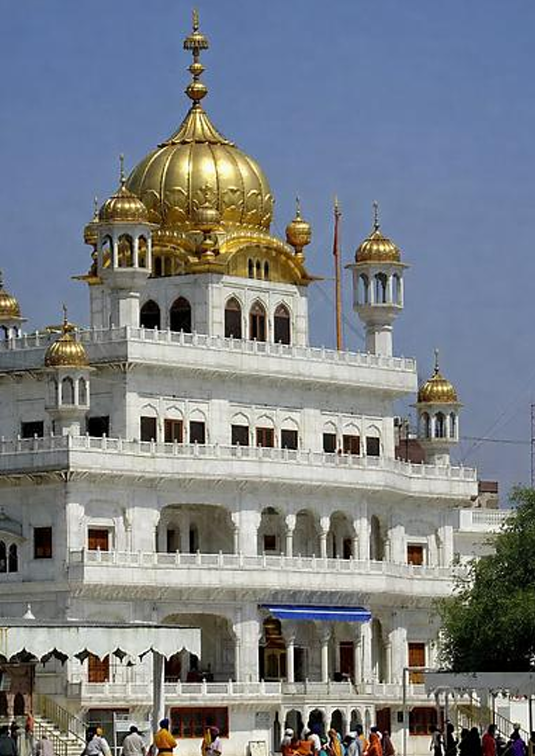
The Akal Takht Sahib — the supreme seat of Sikh temporal authority — where Jassa Singh Ahluwalia served as Jathedar, guiding the political and spiritual destiny of the Khalsa.
❖ ❖ ❖
Section XIII
The Rakhi System: Economic Statecraft and Social Protection
Among Jassa Singh Ahluwalia's most innovative and far-reaching achievements was the establishment and expansion of the Rakhi system — a revolutionary protection-revenue pg. 22 arrangement that constituted, in effect, a functioning parallel government across much of the Punjab. The Rakhi system was formally established through a Gurmata passed in 1753, and its expansion under Jassa Singh's leadership transformed the Sikh Confederacy from a guerrilla resistance movement into a territorial state.
The principle of Rakhi was elegantly simple: villages that accepted the protection of the Khalsa paid one-fifth of their grain harvest as revenue. In return, the Khalsa guaranteed their security against all threats — Afghan raiders, Mughal tax collectors, bandits, and rival warlords. The arrangement was voluntary, and its popularity across the Punjab — among Hindus, Sikhs, and Muslims alike — was a testament to its effectiveness. In an age when the existing Mughal administration had collapsed into chaos and the Afghan invaders offered nothing but plunder and enslavement, the Khalsa's Rakhi system provided something genuinely rare: reliable, competent governance.
The Rakhi system was often compared to the Chauth system operated by the Maratha Confederacy in western and central India. But the comparison highlights the Khalsa's superiority: the Marathas collected Chauth as a form of protection money but frequently failed to deliver actual protection or indeed became predators themselves. The Khalsa, by contrast, maintained its end of the bargain with remarkable consistency. Villages under Rakhi were defended. Disputes were adjudicated. Trade routes were secured. Agriculture could proceed without the constant terror of raids and pillage.
So effective and popular was the system that even Adina Beg — the last Mughal governor of the Jalandhar Doab, a wily and resourceful administrator — paid Rakhi to the Khalsa in the amount of 1.25 lakh rupees. When a Mughal governor finds it more expedient to pay tribute to the Khalsa than to fight it, the balance of power has shifted decisively.
At its height, the Rakhi system extended across four of the Punjab's five doabs — an enormous territory stretching from the foothills of the Himalayas to the edges of Rajputana. In the Gangetic Doab, east of the traditional Sikh heartland, the Rakhi system endured until 1803, when the British East India Company assumed control of the region following the Second Anglo-Maratha War. The fact that a system designed by Sikh guerrilla warriors in the 1750s proved durable enough to function as a governing institution for half a century — outlasting the Mughal Empire itself — is a remarkable tribute to its design and to the statesmanship of the men who created it.
❖ ❖ ❖
Section XIV
Equal Treatment and Secular Governance
The Rakhi system was more than a revenue mechanism — it was a genuine social contract, and the governance it enabled reflected the deepest values of Sikh theology translated into political practice. Jassa Singh Ahluwalia's administration of the territories under Khalsa control was characterized by a principle of equal treatment that was extraordinary by the standards of any century, and virtually unprecedented in the sectarian and communal politics of eighteenth-century South Asia.
The Khalsa under Jassa Singh's command implemented a ban on cow slaughter in territories under their control — not because this was a Sikh religious requirement (Sikhism does not mandate vegetarianism), but out of sensitivity to the sentiments of the Hindu population. This was a deliberate act of intercommunal respect, a recognition that governance must accommodate the values of all the communities it serves.
Muslim populations in Khalsa territories were treated with respect. Mosques were not destroyed. Muslim religious practices were not interfered with. When captive women were rescued from Afghan columns, Muslim women were returned to Muslim families with the same honour and care as Hindu women returned to Hindu families. No forced conversions were attempted — indeed, the very concept of forced conversion was anathema to a faith founded on the principle that all paths to the Divine are worthy of respect.
This was Sarbat da Bhala — the welfare of all humanity — not as a pious aspiration but as an operational principle of governance. In the bloodstained landscape of eighteenth-century India, where Hindu-Muslim violence, caste oppression, and sectarian warfare were the norm, the Khalsa under Jassa Singh Ahluwalia offered a radical alternative: a state that protected all its subjects equally, that respected all faiths, and that derived its legitimacy not from the domination of one community over others but from the provision of justice and security to all. This was the direct pg. 24 expression of Sikh theology in the practice of statecraft — the political embodiment of Guru Nanak's declaration that there is no Hindu and no Muslim, only the human soul seeking its Creator.
❖ ❖ ❖
Section XV
The Conquest of Delhi (11 March 1783)
The final and most dramatic military achievement of the Sikh Confederacy under the generation that Jassa Singh Ahluwalia had forged came in March 1783, when Sikh forces entered the Mughal capital of Delhi itself. The Nishan Sahib — was hoisted over the ramparts of the Red Fort, the seat of Mughal imperial power, the palace from which Aurangzeb had issued the orders for the execution of Guru Tegh Bahadur and from which the campaigns of extermination against the Sikhs had been directed for nearly a century.
The conquest of Delhi presented a profound moment of reflection on the nature of Khalsa power. Upon entering the Red Fort, Nawab Jassa Singh Ahluwalia was invited to ascend the Mughal throne — and he did so, briefly, as a symbolic gesture acknowledging the Khalsa's supreme triumph over the very empire that had persecuted them for generations. Yet he did not remain seated long. In a display of extraordinary humility and spiritual conviction, he stepped down from the throne, recognizing that true sovereignty belonged not to any individual but to the Khalsa Panth and, through the Panth, to the Almighty. He harboured no greed for worldly power, no ambition for personal empire. His brief moment upon the throne was a dedication — an offering of every victory, every sacrifice, every conquest to the Guru and the Khalsa. A tribute of three lakh rupees was extracted from the Mughal authorities as an acknowledgement of Sikh supremacy.
Sardar Baghel Singh remained in Delhi with a force of four thousand troops and undertook a project of immense historical and spiritual significance: the construction of gurdwaras at the sites associated with the Sikh Gurus' visits to Delhi. Among the gurdwaras built under his supervision were Gurdwara Bangla Sahib (at the site associated with Guru Har Krishan Ji) and Gurdwara Sis Ganj Sahib (at the site of Guru Tegh Bahadur Ji's martyrdom). These gurdwaras stand to this day as living monuments to the Sikh presence in the heart of India's capital.
In an act of poetic justice that reverberates through history, Aurangzeb's throne — the seat from which the most fanatical and oppressive of the Mughal emperors had ruled — was removed from Delhi and transported to Amritsar. The throne of the persecutor now stood as a trophy in the city of the persecuted — a silent but eloquent testimony to the triumph of faith over tyranny.
❖ ❖ ❖
Section XVI
The Founding of Kapurthala State
While Jassa Singh Ahluwalia's primary identity was always that of a leader of the collective Khalsa, his establishment of the Kapurthala State in the Jalandhar Doab represents a crucial transition in Sikh political history — the evolution from a mobile military confederacy to a territorial state with defined boundaries, administrative institutions, and hereditary governance.
The state was established in the late 1770s (some sources date it to 1772) through a military operation against Rai Ibrahim Bhatti, a local Muslim chieftain. Jassa Singh consolidated a substantial territorial domain that included Kot Isa Khan, Jagraon, Fatehgarh, Sultanpur Lodhi (the historic city associated with Guru Nanak), Jandiala, Sathiala, Bundala, Goindval (the city of Guru Amar Das), Tarn Taran (established by Guru Arjan Dev), and Khadur (the seat of Guru Angad Dev). The inclusion of so many sites associated with the Sikh Gurus within the Kapurthala domain was not coincidental — it reflected Jassa Singh's determination to protect and preserve the sacred geography of the Sikh faith.
Kapurthala was not merely a personal fiefdom — it was a model of the kind of territorial state that would become the standard unit of Sikh political organization in the late eighteenth century. Its administrative structures, its revenue systems, and its military organization provided a template that other Misls would follow. In this sense, Kapurthala was a foundation stone of the Sikh Empire that Maharaja Ranjit Singh would later build — the proof of concept that Sikh sovereignty could be pg. 26 exercised not only through guerrilla campaigns and lightning raids but through the patient, systematic work of territorial governance.
❖ ❖ ❖
Section XVII
The Sri Jassa Singh Binod Manuscript
Our knowledge of Jassa Singh Ahluwalia's life and achievements rests substantially on a single extraordinary document: the Sri Jassa Singh Binod, a biographical manuscript written by Ram Sukh Rao, a Brahman scholar who served as a tutor in the Kapurthala royal household. The manuscript was commissioned by Sardar Fateh Singh, the ruler of Kapurthala from 1801 to 1836, who wished to preserve the memory of his illustrious predecessor for posterity.
The Sri Jassa Singh Binod consists of 250 folios. The script is Gurmukhi — the script of the Sikh scriptures — and the language is a rich mixture of Hindi, Persian, and Punjabi, loaded with Sanskrit vocabulary. This linguistic diversity is itself significant: it reflects the pluralistic cultural environment of the Khalsa Raj, where Gurmukhi, Persian, Hindi, and Punjabi coexisted as languages of administration, scholarship, and devotion.
The manuscript is now preserved in the Punjab State Archives at Patiala, catalogued under accession number MS M/772. It remains an indispensable primary source for historians of the Misl period and has been drawn upon by virtually every major scholar of eighteenth-century Sikh history, from Ganda Singh and Hari Ram Gupta to J.S. Grewal and Indu Banga.
Not much is known about Ram Sukh Rao beyond the information embedded in the manuscript itself. He was a Brahman — a member of the Hindu priestly caste — who had been rewarded with a jagir (land grant) after his ward Fateh Singh's accession to the throne. He claims himself to be a poet of renown who had written commentaries on well-known literary texts as well as two treatises on poetics. The fact that the definitive biography of the greatest Sikh warrior of the eighteenth century was written by a Hindu Brahman in a manuscript blending Gurmukhi script with Persian and Sanskrit vocabulary is itself a powerful testament to the pluralistic and inclusive character of the Khalsa Raj that Jassa Singh had built.
❖ ❖ ❖
Section XVIII
Successors and the Bridge to the Sikh Empire
Nawab Sultan-ul-Qaum Jassa Singh Ahluwalia died on 23 October 1783 at Bandala, near Amritsar, at the age of sixty-five. His body was cremated at the Dera Baba Attal, adjacent to the Harmandir Sahib complex in Amritsar — a fitting resting place for the man who had rebuilt the sacred shrine from its ruins. He had fought for more than five decades, survived two genocides, led his people from the brink of annihilation to the threshold of empire, and done so with a selflessness and moral clarity that few leaders in any civilization have matched.
Jassa Singh left no biological son. The leadership of the Ahluwalia Misl and the Kapurthala State passed to his second cousin, Bhag Singh, and subsequently to Bhag Singh's son, Fateh Singh, who would prove a worthy successor. Fateh Singh ruled Kapurthala from 1801 to 1836, and under his administration the revenues of the state grew from 1,76,000 rupees to an impressive 16,00,000 rupees — a nearly tenfold increase that reflected both economic development and territorial expansion.
The relationship between the Kapurthala house and the rising power of Maharaja Ranjit Singh was cemented in 1802, when Fateh Singh and Ranjit Singh exchanged turbans — a Punjabi gesture of eternal brotherhood and mutual commitment. This bond proved consequential: Fateh Singh was a co-signatory of the Treaty of Amritsar (1806) between the Sikh Empire and the British East India Company, and the Kapurthala State functioned as a loyal and valued ally of the Lahore court throughout Ranjit Singh's reign.
Following the collapse of the Sikh Empire after the Anglo-Sikh Wars, Kapurthala became a princely state under British paramountcy in 1846, maintaining its internal autonomy while acknowledging British suzerainty. The state continued to be governed by the Ahluwalia dynasty, and its rulers distinguished themselves in diplomacy, modernization, and international engagement. Maharaja Jagatjit Singh of Kapurthala represented India at the League of Nations in 1926, 1927, and 1929 — an Ahluwalia prince standing on the world stage, a direct descendant of the tradition that Jassa Singh had founded. Under Jagatjit Singh, Kapurthala earned the nickname "The Paris of Punjab" for its elegant architecture, cosmopolitan culture, and modernizing administration.
The arc from the orphaned boy of Ahlu village to the Maharaja who addressed the League of Nations is one of the most extraordinary trajectories in Indian history — a lineage of service, sovereignty, and vision that spans two centuries and connects the guerrilla camps of the eighteenth-century Punjab to the diplomatic salons of twentieth-century Geneva.
❖ ❖ ❖
Section XIX
Enduring Legacy: The Foundations That Built a Nation
The legacy of Nawab Sultan-ul-Qaum Jassa Singh Ahluwalia is not a matter of historical curiosity — it is the very foundation upon which the edifice of Sikh sovereignty was constructed. Every major institution of the Sikh Empire that Maharaja Ranjit Singh established in 1801 has its roots in the structures that Jassa Singh built, the precedents he set, and the principles he upheld.
| Dimension | Achievements of Jassa Singh Ahluwalia |
| Military | Supreme Commander of the Dal Khalsa; over 30 major battles; consolidated 65 jathas into unified military force; developed guerrilla and conventional warfare capabilities; the Dal Khalsa became the nucleus of Maharaja Ranjit Singh's army |
| Political | Architect of the Misl system; champion of the Sarbat Khalsa and Gurmata democratic institutions; Sultan-ul-Qaum elected by collective will; established precedent of accountable, non-dynastic leadership; these institutions informed the political culture of the Sikh Empire |
| Religious | Rebuilt the Harmandir Sahib after Afghan desecration; personally contributed 9 lakhs of rupees; appointed granthis and established institutional infrastructure; served as Jathedar of the Akal Takht for three decades; the shrine he rebuilt became the Golden Temple adorned by Ranjit Singh |
| Economic | Established and expanded the Rakhi system across four of Punjab's five doabs; created a functioning parallel revenue and protection system; founded the Kapurthala State with sustainable revenue structures |
| Social | Liberated thousands of captive women irrespective of faith; implemented policies of equal treatment for all religious communities; banned cow slaughter out of respect for Hindu sentiments; translated Sarbat da Bhala from scripture into governance |
| Cultural | Master Rabab player and Kirtankaar; patronized the Kapurthala Rababi Gharana; embodied the Sant-Sipahi (saint-soldier) ideal; the Sri Jassa Singh Binod manuscript, a pluralistic document blending Gurmukhi, Hindi, Persian, and Sanskrit, exemplifies the cosmopolitan culture of the Khalsa Raj |
The threads connecting Jassa Singh Ahluwalia to Maharaja Ranjit Singh and the Sikh Empire are direct and unmistakable. The Dal Khalsa that Jassa Singh unified and led became the core of Ranjit Singh's formidable army — the Khalsa Fauj — which would be recognized by European military observers as one of the finest fighting forces in Asia. The Sarbat Khalsa and Gurmata institutions that Jassa Singh championed informed the political culture of the Sikh court at Lahore. The Harmandir Sahib that Jassa Singh rebuilt from its ruins was the same shrine that Ranjit Singh adorned with gold, creating the resplendent Golden Temple that became the symbol of Sikh civilization to the world. The territories that Jassa Singh secured through the Misl system became the provinces of the Sikh Empire. The assertion of Khalsa sovereignty that Jassa Singh established at Lahore was continued and expanded by Ranjit Singh across the entire Punjab.
In every domain — military, political, religious, economic, social, and cultural — Jassa Singh Ahluwalia laid the foundations that made the Sikh Empire possible. He was the architect; Ranjit Singh was the builder who raised the structure to its full height. Without the one, the other would have had nothing to build upon.
❖ ❖ ❖
Section XX
Conclusion: The Measure of a Life
How shall we measure the life of Nawab Sultan-ul-Qaum Jassa Singh Ahluwalia? By the number of battles, he won? He fought more than thirty and lost none decisively. By the territory he conquered? He captured Lahore and Sirhind and extended Khalsa authority across four-fifths of the Punjab. By the institutions he built? The Dal Khalsa, the Misl system, the Rakhi revenue structure, the rebuilt Harmandir Sahib, and the Kapurthala State are all his creation. By the lives he saved? The thousands of captive women he liberated and returned to their families — Hindu, Muslim, and Sikh alike — constitute an act of humanitarian intervention without parallel in eighteenth-century Asia.
The Khalsa's democratic principles — the Sarbat Khalsa, the Gurmata, the election of leaders by collective consent, the principle that sovereignty belongs to the community and not to the ruler — predated the French Revolution of 1789 by decades. In the global history of democratic governance, the Sikh Confederacy under Jassa Singh Ahluwalia occupies a place of honour that is yet to be fully recognized.
But perhaps the truest measure of Jassa Singh's life is not found in comparison with other leaders or in lists of achievements. It is found in the image of the man himself — the orphaned boy from Ahlu who sang Asa di Var at dawn and answered alone in the storm. The boy who lost his father at four and found a mother in Mata Sundri Ji. The Kirtania whose music moved the great Nawab Kapur Singh to tears. The sentinel who stood alone in the rain while every other guard sought shelter. The commander who refused to flee the killing field at Kup-Rahira. The conqueror who attributed sovereignty to the Guru rather than to himself. The liberator who returned captive women to their families with honour and asked nothing in return.
This was a life lived in the image of the ideal that Guru Gobind Singh articulated when he created the Khalsa — the ideal of the human being who fears no one and causes no one to fear, who wields power in the service of justice, who sings the praises of the Creator and fights the battles of the oppressed with equal devotion. Jassa Singh Ahluwalia was the supreme embodiment of the Sant-Sipahi — the saint-soldier — and his legacy is nothing less than the survival, the sovereignty, and the eternal spirit of the Khalsa Panth.
❖ ❖ ❖
Appendix: Chronological Summary
| Date | Event |
| 3 May 1718 | Birth of Jassa Singh at village Ahlu, near Lahore (Baisakh Sudi Puranmashi, 1775 Bikrami) |
| 1716 | Execution of Banda Singh Bahadur in Delhi — two years before Jassa Singh's birth |
| 1723 | Death of father Sardar Badar Singh; Jassa Singh aged 4. Mother takes him to Delhi |
| 1723-1729/30 | Seven years in the household of Mata Sundri Ji, Delhi. Learns Kirtan, Rabab, Urdu, Persian. Receives prophecy and weapons from Mata Sundri Ji |
| c.1729/30 | Returns to Punjab at age ~12; settles near Jalandhar. Encounter at Kartarpur; adopted by Nawab Kapur Singh |
| 1733 | Nawab Kapur Singh elected leader of the Panth after Zakariya Khan's jagir offer |
| 1739 | Khalsa attacks Nadir Shah's retreating columns; rescue of captive Indian women |
| 1745 | Battle of Naurangabad |
| 1746 | Chhota Ghallughara (Lesser Holocaust): 7,000–10,000 Sikhs massacred under Lakhpat Rai |
| 1747-1769 | Ahmad Shah Abdali's nine invasions of India |
| Baisakhi 1748 | Sarbat Khalsa at Amritsar: 65 jathas consolidated into Dal Khalsa; Jassa Singh democratically elected Supreme Commander. Construction of Ram Rauni at Amritsar |
| 1748-1753 | Persecution under Mir Mannu: bounties on Sikh heads, women and children imprisoned |
| 1749 | Khalsa forces assist Diwan Kaura Mal in Multan expedition |
| 1753 | Gurmata establishing the Rakhi system. Death of Nawab Kapur Singh (7/9 October); formal transfer of leadership to Jassa Singh |
| 1754 | Title of "Nawab" conferred on Jassa Singh at Amritsar |
| 1757 | Battle of Mahilpur |
| 1759 | First capture of Lahore by Dal Khalsa |
| 14 Jan 1761 | Third Battle of Panipat: Abdali defeats Marathas |
| 1761 | Liberation of ~2,200 captive Hindu women from Abdali's retreating columns |
| 27 Oct 1761 | Sarbat Khalsa at Amritsar (Diwali): Gurmata to march on Lahore |
| Late 1761 | Capture of Lahore; title "Sultan-ul-Qaum" conferred. First non-Muslim sovereignty over Punjab in ~750 years |
| 5 Feb 1762 | Vadda Ghallughara (Greater Holocaust): 20,000–50,000 Sikhs massacred at Kup-Rahira. Jassa Singh wounded but continues commanding the retreat |
| 1762 | Within 3 months of Vadda Ghallughara: Dal Khalsa regrouped, resumed operations against Zain Khan. Battles of Harnaulgarh and Pipli Sahib |
| 1763 | Battle of Urmar Tanda |
| 14 Jan 1764 | Battle of Sirhind: Zain Khan killed; 10,000 Afghan horsemen destroyed. Cis-Sutlej tract conquered. Territory divided among Misls |
| 1764 | Systematic rebuilding of the Harmandir Sahib. Out of total 14 Lakhs, Jassa Singh contributes 9 lakhs. Bungas built; granthis appointed |
| 1769 | Battle of Jalandhar; end of Abdali's invasions |
| c. 1772 | Founding of Kapurthala State in Jalandhar Doab |
| 1779 | Siege of Patiala |
| 1780 | Battle of Shujabad |
|
11 Mar 1783 |
Sikh forces enter Delhi; Nishan Sahib hoisted over Red Fort. Tribute of 3 lakh rupees extracted. Baghel Singh builds gurdwaras. Aurangzeb's throne taken to Amritsar |
| 23 Oct 1783 | Death of Nawab Sultan-ul-Qaum Jassa Singh Ahluwalia at Bandala, aged 65. Cremated at Dera Baba Attal, Amritsar |
❖❖ ❖
Endnotes and Bibliography
1. Ram Sukh Rao, Sri Jassa Singh Binod, MS M/772, Punjab State Archives, Patiala. 250 folios, Gurmukhi script. Primary biographical source for Jassa Singh Ahluwalia.
2. Giani Gian Singh, Panth Prakash (1880). The foundational text of modern Sikh historiography, containing extensive accounts of the Misl period and Jassa Singh's campaigns.
3. Ratan Singh Bhangu, Prachin Panth Prakash (1841). Oral histories of the Khalsa collected from surviving veterans and their descendants. Source of the "hen covering its chickens" quotation regarding the Vadda Ghallughara.
4. Qazi Nur Muhammad, Jangnama (1765). Hostile Afghan chronicle of the campaigns against the Sikhs. Contains the "like a mountain" description of Jassa Singh.
5. Ganda Singh, Ahmad Shah Durrani: Father of Modern Afghanistan (Bombay: Asia Publishing House, 1959). Standard scholarly biography of Abdali with extensive treatment of the Sikh-Afghan wars.
6. Ganda Singh (ed.), Early European Accounts of the Sikhs (Calcutta: Indian Studies Past and Present, 1962).
7. Hari Ram Gupta, History of the Sikhs, Vols. I–VI (New Delhi: Munshiram Manoharlal, 1978–2001). The most comprehensive modern history of the Sikh community from the Guru period through the Misl era.
8. Lepel H. Griffin, The Rajas of the Punjab (London: Trübner & Co., 1873). British administrator's account of the ruling families of the Punjab, including the Ahluwalia dynasty of Kapurthala.
9. Lepel H. Griffin, The Punjab Chiefs, revised ed. (Lahore: Civil and Military Gazette Press, 1890).
10. J.D. Cunningham, A History of the Sikhs (London: John Murray, 1849). One of the earliest comprehensive histories of the Sikhs by a British officer.
11. J.S. Grewal, The Sikhs of the Punjab, revised ed. (Cambridge: Cambridge University Press, 1998). Part of the New Cambridge History of India series; standard academic overview.
12. J.S. Grewal, Miscellaneous Articles (Amritsar: Guru Nanak Dev University, 1974).
13. Indu Banga, Agrarian System of the Sikhs (New Delhi: Manohar Publications, 1978). Essential study of the Rakhi system and Sikh revenue administration.
14. Indu Banga (ed.), Five Punjabi Centuries: Polity, Economy, Society and Culture, c. 1500–1990 (New Delhi: Manohar, 1997).
15. Surjit Singh Gandhi, Struggle of the Sikhs for Sovereignty (Delhi: Gur Das Kapur, 1980). Detailed account of the political evolution of the Sikh community.
16. Surjit Singh Gandhi, Sikhs in the Eighteenth Century (Amritsar: Singh Brothers, 1999).
17. Bhagat Singh, Maharaja Ranjit Singh and His Times (New Delhi: Sehgal Publishers, 1990). 1
8. Bhagat Singh, Sikh Polity in the Eighteenth and Nineteenth Centuries (New Delhi: Oriental Publishers, 1978).
19. Harbans Singh (ed.), The Encyclopaedia of Sikhism, 4 vols. (Patiala: Punjabi University, 1992–1998). Definitive reference work on Sikh history, theology, and culture.
20. Harbans Singh, The Heritage of the Sikhs, 2nd ed. (New Delhi: Manohar, 1983).
21. Teja Singh and Ganda Singh, A Short History of the Sikhs, Vol. I: 1469–1765 (Bombay: Orient Longmans, 1950).
22. Khushwant Singh, A History of the Sikhs, Vol. I: 1469–1839 (Princeton: Princeton University Press, 1963).
23. W.L. McGregor, The History of the Sikhs, 2 vols. (London: James Madden, 1846).
24. Sohan Singh Seetal, The Sikh Misls and the Punjab (Ludhiana: Lahore Book Shop, 1981).
25. A.C. Banerjee, The Khalsa Raj (New Delhi: Abhinav Publications, 1985).
26. Fauja Singh, Military System of the Sikhs (Delhi: Motilal Banarsidass, 1964).
27. Fauja Singh (ed.), Historians and Historiography of the Sikhs (New Delhi: Oriental Publishers, 1978).
28. Irfan Habib, An Atlas of the Mughal Empire (Delhi: Oxford University Press, 1982). For the geographic context of the Punjab campaigns.
29. Muzaffar Alam, The Crisis of Empire in Mughal North India (Delhi: Oxford University Press, 1986). Essential for understanding the power vacuum that the Khalsa filled.
30. Jos J.L. Gommans, The Rise of the Indo-Afghan Empire, c. 1710–1780 (Leiden: E.J. Brill, 1995). European scholarly assessment of Abdali's campaigns.
31. Giani Gian Singh, Twarikh Guru Khalsa (1891). Comprehensive history of the Khalsa with detailed accounts of the Misl period.
32. B.S. Nijjar, Panjab Under the Great Mughals (Bombay: Thacker & Co., 1968).
33. Kanaiyalal Munshiram Panikkar, The Founding of the Kashmir State (London: Allen and Unwin, 1953). For context on Abdali's broader campaigns.
34. W.H. McLeod, The Sikhs: History, Religion and Society (New York: Columbia University Press, 1989).
35. Madanjit Kaur, The Golden Temple: Past and Present (Amritsar: Guru Nanak Dev University, 1983). Essential for the history of the Harmandir Sahib's destruction and rebuilding.
36. Rishi Singh, "The Sikh Confederacy and Democratic Governance in 18th Century Punjab," Proceedings of the Punjab History Conference (Patiala: Punjabi University, 2003).
37. Balwant Singh Dhillon, "The Rakhi System of the Sikhs," Journal of Sikh Studies, Vol. XII (Amritsar: Guru Nanak Dev University, 1985).
38. Himadri Banerjee (ed.), The Khalsa and the Punjab: Studies in Sikh History to the Nineteenth Century (New Delhi: Tulika Books, 2002).
39. Encyclopaedia of Sikhism, s.v. "Sri Jassa Singh Binod," "Jassa Singh Ahluwalia," "Dal Khalsa," "Misl," "Sarbat Khalsa," "Gurmata," "Vadda Ghallughara," "Chhota Ghallughara," "Rakhi System."
❖ ❖ ❖