
Introduction to Aadh Guru Granth Bhagat Mala
These short stories have been taken from Aadh Guru Granth Bhagat Mala and translated into English. The purpose of translating these stories is to provide understanding and emphasise its significance when reciting Gurbaani and Bhai Gurdas Ji Vaaran.
The Sikh Gurus, Bhagats and Bhatt (bards) within Sri Guru Granth Sahib Ji have made references to various great saints and disciples who existed at the time of the Hindu deities in different Yugas. These narratives are presented not to venerate Hindu deities; rather, they serve solely as references to illustrate the value of faith and understanding the importance of meditating upon the Lord’s Name.
The stories provide examples from the lives of many revered saints, aristocrats and common people serving as parallels for understanding the power and immense greatness of the One Lord, Vaheguru. They highlight the importance of living by faith and Dharma, and how meditation upon the Primal Lord leads to liberation from sin and misfortune.
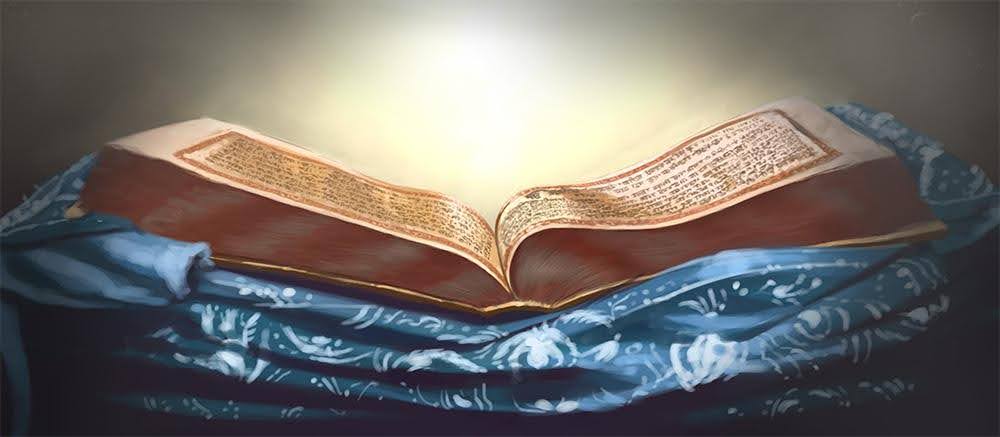
The Story of Sarvan Bhagat
ਜੈਸੇ ਮਾਤ ਪਿਤਾ ਕੇਰੀ ਸੇਵਾ ਸਰਵਨ ਕੀਨੀ ਸਿਖ ਬਿਰਲੋ ਈ ਗੁਰ ਸੇਵਾ ਠਹਰਾਵਈ ।
Just as the noble Sarvan served his blind parents so dedicatedly
So is the rare disciple who would stay and serve his Guru.
(Bhai Gurdas Ji; Kabit 103 pg. 1)
In his Kabit, Bhai Gurdas Ji likens the unconditional service and devotion of Sarvan Kumar for his parents to the devotion that a Sikh has towards their Guru.
In the age of Tretha Yug lived an old couple named Shantavan Kumar and Gyanvanti Devi. After learning that Gyanvanti was unable to conceive, both husband and wife decided to become hermits and lived in solitude to meditate upon Shiva.
After many years of intense meditation, Shiva appeared before the couple. Pleased with their meditation and as a reward of their devotion to him, Shiva asked the couple to ask for a boon. Both Shantavan and Gyanvanti asked Shiva to bless them with a son. Shiva informed the couple that a child was not destined in their Karma. In order for their wish to be fulfilled, both husband and wife would lose their vision as a result.
Both Shantavan and Gyanvanti accepted their fate and said to Shiva, “O Lord Shiva, if having a child means we are born blind in another seven rebirths, then so be it.”
Shiva granted them their wish. Soon Gyanvanti gave birth to a beautiful boy. He was named Sarvan Kumar. The moment Sarvan was born, both Shantavan and Gyanvanti lost their vision.
As Sarvan grew older, he turned his attention to devoting his life and serving his parents instead of God. A day came where Sarvan was faced with the truth regarding his birth and the sacrifice both his parents made. Struck with guilt and contrition, Sarvan decided to take his parents on a pilgrimage to the forty Hindu holy places of worship in an attempt to restore his parents’ vision.
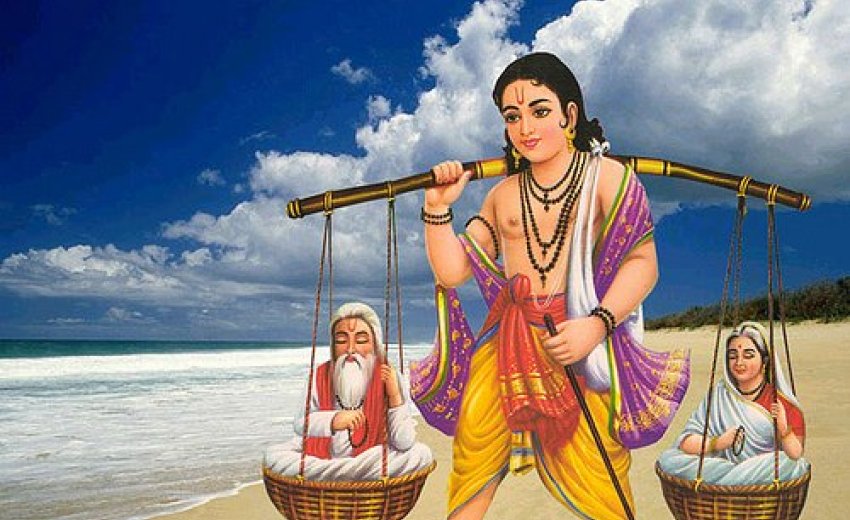
Sarvan made a carriage from a solid bamboo stick with two baskets hanging either side with ropes. 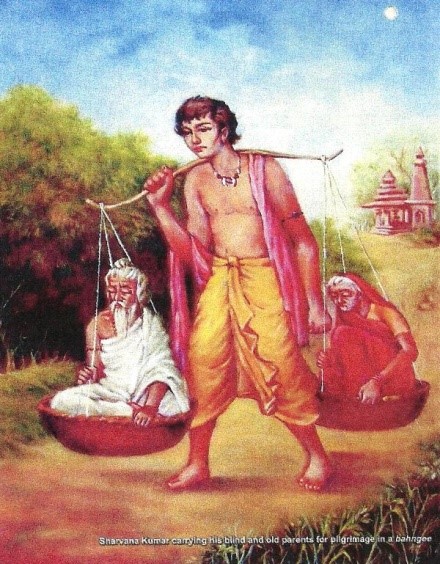 He placed his mother in one basket and his father in the other. Day and night he would carry his blind, old parents on his shoulder.
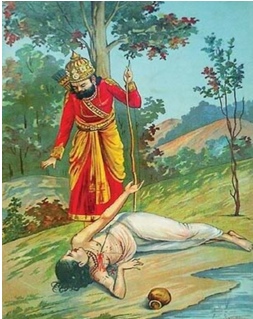
As they came near to the end of their pilgrimage, Sarvan’s father asked him to fetch some water to quench his thirst. Sarvan placed the carriage down, picked up his pitcher and made his way to the nearby forest. On the other side of the forest, Sarvan’s maternal uncle, Raja Dasrath of Ayodhya was on a hunting expedition. Sarvan reached the riverside and immersed the pitcher into the water. Raja Dasrath’s attention turned to the sound of the trickling water. Assuming there was a deer drinking water at the riverside; he drew his bow and shot an arrow in the direction of Sarvan.
The arrow fatally pierced the heart of the young boy. Sarvan fell to the ground and cried out “Ram Ram Ram” three times. On hearing the pain-stricken cries of the young boy, Raja Dasrath ran towards Sarvan. Realising he has just shot his nephew; a horrified and repentant Dasrath held the young boy in his arms and began to weep and wail out aloud.
Sarvan said to his uncle, “O uncle, now is not the time to be crying. There is very little time. My old parents are thirsty. They will die of thirst if they do not receive this water. Please take this pitcher and give them this water.”
Sarvan breathed his last and died in the arms of his maternal uncle. A mortified and guilt-stricken Raja Dasrath picked the pitcher of water and carried the lifeless body of his nephew upon his shoulder. He made his way to the spot where Sarvan’s parents were eagerly waiting for the return of their son.
Raja Dasrath approached the carriage. Wanting to avoid revealing the events of the tragic death of his nephew to Sarvan’s parents, he splashed some of the water on Gyanvanti’s face. Assuming Sarvan returned, Gyanvanti spoke, “Sarvan, is that you my son? May the Lord bless you with a long life! We have been waiting so long for your return. What took you so long? Did you have to travel far to fetch us some water? Sarvan? Please say something my son.”
Too afraid to speak, Raja Dasrath let out a small murmur. Suspicious of the voice, Gyanvanti said, “Who are you? This is not the voice of my Sarvan! Keep away from us!”
Raja Dasrath: “O sister, this is your brother, Dasrath. I have brought you some water, please drink it.” 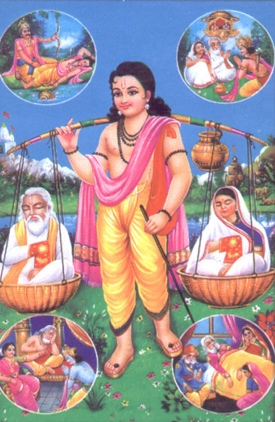
“We refuse to drink this water! Until we do not hear the voice of our son Sarvan, we will not touch a drop of water. We would rather die of thirst.” Gyanvanti replied angrily.
Raja Dasrath clasped the feet of his sister and sobbed, “O my beloved sister. You will not be able to hear the voice of your beloved son, Sarvan. The support of your carriage has broken. I have killed your son!”
Raja Dasrath confessed and told them the truth about what happened in the forest. He placed the body of Sarvan in the laps of his blind parents.
Both Shantavan and Gyanvanti were unable to bear the grief of the death of their son and cursed Raja Dasrath. “Just as you have separated us from our beloved son, you will too face this pain. A day will come where you will be separated from your most beloved son!”
Both Shantavan and Gyanvanti ordered Raja Dasrath to perform the last funeral rites for Sarvan and for them to also be cremated in the funeral pyre with their son.
Sometime after the death of Sarvan, the curse took its toll. Raja Dasrath died as a result of being separated from his most beloved son, Rama, who was banished to the forest for 14 years. This led to the epic event of the Ramayan.
Sarvan Kumar is deemed as a Bhagat, not for his devotion to the Lord, but to his parents. The way, in which Sarvan served his parents and took care of them, he is revered as the most obedient and dutiful son every parent desires.
Bhai Gurdas Ji has many compositions within his Vaaran and Kabit stressing the importance of respecting one’s birth parents. Sarvan is cited as a prime example of this virtue.
ਹੋਵੈ ਸਰਵਣ ਵਿਰਲਾ ਕੋਈ ॥੧੧॥
Rare is any obedient son like Sravan of mythology who was most obedient to his blind parents. (11)
(Bhai Gurdas Ji Vaar 37, Pauri 11)