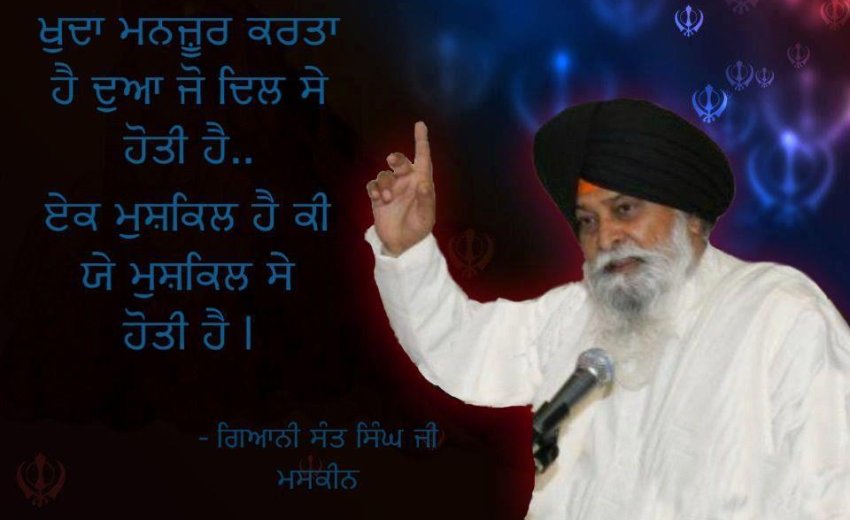

Sant Maskeen Ji: From Partition Survivor to Panth Rattan
Sant Singh Maskeen was one of the most influential Sikh thinkers, speakers, and interpreters of Gurbani in modern times. He was widely known as Sant Maskeen Ji or Giani Sant Singh Maskeen. He dedicated his life to explaining the message of Sri Guru Granth Sahib in a manner that was thoughtful, honest, and accessible. His contribution to Sikh thought, education, and ethical discourse earned him the rare honour of “Panth Rattan”, honoured by the Shiromani Gurdwara Parbandhak Committee for outstanding service to humanity through Gurmat. Maskeen Ji’s influence extended beyond the Sikh community, touching people across faiths, regions, and generations.
Early Life
Sant Singh Maskeen was born in 1934 in Lakki Marwat, located in the North-West Frontier Province (now in Pakistan). His parents were Kartar Singh and Mata Ram Kaur. He received his early education at the Khalsa School and later joined Government High School. His formative years unfolded in a culturally rich environment where Punjabi, Urdu, and Persian were commonly used, and this multilingual exposure shaped his intellectual foundation.
At the age of around twelve, his life took a dramatic turn with the Partition of India in 1947. Like millions of Sikhs living in the western regions, his family was forced to flee their ancestral home amid widespread violence and uncertainty. They survived the journey and eventually settled in Alwar, Rajasthan. This displacement brought immense emotional and economic strain.
In Alwar, Maskeen Ji faced a major educational setback. His earlier schooling had been in Urdu and Persian, while the education system in India required proficiency in Hindi. This language barrier made it difficult for him to continue formal studies. Financial conditions at home were also fragile, leaving little room for academic pursuits. For a short period, he worked in a factory to contribute to the family’s income.
The death of his father in 1952 deeply affected him. It left him withdrawn, introspective, and increasingly detached from material concerns. This personal loss became a turning point. Instead of pursuing conventional stability, he chose a path of inner inquiry. He left home and began travelling to different places, learning the basic tenets of Gurbani from various scholars, saints, and preachers. These years of wandering were not marked by comfort, but by intense learning and reflection.
Gradually, his understanding of Gurbani deepened. He absorbed its message not only as scripture, but as a guide for ethical living and universal harmony. His natural clarity of expression and sharp analytical ability soon distinguished him as a gifted narrator of Gurbani.
Growth of Gurmat Parchar
The early phase of Maskeen Ji’s Gurmat parchar was filled with hardship. He had no stable income, no institutional backing, and very limited resources. Often, he walked long distances to reach villages and small towns where he had been invited to speak. Whatever the sangat offered him—out of affection and respect—became his only means of survival.
Despite these challenges, he never diluted his message or compromised his principles. He stayed firmly away from politics, factionalism, and ideological extremism. His sole focus remained the teachings of Guru Nanak and the Guru Granth Sahib. He believed that Gurbani should guide personal conduct, social responsibility, and spiritual discipline, rather than be used as a tool for power or division.
Maskeen Ji married Sunder Kaur in 1958. Together, they raised a family of three sons and two daughters. Even as family responsibilities grew, his commitment to Gurmat parchar did not waver. For him, discipline was non-negotiable. Once he fixed a programme, he followed it strictly, regardless of personal inconvenience or physical strain.
Over time, his reputation as a serious scholar and engaging speaker spread. His discourses were marked by logical structure, deep textual knowledge, and the ability to connect Gurbani with everyday life. He made complex ideas understandable without oversimplifying them.
Alwar gradually became the centre of his activities. For nearly four decades, an annual Gurmat Samagam was organised there every year from 1st to 3rd March under his direct supervision. These gatherings drew eminent scholars, kirtan jathas, and thousands of devotees from different parts of the country. As per Sikh tradition, Guru ka Langar was served continuously for all, without distinction.
Maskeen Ji also played a key role in strengthening the Sikh presence in and around Alwar. A moderate Sikh population lived in nearby villages, and under his guidance, educational institutions began to take shape. Sikh schools and a meditation centre were established with the aim of combining spiritual learning with formal education. These initiatives reflected his belief that Sikhi must remain rooted in both knowledge and seva. After his passing, the future of some of these projects became uncertain, raising concerns about their completion and continuity.
A Voice Without Fear
Sant Maskeen Ji was a scholar of rare breadth. He had command over Punjabi, Hindi, Urdu, and Persian, and possessed a working knowledge of English. His reading extended far beyond Sikh texts. He studied the Vedas, the Bhagavad Gita, the Quran, and the works of Sufi and Bhakti saints. During his discourses, he frequently quoted poets such as Ghalib, Iqbal, Ustad Zauq, Bulleh Shah, and Bhai Nand Lal, using poetry to clarify philosophical ideas.
He paid particular attention to Bhagat Bani enshrined in the Guru Granth Sahib. He often explained that to understand Gurbani fully, one must have some awareness of India’s cultural and historical background. References to Ram, Krishna, Allah, and Rahim in the Guru Granth Sahib, he argued, reflected the universal nature of Sikh thought. Some critics misunderstood this approach and wrongly labelled him as aligned with certain ideologies. Maskeen Ji never responded with bitterness. He continued to stress that Gurbani speaks to all humanity and cannot be confined within narrow interpretations.
His secular outlook was evident in both word and action. On one occasion, he even agreed to perform katha in a mosque in Rajasthan, though the plan was later dropped due to objections from organisers who were uncomfortable with a non-Muslim speaker.
Maskeen Ji was also known for his fearlessness in exposing wrongdoing. He openly spoke about financial mismanagement and corruption in certain Sikh institutions. He authored books that detailed how donations were misused in some temples. These revelations caused significant discomfort within sections of the community. While many admired his honesty, others opposed him strongly. Yet, he remained unmoved, guided by conscience rather than popularity.
His personal integrity matched his public stance. Despite opportunities to align with political groups or gain influence, he deliberately stayed away. He believed that mixing politics with spiritual teaching weakened both.
A Life of Discipline and Commitment
Sant Maskeen Ji carried the message of Gurbani far beyond India. He travelled extensively to the United States, Canada, the United Kingdom, the Middle East, Thailand, Singapore, and other regions. His audiences included not only Sikhs but also people from other faiths who found clarity and depth in his interpretations.
He was deeply committed to keeping his promises. After assuring a Sikh high priest that he would perform katha in Amritsar every year during Diwali, he honoured that commitment for twenty-five consecutive years. During the 300-year celebrations of the Khalsa Panth, he was invited by the Jathedar of the Akal Takht to perform katha at Harmandir Sahib. At the time, he was recovering from a heart condition in the United States. Against medical advice, he travelled to Amritsar to fulfil his duty.
Despite limited formal education, Maskeen Ji authored more than a dozen books. His notable works include Guru Chintan, Ras Dhara, Jiwan Jhalkian, Aise Jan Virle Sansare, Brahm Gyan, Gyan Da Saagar, Amrit Manthan, Ratnagar, and Shabad Guru. He also produced numerous audio recordings that circulated widely among the Sikh community. His daily discourses on the Guru Granth Sahib were broadcast on national television and reached audiences worldwide. For many viewers, these programmes became a daily source of reflection and guidance.
In recognition of his exceptional service, the Shiromani Gurdwara Parbandhak Committee conferred upon him the title of Panth Rattan, one of the highest honours awarded for contribution to the Sikh cause and humanity. He was also honoured with the Bhai Gurdas Gold Award and, posthumously, the Gurmat Vidya Martand Award.
Sant Singh Maskeen passed away in 2005 after suffering a massive heart attack in Etawah, Uttar Pradesh. He is survived by his wife, three sons, and two daughters.
Legacy
For nearly five decades, he stood as a powerful voice in contemporary Sikh society. His death created a void that remains difficult to fill, especially at a time when cultural dilution and superficial interpretations challenge Sikh identity. Maskeen Ji’s life reminds us that true scholarship requires discipline, courage, and humility.
From a young boy uprooted by Partition to a thinker honoured as Panth Rattan, Sant Maskeen Ji’s words continue to guide seekers, and his legacy lives on through his writings, recordings, and the lives he influenced.
Gyaniji once said:
"That a Lion is considered more beautiful than a Lioness and a peacock more beautiful than a peahen is true, but a Lion never goes to a barber to have his beard shaved or his hair cut and a peacock never goes to a barber to pluck its feathers, but Men who also have this distinguishing quality go to barbers and cut their hair and shave their body and beard. Which is exactly similar to a woman, so indirectly men want to look like women and lose the beautiful and distinguishing qualities God has given them."
Reference Links:
SikhiWiki - Giani Sant Singh Maskeen
https://www.sikhiwiki.org/index.php/Giani_Sant_Singh_Maskeen
Explains the life and influence of Giani Sant Singh Maskeen, a leading Sikh scholar honoured with the rare title of Panth Rattan for his deep understanding and teaching of Gurbani. Tha article also highlights his global reach, contributions to Sikh thought, and enduring impact on communities worldwide.
Wikipedia - Sant Singh Maskeen
https://en.wikipedia.org/wiki/Sant_Singh_Maskeen
Explores the life, teachings, and impact of Sant Singh Maskeen, a respected Sikh scholar known for his deep interpretation of Gurbani.