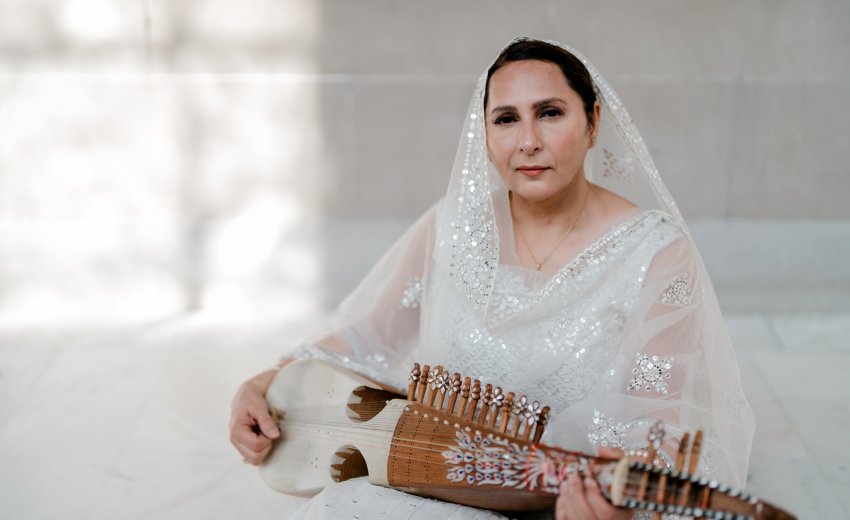

New research reconstructs the first integrated timeline of Rai Balwand and Bhai Satta and offers a multi-dimensional study of Ramkali Ki Vaar (Ang 966–968).
The Rababi tradition has long been acknowledged as foundational to Sikh devotional practice, yet in formal historiography the lives and contributions of Rababi figures have remained scattered across sources rather than studied in an integrated way. While Bhai Mardana Ji’s companionship with Guru Nanak Dev Ji is occasionally discussed in Sikh scholarship, sustained academic study of the Rababi tradition beyond this early period has been limited. In particular, Rababi Rai Balwand and Bhai Satta, whose Bani Ramkali Ki Vaar appears on Ang 966 of the Sri Guru Granth Sahib in glorification of the first five Gurus from Guru Nanak Dev Ji to Guru Arjan Dev Ji, served in the Guru’s Darbar across multiple Guru periods extending into the time of Guru Hargobind Sahib. Despite their significant musical and scriptural contributions, they have rarely been examined in depth. For centuries, Rai Balwand and Bhai Satta have been remembered primarily through brief references in Sikh history, often centered on a single episode of separation from the Guru’s court. However, new research reveals a much deeper and more meaningful legacy rooted in Keertan, devotion, humility, and scriptural contribution.
A newly awarded doctoral thesis, An Analytical Study of Rababi Rai Balwand and Bhai Satta’s Contributions to Gurmat Sangeet, by US-based Dr. Leena Singh Bedi in the Department of Gurmat Sangeet, Faculty of Visual and Performing Arts, Guru Kashi University, Talwandi Sabo, under the supervision of Dr. Gurnam Singh, renowned Sikh Keertankar, former Dean, and Founder Professor of the Gurmat Sangeet Chair at Punjabi University, offers a comprehensive and source-based re-examination of these two Rababi Keertankars.
The thesis traces the evolution of Gurmat Sangeet from Guru Nanak Dev Ji’s integration of Raag-based Shabad with Rabab accompaniment, exemplified through Bhai Mardana Ji’s service, through the refinement of Keertan discipline across successive Gurus, culminating in the institutional establishment of Keertan Chaukis at Sri Harmandir Sahib under Guru Arjan Dev Ji. This historical foundation clarifies that the Rababi tradition developed within a structured musical-spiritual system rather than outside it. The study also examines the architecture of the Sri Guru Granth Sahib as an inclusive yet doctrinally anchored scripture shaped by the Sikh Gurus as composers, preservers, and compilers of Gurbani. The canon includes voices of Bhagats, Bhatt Bards, and devoted Gursikhs whose compositions were accepted based on alignment with Gurmat. Within this scriptural world, Rai Balwand and Bhai Satta occupy a distinctive position. Though remembered historically as Rababis and Keertankars, they are explicitly recognized as Banikars, affirming a profound Sikh principle that spiritual authority rests upon devotion, humility, and alignment with Gurmat rather than lineage, profession, or status.
A central scholarly focus of the thesis is a comprehensive textual, structural, and musicological study of Ramkali Ki Vaar, set in Raag Ramkali, a Raag associated with introspection, awakening, discipline, and transformation. The research shows that the Vaar is structurally distinctive: it consists of eight Pauris, contains no Saloks, and carries no Dhuni heading, yet retains a powerful oral-performative character through cadence, rhetorical structure, and bardic expression. Through stanza-wise analysis, the Vaar emerges simultaneously as a theological proclamation of Guruship, a spiritual historiography of divine continuity across the Guru lineage, an affirmation of Sikh institutions and communal life, and a musically performable testimony rooted in Raag discipline. The composition articulates the principle of continuity of divine Light, Jot Ohi, Jugat Sai, while emphasizing humility, seva, and spiritual sovereignty over hereditary authority. Its praise of Mata Khivi Ji and the institution of Langar illustrates Sikh spirituality as lived ethics embodied through service, nourishment, and equality. Linguistically, the Vaar reflects a fusion of vernacular Punjabi bardic expression with Persian-Arabic vocabulary associated with the Rababi milieu, reoriented toward Gurmat articulation.
One of the most original contributions of this research is the reconstruction of a consolidated historical timeline of Rai Balwand and Bhai Satta, something previously absent in Sikh historiography. References to their lives were dispersed across primary sources such as Mahima Prakash, Sri Gur Pratap Suraj Granth, and Gur Bilas Patshahi Chevin. By systematically collecting, comparing, and analyzing these sources, the study constructs source-specific timelines and synthesizes them into an integrated master timeline. This reconstruction reveals sustained Rababi service across multiple Gurus, extending from early Guru-period references following Guru Nanak Dev Ji to the time of Guru Hargobind Sahib. It illuminates Keertan as a disciplined institutional practice within the Guru’s Darbar and highlights the Rababis’ close participation in communal, spiritual, and social life. The episode of separation and reconciliation, often treated as a brief anecdote, emerges as a profound Gurmat lesson in humility, correction, grace, and restoration, with the acceptance of Ramkali Ki Vaar interpreted as the culmination of spiritual transformation expressed through musical devotion.
This research restores Rai Balwand and Bhai Satta to their rightful place as central contributors to Sikh musical theology and devotional consciousness. It strengthens the scholarly foundation for authentic Gurmat Sangeet by demonstrating how the Rababi tradition operated within a disciplined Raag-based system and contributed to Sikh institutions and devotional practice during the Guru period. The analytical synthesis of the research highlights their multi-dimensional contributions as Keertankars, Banikars, and Gursikhs, demonstrating how their disciplined Raag-based Keertan, Rabab accompaniment, and participation in structured Keertan Chaukis helped shape early Gurmat Keertan practice. Their composition Ramkali Ki Vaar is examined not only as scriptural Bani, but also as a theological, literary, and musical expression emerging from their lived proximity to the Guru and evolving Sikh institutions. A comparative analysis alongside Bhatt Svayiye and the Vaaran of Bhai Gurdas Ji further situates their voice within the broader devotional and theological discourse of the Guru period and its contemporary Sikh literary tradition.
By offering an integrated historical framework and a multi-dimensional analysis of Ramkali Ki Vaar, the work provides valuable reference material for Keertankars, Kathakars, scholars, educators, and researchers. Its implications extend beyond Sikh studies into Indian musicology and global scholarship on sacred musical traditions. The thesis opens pathways for further inquiry into Rababi musical traditions, comparative studies of historical and contemporary Shabad Keertan practice, musicological reconstruction of Rababi performance styles, and comparative literary analysis alongside Bhatt Bani and Bhai Gurdas Ji’s Vaaran.
The degree was awarded in December 2025, marking the first PhD completion in the Faculty of Visual and Performing Arts at Guru Kashi University, Talwandi Sabo. At the university convocation in January 2026, Vice Chancellor Prof. Dr. Rameshwar Singh congratulated Dr. Leena Singh Bedi on this milestone. The occasion was followed by the Rabab Festival at the university, dedicated to the Rababi tradition and Bhai Mardana Ji, featuring a performance by Rabab Maestro Ustad Homayoun Sakhi alongside Dr. Leena Singh Bedi.
In restoring the Rababi legacy to its full spiritual, musical, and scriptural stature, this research affirms a central Sikh truth: the Shabad is not merely read, it is sung, lived, embodied, and transmitted through disciplined devotion. And in that living transmission, the Rababi voice has always been essential.