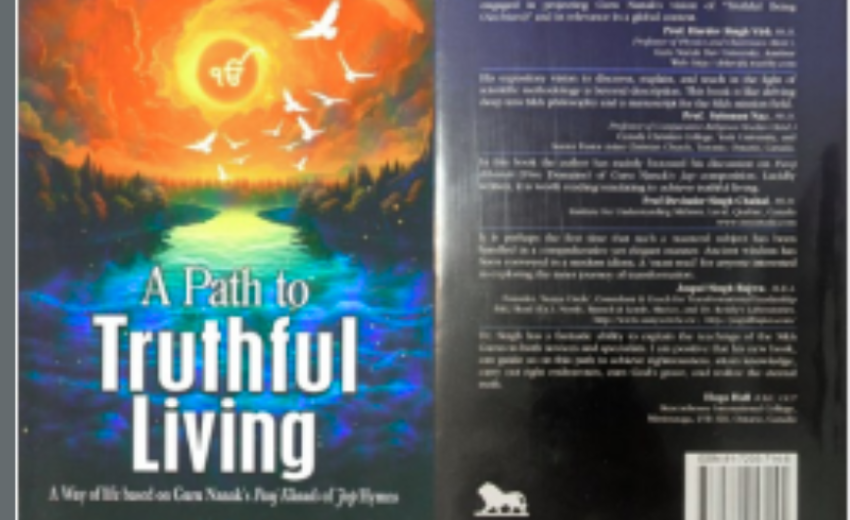

A Path to Truthful Living
(A Way of Life based on Guru Nanak's Panj Khand of Jap Hymns)
Book Title: A Path to Truthful Living
Author: Dr. D.P. Singh, Director, Centre for Understanding Sikhism, Toronto, Canada
Publisher: Singh Brothers, Amritsar; Website: www.singhbrothers.com
ISBN:81-7205-714-8; Price: Rs. 395.00; Pages: 256; First Edition: 2025.
Reviewer: Dr. H.S. Virk, Prof. of Eminence (Hon.), SGGS World University, Fatehgarh Sahib (Pb.)
Dr. D.P. Singh is a brilliant Physicist by training, a practicing Gursikh, and a dedicated researcher of Science and Sikhism. I was wondering how a physicist would justify his new venture as the Director of the Centre for Understanding Sikhism? After reading his half a dozen books on the Sikh religion, I am fully satisfied and testify that DP Singh is one of the best Sikh theologians in the Sikh world. He has not only imbibed the spirit of Sikhi based on the core principles of the Sikh scripture, Sri Guru Granth Sahib, but also interpreted its message for Sikhs in general and Sikh Youth in particular using scientific methodology.
Dr. Bhai Harbans Lal, a celebrated Scientist and a Theologian himself, mentions briefly in the introduction that DP Singh deems it necessary to give a background of the contents of this book before the discussion of the main theme. He presents the main topics under discussion by DP Singh and elaborates on the social and cultural background in which Guru Nanak launched his revolutionary mission to reform society, which was riven by the decadent religiosity of his times.
The author explains the purpose of writing “A Path to Truthful Living” in his Foreword: “This book is not a mere intellectual exercise or a scholarly treatise. It is a heartfelt exploration of Guru Nanak’s timeless teachings, presented in a way that seeks to touch the very core of our being”. The author further elaborates the central theme of his book: “The Panj Khands are five distinct domains of existence described by Guru Nanak in his profound compositions. Through the exploration of the Dharam Khand (Domain of Righteousness), Gyan Khand (Domain of Knowledge), Saram Khand (Domain of Endeavour), Karam Khand (Domain of Grace), and Sach Khand (Domain of Truth), we are encouraged to reflect on the nature of our thoughts, actions, and beliefs”.
“A Path to Truthful Living” has 16 Chapters. I will call the first seven chapters peripheral to the book's main theme. The author begins his narrative with “Guru Nanak- His Life and Time”, followed by “Jap Ji – An Introduction”, “Concept of Truth in Guru Nanak’s Hymns”, “Maya - The Veil of Illusion”, “Truthful Being (Sachiara)”, “Hukam”, and “A Path to Truthful Living”. Chapter 1 summarizes the life, teachings, and legacy of Guru Nanak in a concise manner. DP Singh displays his ingenuity and scholarship in delineating the history and philosophy of Guru Nanak. Chapter 2 explains the message of Jap in a nutshell: “Jap Ji defines a way for the truthful living to realize the Ultimate Truth”. Chapter 3 describes the concept of ultimate truth (Reality) and its realization by quoting appropriate hymns from Nanak Bani. The author concludes: “Ultimate Truth is a phenomenon free from the duality of apprehender and apprehended. The ultimate Truth can be realized only through a truthful way of living and by imbibing the love for Truth (God) in one’s life, and not by theorizing or speculating”.
Chapter 4, “Maya - The Veil of Illusion,” beautifully distinguishes between the Sikh and Advaita Vedanta concepts of Maya, a cornerstone of Hindu philosophy. The author enumerates eleven ill effects of Maya in his discourse. He concludes: “Maya is the corrupting influence of the world that alienates humankind from God. The root of maya is egoism”. Chapter 5 defines “Truthful Being (Sachiara)” and his role in society: “Guru Nanak’s ideal of sachiara (God-conscious truthful being) is free from haumai (self-centeredness) and vices, conflicts, and problems, the ego creates. He has shed duality, and his ego has been eliminated. He is not a conditioned or rationalized practice of virtue, but he practices good spontaneously”.
In Chapter 6, “Hukam – It’s Meaning, Scope and Significance”, the author illustrates his deep understanding of this concept, which governs all creation and activity in this Universe: “In Guru Nanak’s view, the hukam signifies the divinely instituted and maintained principle governing the existence and movement of the universe. It controls the universe, physical and psychical, and governs everything within it”. However, according to Gurbani, Hukam is indescribable: “The extent of Your hukam cannot be perceived; no one can describe it. (Sri Raag M. 1, p. 53)” Chapter 7, “A Path to Truthful Living,” is the foundation on which the structure of this book is erected, and its title is based. The author has done full justice to defining the concept of Truth in human life and its implications: “Truth is the foundation for a fair and just society.” He develops his thesis based on three cardinal principles (Naam, Daan, Ishnaan) and ten daily practices for a truthful living.
Chapter 8 “Panj Khands (Five Domains) – A Pathway to Ultimate Reality” is a core Chapter of this volume. The author has explained the Panj Khands based on the liturgical text of Guru Nanak, called Jap Ji. These are defined in Jap Ji: 1. Dharam Khand (Domain of Righteousness), 2. Gian Khand (Domain of Knowledge), 3. Saram Khand (Domain of Endeavour), 4. Karam Khand (Domain of Grace), 5. Sach Khand (Domain of Truth). These khands are not related to any celestial spheres in the literal sense of the word, but rather represent different phases of human life toward reaching Ultimate Reality.
Chapters 9-13 elaborate on the Panj Khands of Jap Ji, ascribed to Guru Nanak. The author has made a unique contribution to Sikh literature by defining and explaining five phases of human life in a scholarly manner, quoting appropriate hymns from Gurbani. In Dharam Khand, the devotee works in full cognizance of the worldly phenomena and their primal source of creation. Being fully aware of the universal law of cause and effect, the person is conscious of its immutability. The author recommends 10 daily practices from Sri Guru Granth Sahib to help you build your relationship with God. Chapter 10 “Gian Khand” pertains to spiritual knowledge: “Sikhism, without rejecting empirical knowledge, holds gian (spiritual knowledge) superior and more desirable than ordinary knowledge. Guru Nanak beautifully illustrates gian vis-à-vis practical knowledge in Jap composition.”
Chapter 11 deals with the third step in the ladder of Panj Khands. The author defines “Saram Khand” as the “Domain of Endeavour, where things are chiselled and beautified. It is the stage at which numerous human faculties are sharpened. On the whole, the mental, aesthetic, intellectual, and spiritual faculties of the devotee are sharpened in this domain”. Chapter 12 describes the fourth stage of Panj Khand. I agree with the choice of the author’s definition: “The fourth stage on the path of Truthful Living is the “Domain of Grace” (Karam Khand), where power and authority of the divine Word are established in the life of the devotee”. Chapter 13 deals with the fifth and final stage of spiritual evolution of a human being. The author traces its definition in Gurbani: “The domain of Truth is the realm of the Timeless One, the abode of the Formless Ultimate Reality”. According to Guru Nanak: In the Domain of Truth (Eternity), dwells the formless One, Who having created, watches over Its creation with a benevolent eye. (Jap Ji, p. 8). In this domain, there is a total merger of the human being and the Divine Reality.
The last three Chapters (14-16) may be considered as supplementary to justify the Title “A Path to Truthful Living”. These are important to complement the aims and objectives of the author, who justifies that truthful living is an urgent need of our time; it is the way for Peace and Harmony in this world full of strife; and Guru Nanak’s teachings have a universal relevance for all humankind. The author is aware of Guru Nanak’s concern for the environment and ecology: “Guru Nanak reveals that an awareness of the sacred relationship between humans and the environment is necessary for the health of our planet, and our survival. Such an integrated approach to the current ecological crisis can lead to a permanent sustainability of life on Mother Earth”.
To sum up, Dr DP Singh has created a masterpiece in Sikh literature of the twenty-first century. He has used Gurbani hymns from Sri Guru Granth Sahib to support his thesis with full conviction and clarity. It is written in simple language, which is intelligible to readers across a wide spectrum in India and abroad. I may call this book his magnum opus, and its author a doyen among the Sikh theologians. I recommend this book as a must-read among both the Sikh and non-Sikh circles.