
Abstract
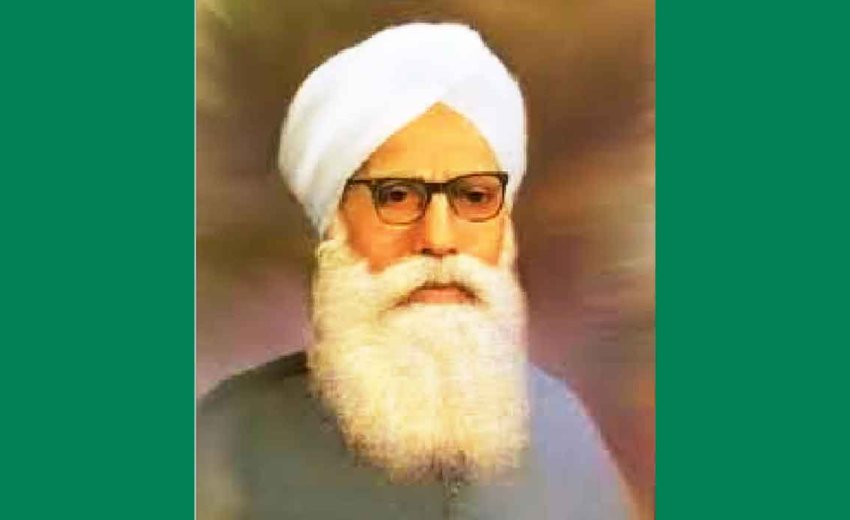
Sahib Singh, respectfully known as Professor Sahib Singh, was not only a towering Sikh scholar but also a man of deep humility and unwavering faith. Despite facing financial hardships in his early life, he remained inwardly steadfast and disciplined in character.
Personally, he lived a simple and principled life, balancing family responsibilities with intense scholarly dedication. His integrity, modest lifestyle, and spiritual commitment reflected the very teachings he interpreted. Even during his later years of illness, he remained composed and devoted, leaving behind a legacy of scholarship enriched with moral strength and personal grace.
A Journey from Modest Roots to Eminence
Few individuals shape their life with such conviction and purpose that they become a source of enduring inspiration for generation to come. Nathu Ram was born on 16 February 1892 in the village of Fatehwali, located in the Pasroor tehsil of Sialkot district in undivided Punjab (now in Pakistan). He was born into a modest and economically disadvantaged family. At the time of his birth, his father was approximately forty-five years old.
He was the eldest among five surviving children, having two younger brothers and three younger sisters. Several children born to his parents prior to him had not survived infancy. In accordance with a Hindu protective custom observed in such circumstances, his parents adorned him with a nose ring (nath) to ward off evil and safeguard his life. It was from this ritual that he received the name “Nathu Ram,” a name that thus carries a story of faith and cultural significance
From the early stages of education to advanced scholarly pursuits, Nathu ram academic path demonstrates dedication, resilience, and a passion for learning. At the age of four and a half, his primary education was initiated under the guidance of Hyatt Shah, the son of Hasham Shah, the esteemed court poet of the Darbar of Maharaja Ranjit Singh. This early instruction laid the foundation for his academic growth.
Subsequently, he enrolled in a primary school along with the son of his grandmother’s sister and successfully completed his studies up to the fifth grade. In January 1902, he gained admission to the Vernacular Middle School at Gota Fatehgarh. After completing the eighth grade in January 1905, he proceeded to pursue higher education at the High School in Pasroor.
During his ninth-grade studies, he demonstrated exceptional intellectual ability by mastering Sanskrit within a mere three months of vacation—an accomplishment for which other students typically required three years of study.
In September 1906, during his high school years, Nathu Ram experienced a profound spiritual transformation; inspired by the dignified appearance and commitment of his cousin, who had embraced the name Dharam Singh, he partook in Amrit (Amrit Chak) and thereafter adopted the name Sahib Singh. At the tender age of 15, on 20th July 1907, following the demise of his father, the responsibility of supporting the family fell upon his shoulders, compelling him to discontinue his education and seek employment. Despite belonging to a financially struggling family, his father ensured that he received an education by taking loans to support his schooling. Recognizing Sahib Singh’s potential, his teachers consistently encouraged his father to continue his studies, emphasizing that he was a bright and deserving student. In 1909, he applied for his first position at a middle school in Sangla, serving as a Second Headmaster. However, in April 1910, his services were terminated. After remaining unemployed for nearly two and a half years, he secured a position as a clerk in the Post Office in December 1910, earning a modest monthly salary of twenty rupees. However, the income proved insufficient, as it was largely consumed in repaying family debts, leaving little financial relief.
In May 1911, he met his former middle school classmate, Mohammad Ashraf, who was then pursuing his F.A. studies. This encounter rekindled a new hope within him to resume his own education. It was a decisive and courageous step — almost a gamble — as he believed that only through academic advancement could he liberate his family from poverty and debt. He was aware that failure would leave him with neither progress nor pride, but he chose to pursue education despite the risks. On 6th sept, before 10:0 am left his home for Lahore, Dayal Singh college. To pursue his F.A. studies, he received financial assistance in the form of a scholarship from the college and additional support from a close friend, who generously provided pocket money. This encouragement and aid enabled him to continue his education despite the severe financial constraints he faced. In 1913, the results of his F.A. examination were declared, and he secured the seventh position. In recognition of his outstanding academic performance, the government agreed to bear the expenses of his B.A. studies and awarded him a scholarship of ten rupees per month. Accordingly, in September 1913, he enrolled in Government College to pursue his Bachelor of Arts degree. In May 1915, he successfully completed his graduation, securing the third position in the college and the thirteenth position in the university.
To fulfill the very purpose for which he had undertaken considerable risk and perseverance, he sought employment with firm resolve. On 8 September 1915, he joined a school at Farooke as a Third Master. The institution was managed by Bhai Hira Singh, a Raagi. His monthly salary was fixed at Rs. 75. Upon his promotion to the post of Superintendent, he received an additional allowance of Rs. 12 per month, which was subsequently increased to Rs. 20 per month.
After clearing all his debts and freeing himself entirely from financial liabilities, he permanently left Farooke on 9 May, thereby closing that significant chapter of his life. In 1917, his mother also passed away, marking a profound personal loss and a period of deep sorrow in his journey.
After continuing his professional career at Gujranwala College, he later joined the Shiromani Gurdwara Parbandhak Committee as its General Secretary. He served the Committee with dedication until 13 September 1927. During this significant phase of his life, he devoted himself earnestly to religious, educational, and organizational reforms.
On 17 September 1927, he joined Guru Nanak Khalsa College, Gujranwala and resumed his academic contributions. Notably, during his tenure with the Shiromani Committee, he undertook an in-depth and scholarly study of Gurbani grammar. His focused engagement with linguistic and theological analysis brought forth a revolutionary intellectual dimension to his work, reflecting both reformist zeal and profound commitment to Sikh scholarship. During his tenure as General Secretary of the Shiromani Committee (until 13 September 1927), he witnessed and actively participated in some of the most defining agitations of the Sikh reform movement. This period coincided with the historic Gurdwara Reform Movement, which sought to liberate Sikh shrines from corrupt mahants and place their management under representative Sikh control.
He closely observed the aftermath of the tragic events of the Nankana Sahib Massacre (20 February 1921), which deeply stirred the Sikh community and intensified reformist efforts. He was associated with the wider mobilization that followed, contributing organizationally and intellectually to the cause.
He also witnessed the developments surrounding the Guru Ka Bagh Morcha (August–November 1922), during which peaceful Sikh volunteers faced severe repression while asserting their right to access gurdwara land. The movement demonstrated the community’s commitment to non-violent resistance and discipline. His role in coordinating, supporting, and documenting such efforts strengthened his administrative experience and reformist resolve.
Furthermore, the Jaito Morcha (1923–1925) proved to be a prolonged and testing struggle. The agitation, launched in defense of Sikh religious rights and institutional autonomy, resulted in large-scale arrests of volunteers. During this turbulent phase, he too faced imprisonment for his participation and association with the movement. His time in jail became a period of intense reflection rather than discouragement.
It was during imprisonment and throughout his service in the Committee that he devoted himself earnestly to the systematic study of Gurbani grammar. In the quiet and disciplined environment of confinement, he engaged deeply with linguistic structures, exegetical methods, and doctrinal clarity. These experiences laid the foundation for his later scholarly contributions, through which he sought to present Gurbani interpretation in a structured and grammatically grounded manner.
Thus, his years with the Shiromani Committee were marked not only by administrative responsibility but also by direct involvement in historic agitations, personal sacrifice through imprisonment, and the intellectual maturation that shaped his revolutionary approach to Gurbani scholarship. After completing his distinguished service in the reform movement and the Shiromani Committee, he joined Khalsa College, Amritsar in 1929 as a Lecturer in Punjabi and Divinity. He remained associated with the institution until his retirement in 1952, rendering nearly three decades of dedicated academic service. At Khalsa College, he emerged not merely as a teacher but as a distinguished scholar of Gurbani and Sikh history. His classroom became a center of rigorous intellectual engagement, where he emphasized grammatical precision, contextual interpretation, and doctrinal coherence in understanding Gurbani. Among his most important works are:
- Sri Guru Granth Sahib Darpan – His magnum opus, a comprehensive grammatical commentary on the entire Guru Granth Sahib. In this work, he systematically applied principles of Gurbani grammar to clarify meanings, resolve ambiguities, and present interpretations grounded in linguistic accuracy rather than traditional assumptions.
- Sri Dasam Granth Darpan – A detailed analytical commentary offering grammatical and doctrinal examination of compositions attributed to Guru Gobind Singh Ji.
- Jap Ji Sahib Darpan – A focused grammatical and theological exposition of Japji Sahib, explaining structural coherence and doctrinal depth.
- Asa Di Vaar Darpan – An analytical interpretation highlighting historical context and internal consistency of Asa Di Vaar.
- Gurbani Vyakaran – A foundational work outlining the grammatical framework necessary for correct understanding of Gurbani. This text became the methodological base for his later commentaries.
Through these steeks, he introduced a revolutionary and scientific approach to Gurbani Arth. He demonstrated that Gurbani must be interpreted according to its grammatical structure, contextual flow, and Gurmat philosophy. His method rejected mythological insertions, sectarian biases, and speculative meanings, instead restoring scriptural interpretation to linguistic discipline and doctrinal clarity. Although he did not enroll in a conventional doctoral program or pursue a Ph.D. through formal academic research registration, his extraordinary scholarship earned him the highest academic recognition. In acknowledgment of his monumental contributions to Gurbani exegesis, linguistic analysis, and Sikh theology, he was conferred the honorary degree of Doctor of Literature (D.Litt.) by Panjab University.
This distinction was awarded in recognition of his pioneering and methodical work, particularly his comprehensive commentary Sri Guru Granth Sahib Darpan, as well as his foundational research in Gurbani grammar. The conferment of the honorary doctorate reflected the academic community’s appreciation of his original methodology, intellectual rigor, and lasting impact on Sikh studies. In the final years of his life, he suffered from Parkinson’s disease, a progressive neurological disorder that gradually affected his physical strength and mobility. The illness brought increasing physical limitations, including tremors and weakness, making routine activities and scholarly work difficult.
Despite these challenges, he endured his condition with remarkable patience, dignity, and spiritual composure. His life had always been rooted in discipline and faith, and even during illness, he remained inwardly steadfast. Though his active academic engagement diminished due to declining health, his intellectual legacy and previously completed works continued to guide students and scholars of Gurbani and Sikh history.
Those who met him during this period often observed his calm acceptance of suffering, reflecting the Gurmat principles he had taught throughout his life. His final years thus stood as a testament not only to his scholarly greatness but also to his spiritual resilience and unwavering devotion. During the advanced stage of Parkinson’s disease, one particularly remarkable aspect of his life was his unwavering mental clarity despite severe physical weakness. Although tremors and frailty restricted his movement and writing ability, his memory, analytical sharpness, and spiritual awareness remained largely intact. Visitors and former students who met him during this period often noted that he could still discuss complex points of Gurbani grammar and doctrinal interpretation with precision.
On some occasions, even when his hands trembled and speech slowed, he would gently correct misinterpretations of Gurbani or clarify subtle grammatical nuances from memory—demonstrating that his scholarship was deeply internalized rather than dependent on books or notes. This left a profound impression on those present.
He left behind a legacy of disciplined scholarship, grammatical precision in Gurbani interpretation, and unwavering commitment to Gurmat principles.
His life stands as a synthesis of faith and reason—an enduring inspiration for scholars, students, and seekers alike.