
How the Nishan Sahib is Maintained and Respected in Gurudwaras Worldwide
A saffron flag with the sikh emblem, khanda, stands tall in all gurudwaras. It is called Nishan Sahib. Even if you’re passing by a gurudwara, you’d see the Nishan Sahib tall on its flagpole, clearly visible from a distance. To many, it may appear to be a religious flag marking a place of worship. For Sikhs, however, it represents far more than identity or location. The Nishan Sahib reflects faith, responsibility, service, and the collective spirit of the Sikh Panth.
Its presence tells a simple message. This is a place where anyone can walk in without fear. Food, shelter, and dignity are available to all, regardless of religion, caste, gender, or social status. The way Sikhs treat, maintain, and honour the Nishan Sahib shows how deeply these values remain rooted in daily practice.
Origin of the Nishan Sahib
The Nishan Sahib has its roots in the early period of Sikh history. Its origin is closely linked with Guru Hargobind Sahib, the sixth Sikh Guru. In 1606, Guru Hargobind Sahib established the Akal Takht in Amritsar. This marked a clear shift in Sikh thought. Sikhs would now balance spiritual devotion with social and moral responsibility.
At this time, Guru Hargobind Sahib raised a flag over the Akal Takht. This flag came to be known as Akal Dhuja, meaning the eternal flag, or Satguru ka Nishan, the standard of the True Guru. This act carried a strong meaning. The flag did not represent political rule. It represented moral authority and the right to stand against injustice.
Later, Guru Gobind Singh, the tenth Sikh Guru, reinforced the importance of the Nishan Sahib. With the formation of the Khalsa Panth in 1699, the flag became a symbol of collective Sikh identity. It stood for discipline, courage, and readiness to protect the weak.
In 1771, Sardar Jhanda Singh of the Bhangi clan installed a Nishan Sahib atop Harmandir Sahib. From then on, the presence of the flag became closely tied to Sikh places of worship. Every gurdwara began to display it prominently.
The Nishan Sahib also played an important role in Sikh history during times of conflict. During the period of Guru Gobind Singh and throughout the eighteenth century, Sikh armies carried the flag at the front. Specially appointed flag bearers, known as nishanchis, marched ahead of the Sikh forces. The flag reminded them that even during battle, they carried moral responsibility and restraint. From its beginning, the Nishan Sahib symbolised Sikh sovereignty guided by ethics, faith, and service rather than power or dominance.
Symbolism of the Nishan Sahib
The Nishan Sahib follows a traditional and recognisable design. It is triangular in shape and made from cotton or silk. The colour is usually saffron or deep orange. In Sikh tradition, these colours represent sacrifice, courage, and readiness to stand for truth.
The word Nishan comes from Persian and refers to a sign or standard. Sahib comes from Arabic and is used as a respectful term meaning master or revered one. Together, Nishan Sahib means a respected or sacred flag. The term jhanda, commonly used in Punjabi and Hindi, simply means banner or flag.
Most Nishan Sahibs display the Khanda symbol. Each part of the Khanda carries meaning that reflects Sikh teachings. The double-edged sword at the centre represents divine wisdom and truth. It reminds Sikhs that truth has the power to cut through falsehood and ego. On either side of the central sword are two curved swords. One represents Piri, which stands for spiritual authority. The other represents Miri, which stands for worldly responsibility and justice. These swords show that spiritual life and daily action must stay balanced. Also, there is a circular symbol or chakra around it. The circle represents unity, equality, and the oneness of humanity. It has no beginning and no end, reminding Sikhs that divine truth remains constant.
Ceremonies Associated with the Nishan Sahib
Every gurdwara treats the Nishan Sahib with great respect. It usually stands on a tall flagpole placed near the main entrance or in an open area where it remains clearly visible. The pole often rests on a marble or concrete base, and the area around it is kept clean and orderly.
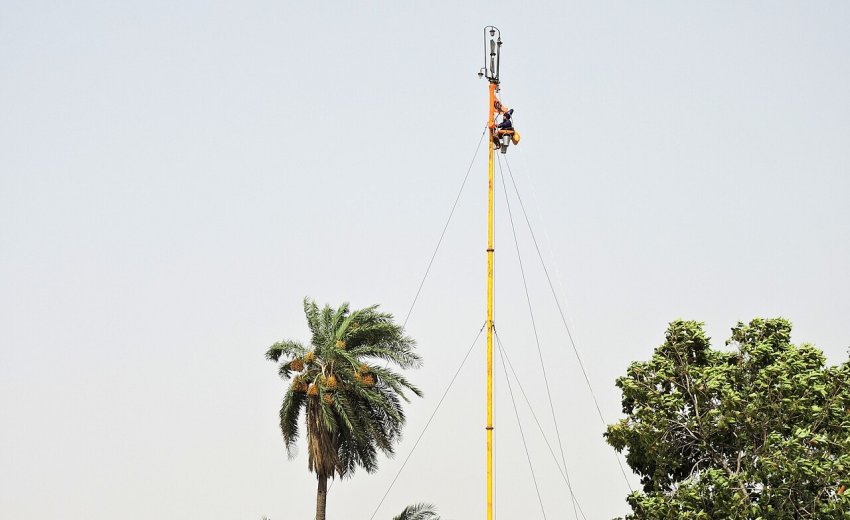
The cloth wrapped around the flagpole matches the colour of the Nishan Sahib. Over time, this cloth wears out due to weather and exposure. Sikhs regularly replace it through a formal and respectful ceremony. This renewal usually takes place on important Sikh occasions such as Vaisakhi. During the ceremony, members of the sangat gather together. They wash the flagpole with milk and yogurt, substances traditionally associated with cleanliness and respect. After this, a new cloth is carefully wrapped around the pole. It reflects the Sikh belief that respect for faith must show itself through action and collective participation. The ceremony allows the sangat to take part in seva and reaffirm their connection with Sikh tradition.
The Nishan Sahib also plays a central role in Sikh processions. During Nagar Kirtan, which are religious processions held on major occasions, the Nishan Sahib leads the gathering. Five Sikhs known as the Panj Pyare carry Nishan Sahibs at the front. Behind them follows the palki carrying Sri Guru Granth Sahib, accompanied by kirtan and the sangat.
Moreover, public Sikh gatherings often begin with the hoisting of the Nishan Sahib. A respected member of the Sikh community usually performs this task. The act highlights that the flag represents the Panth as a whole, not individual authority. Through these customs, Sikhs maintain a living connection with their history and values.
Role of the Nishan Sahib in the Present Day
Even now, the Nishan Sahib continues to hold strong meaning for Sikhs everywhere. Whether in large cities or small towns, the flag signals the presence of a gurdwara and the values it upholds. One of its most important meanings is shelter. Historically, the Nishan Sahib guided the hungry, the homeless, and the persecuted to gurdwaras where they could find safety. This tradition continues today through langar, the free community kitchen that operates in every gurdwara. Anyone who sees the Nishan Sahib knows they can enter and receive a meal with dignity.
The Nishan Sahib also helps Sikhs maintain a shared identity across the world. No matter where a gurdwara stands, the flag remains the same. This consistency creates a sense of belonging among Sikhs living far from their original homes.
In multicultural societies, the Nishan Sahib serves as a visible reminder of Sikh values. For non Sikhs, it often becomes the first point of contact with Sikh principles of equality, service, and justice. Spiritually, the Nishan Sahib reminds Sikhs of their duties. It encourages them to live honestly, help those in need, and stand against injustice. It does not allow faith to remain limited to prayer alone. Instead, it calls for action guided by ethics and compassion.
Final Words
The Nishan Sahib holds a central place in Sikh life. From its beginnings under Guru Hargobind Sahib to its presence in gurdwaras across the world today, it reflects faith joined with responsibility. Its design carries meaning, its maintenance reflects discipline, and its message remains clear.
Nishan Sahib is more than just a flag. It represents service, courage, and openness. As long as it flies outside gurdwaras, it reminds Sikhs of their duty to live with integrity, protect the vulnerable, and serve humanity without distinction.
Reference Links:
The World Sikh News - Nishan Sahib proclaims the unique identity of Sikhs and Sikhism
https://www.theworldsikhnews.com/nishan-sahib-proclaims-the-unique-identity-of-sikhs-and-sikhism/
Explains the Nishan Sahib as the sacred Sikh flag that marks every gurdwara and represents Sikh identity, sovereignty, and core values such as equality, service, and refuge for all who seek shelter and justice.
ShiningSikh - The Sacred Symbol: Understanding the Nishan Sahib
https://shiningsikh.com/the-sacred-symbol-understanding-the-nishan-sahib/
Summarises the Nishan Sahib as the sacred Sikh flag displayed at every gurdwara, outlining its historical origins, religious symbolism, and its role as a marker of Sikh identity, spiritual values, and refuge for all who seek help.
Wikipedia - Nishan Sahib
https://en.wikipedia.org/wiki/Nishan_Sahib
The article explains Nishan Sahib as the Sikh flag symbolising the faith’s identity, sovereignty, and core values, detailing its origins, design, religious importance, and role at gurdwaras around the world.