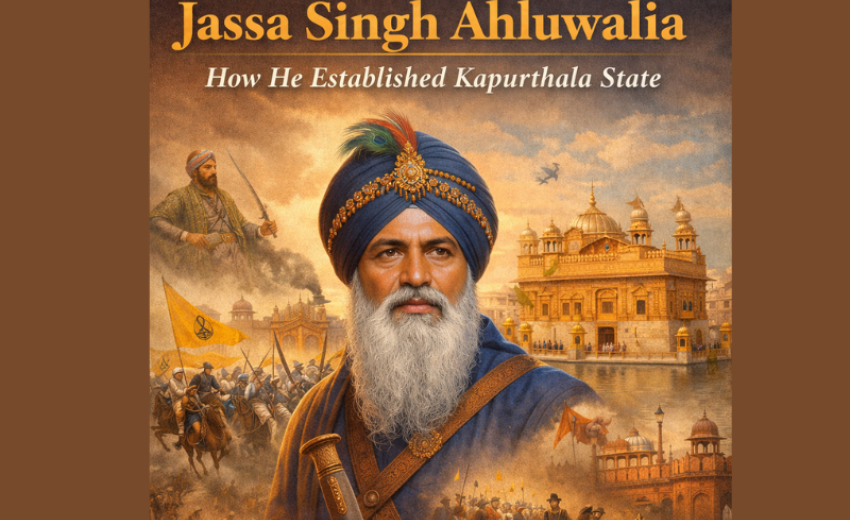

How Jassa Singh Ahluwalia Established Kapurthala State
Jassa Singh Ahluwalia holds an important place in Sikh history. The establishment of Kapurthala State is an integral part of his life. Jassa Singh Ahluwalia’s rise occurred during one of the most unstable periods in North Indian history, when Mughal authority collapsed and repeated Afghan invasions devastated Punjab. Through disciplined leadership, military organisation, and political foresight, he transformed a confederation of Sikh warriors into a territorial power. The foundation of Kapurthala in 1779 marked the beginning of a princely state as well as the establishment of Sikh authority in the central Punjab.
Early Life and Formation of Leadership
Jassa Singh Ahluwalia was born on 3 May 1718 in the village of Ahlu near Lahore. His family belonged to a Jat Sikh background and adopted the name Ahluwalia from their ancestral village. Sikh tradition records that his birth followed the blessings of Guru Gobind Singh sought by his ancestors, a belief that deeply shaped his religious outlook and sense of responsibility.
The turmoil following the execution of Banda Singh Bahadur in 1716 defined Jassa Singh’s formative years. Mughal governors intensified persecution of Sikhs, forcing them into forests and hills. These conditions hardened Jassa Singh’s character and introduced him early to warfare, discipline, and collective leadership. He grew under the guidance of senior Sikh leaders and absorbed both spiritual training and martial skills, preparing him for a leadership role that demanded endurance rather than formal education.
Rise within the Dal Khalsa and the Ahluwalia Misl
In 1733, the Mughal governor Zakariya Khan attempted reconciliation with the Sikhs by offering them a jagir and recognition. The Sarbat Khalsa responded by appointing Nawab Kapur Singh as leader, who reorganised Sikh forces into the Budha Dal and Taruna Dal under the collective banner of the Dal Khalsa. This structure created discipline, territorial clarity, and command hierarchy among Sikh bands.
Jassa Singh Ahluwalia emerged as a key figure within this system. His administrative ability, battlefield presence, and personal integrity earned wide respect. In 1748, Nawab Kapur Singh formally appointed him as successor. The Sikh community conferred upon him the title Sultan-ul-Qaum, recognising him as the national leader of the Khalsa.
As head of the Ahluwalia misl, Jassa Singh commanded both military and moral authority. He coordinated actions among different misls during crises, resolved internal disputes, and upheld Sikh principles of collective decision-making. His leadership transformed the Dal Khalsa into a force capable of confronting imperial powers
Military Campaigns and Territorial Expansion
Jassa Singh Ahluwalia’s leadership coincided with repeated invasions of India by Nadir Shah and later Ahmad Shah Durrani. During Nadir Shah’s invasion in 1739, Sikh forces under Jassa Singh attacked Afghan columns and freed Indian women taken as captives, returning them safely to their families. This action enhanced Sikh prestige and moral standing across Punjab.
Ahmad Shah Durrani launched nine invasions between 1747 and 1769. Despite severe losses, including the massacre known as Vadda Ghalughara in 1762, Jassa Singh reorganised Sikh resistance and maintained pressure through guerrilla warfare. Sikh forces harassed Afghan supply lines, disrupted communications, and prevented long-term Afghan control of Punjab.
In 1761, Sikh forces captured Lahore, killed the Afghan governor Khawaja Abed Khan, and issued coins in Jassa Singh’s name. Contemporary Persian sources confirm that Sikh authority openly challenged imperial symbols. Jassa Singh also led campaigns across the Jalandhar Doab, Malerkotla, Sirhind, and the hill states, compelling local rulers to pay tribute and accept Sikh supremacy.
Following the sack of Sirhind in 1764, Jassa Singh supervised the division of territory among Sikh misls. He retained strategic villages while ensuring fair distribution among allied forces. From the wealth gathered during campaigns in the Ganga-Yamuna Doab, he allocated substantial funds for rebuilding the Harmandir Sahib at Amritsar, personally contributing large sums and overseeing reconstruction for several years.
Establishment of the State
The decisive step toward state formation occurred in December 1779. Kapurthala, located near the Beas River, stood under the control of Rae Ibrahim Bhatti, who had failed to pay tribute and had fortified the region aggressively. The killing of Jassa Singh’s son-in-law during a skirmish near Kapurthala further escalated tensions.
Jassa Singh led a coordinated military operation against the Bhatti chief. His forces captured the surrounding villages systematically, cutting off resistance and isolating the main fort. Facing inevitable defeat, Rae Ibrahim sought peace. Jassa Singh allowed him safe passage with his family and granted him an allowance, demonstrating restraint and political maturity.
Kapurthala became the headquarters of the Ahluwalia misl and the capital of the emerging state. Although Jassa Singh continued to reside at Fatehabad, the occupation of Kapurthala marked the transition from mobile confederacy to territorial governance. Administrative control, revenue collection, and military organisation now operated from a fixed centre.
Authority Beyond Kapurthala
Jassa Singh Ahluwalia’s authority extended far beyond Kapurthala. Hill rulers of Kangra, Bilaspur, Nalagarh, and Jammu paid tribute. Nawabs of Malerkotla and Kunjpura acknowledged his dominance. Even rival Sikh chiefs often deferred to his leadership during collective campaigns.
In March 1783, Sikh forces under Jassa Singh and Baghel Singh marched on Delhi. After entering the Red Fort, Sikh leaders placed Jassa Singh on the Mughal throne. When internal disagreements arose, he immediately renounced the title, preventing conflict within the Khalsa. The campaign concluded with Mughal authorities agreeing to construct seven Sikh gurdwaras in Delhi, securing lasting religious recognition.
Enduring Legacy
Jassa Singh Ahluwalia died on 23 October 1783 in Amritsar. By the time of his death, he had conquered Lahore, issued sovereign coinage, dictated terms to regional rulers, and laid the foundation of the Kapurthala State. Yet he lived personally with restraint, remained loyal to Sikh principles, and avoided personal kingship.
The Ahluwalia dynasty continued under his descendants, eventually producing rulers such as Maharaja Jagatjit Singh, who modernised Kapurthala and gave it international standing. The state’s later prosperity traced directly to the political and military foundations established by Jassa Singh Ahluwalia.
Reference Links:
Kapurthala Govenment - History
https://kapurthala.gov.in/history/
Explores the history of Kapurthala and its princely state, focusing on the rise of the Ahluwalia dynasty under Jassa Singh Ahluwalia, the state’s political developments, and its cultural and architectural legacy from its foundation through the reign of Maharaja Jagatjit Singh.
Wikipedia - Jassa Singh Ahluwalia
https://en.wikipedia.org/wiki/Jassa_Singh_Ahluwalia
Summarises Jassa Singh Ahluwalia as a prominent 18th-century Sikh leader who united the Sikh Misls, led key military campaigns against invading powers, and established the Kapurthala State.
Kapurthala Online - History of Kapurthala
https://www.kapurthalaonline.in/guide/history-of-kapurthala
Focuses on how the Ahluwalia dynasty under Jassa Singh Ahluwalia took control of the region in 1772, shaped its political power, and influenced its cultural and historical development over the centuries