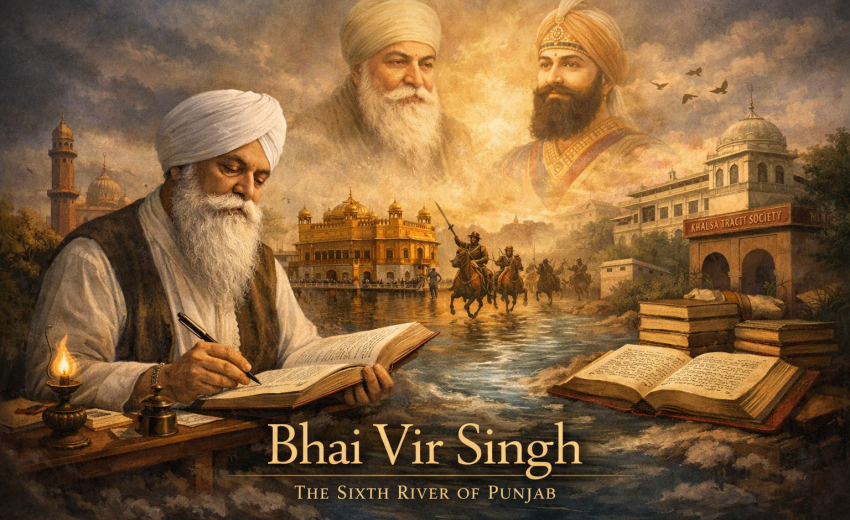

Bhai Vir Singh: The Sixth River Whispering Through Punjab’s Soul
Bhai Vir Singh’s life and legacy symbolize a spiritual and literary renaissance in Punjab during a time of cultural uncertainty. As a poet, historian, theologian, novelist, publisher, and reformer, he profoundly shaped the identity of modern Sikhism and pioneered Punjabi literature in its modern form. His contributions earned him the enduring title: The Sixth River of Punjab.
Background and Early Life
Born on December 5, 1872, in Amritsar, Bhai Vir Singh came from a lineage of scholars and theologians. His father, Dr. Charan Singh, was a well-respected physician, lexicographer, and poet in Braj and Sanskrit, while his maternal grandfather, Giani Hazara Singh, was a leading exegete of Sikh scriptures. Under their guidance, young Vir Singh imbibed deep literary, theological, and linguistic training in Sanskrit, Persian, Braj Bhasha, and classical Sikh exegesis.
He attended Church Mission School and graduated with top honors in 1891, earning a gold medal from the district board. Despite job offers, he turned to publishing and writing, aiming to serve the Sikh community through the written word—a mission he would uphold for the rest of his life.
Cultural and Political Context
The late 19th century saw Punjab reeling from the annexation of the Sikh Empire by the British. As Western ideas proliferated, and Christian and Hindu reform movements gained momentum, Sikh identity was at risk of dilution. In this climate of religious and cultural flux, the Singh Sabha Movement emerged to restore Sikh identity. Bhai Vir Singh became one of its intellectual vanguards.
Through print media, education, and literary innovation, Singh sought to strengthen Sikh self-awareness and faith, while simultaneously redefining Punjabi literature in a modern idiom.
The Foundation of Literary and Social Institutions
In 1892, Bhai Vir Singh co-founded the Wazir-e-Hind Press and in 1894 established the Khalsa Tract Society, which published low-cost religious tracts and literature for the masses. In 1899, he launched the Khalsa Samachar, the first daily Punjabi newspaper, a platform for religious education, women’s rights, and social reform.
His philanthropic work included founding the Chief Khalsa Diwan (1902), Khalsa College Amritsar, Punjab & Sind Bank, and the Central Sikh Orphanage. His tireless service exemplified the Sikh concept of seva (selfless service) on a community-wide scale.
The Birth of Modern Punjabi Literature
Bhai Vir Singh’s creative output spanned genres and decades. His 1898 novel Sundari, about a brave Sikh woman escaping Mughal captivity, is widely regarded as the first Punjabi novel. Its success led to further historical fiction such as Bijay Singh (1899), Satwant Kaur (1900, 1927), and Subhagji da Sudhar Hathin Baba Naudh Singh (1921), which popularized Sikh ideals and revived interest in Sikh history.
His magnum opus, Rana Surat Singh (serialized 1905–1919), a poetic epic of over 14,000 lines, symbolically reflects the post-fall Sikh psyche through the journey of a grieving queen. This work is revered as a cornerstone of Punjabi literary expression.
Philosophical and Spiritual Dimensions
Beyond literature, Bhai Vir Singh was a spiritual thinker. In works like Guru Nanak Chamatkar (1928) and Kalgidhar Chamatkar (1925), he explored the lives of the Sikh Gurus with lyrical grace and theological depth. These biographies, blending devotional fervor with historical narrative, remain essential reading in Sikh households today.
His poetry, often infused with mysticism, emphasized inner transformation, humility, and divine love. He saw the ego as the primary barrier between the individual and God. Collections like Dil Tarang (1920), Tarel Tupke (1921), Matak Hulare (1922), and Mere Saiyan Jeo (1953) highlight this spiritual yearning in metaphorical language that evokes comparisons with Milton, Yeats, and Tagore.
Lexicographer, Historian, and Commentator
Singh’s scholarly efforts went beyond poetry and novels. He revised Sri Guru Granth Kosh (1927), the authoritative dictionary of Sikh scripture, and published critical editions of foundational Sikh texts like Prachin Panth Prakash, Puratan Janamsakhi, and Sakhi Pothi.
His magnum opus in scholarship was the 14-volume annotated edition of Sri Gur Pratap Suraj Granth (1927–1935), authored by Bhai Santokh Singh. He then began a detailed Santhiya (commentary) on the Guru Granth Sahib, of which seven volumes were completed before his death in 1957. These works secured his reputation as the foremost exegete in modern Sikh tradition.
Recognition and Legacy
Bhai Vir Singh’s contributions were acknowledged during his lifetime and after:
- Padma Bhushan: Awarded by the Government of India in 1956.
- Honorary Doctorate: Conferred by Panjab University, Chandigarh in 1949.
- Sahitya Akademi Award: First recipient for Punjabi literature for Mere Saiyan Jeo in 1955.
- Membership: Appointed to the Punjab Legislative Council and the Sahitya Akademi Board.
His humility remained constant—he often published anonymously, considering himself merely a vessel for the Guru’s message. Despite his literary fame, he never sought personal recognition, reflecting his deeply spiritual character.
Spiritual Core
Bhai Vir Singh’s writing is a subtle rebellion against spiritual isolation. Ego—the persistent "I"—was his mourned foe. He offered instead the grace of the ‘continuous melody’ of the Guru Granth Sahib—a song in which individuality dissolves into col
tive harmony. He once wrote that each line of the scripture “moves ahead constantly… a continuous poetic joy… continuous bliss.”
Lasting Cultural Impact
Referred to by poet Harindranath Chattopadhyay as “The Sixth River of Punjab,” Bhai Vir Singh’s influence transcends generations. His works are still in circulation, studied in universities and religious institutions. The Bhai Vir Singh Sahitya Sadan in Amritsar, once his residence, now preserves his manuscripts, letters, and memorabilia.
Modern scholars regard him as the bridge between Sikh classical literature and its modern evolution. He helped rescue Punjabi from linguistic decline under British rule and made it a vibrant medium for spiritual and intellectual discourse.
Bhai Vir Singh was not merely a poet or a novelist—he was a spiritual architect, cultural revivalist, and literary pioneer. His life's work helped reinvigorate Sikh faith during an era of uncertainty and gave Punjabi literature the foundation upon which it flourishes today. Like the rivers that nourish Punjab’s soil, Bhai Vir Singh’s ink continues to nourish its soul.
Research Notes & Sources
-
SikhiWiki – Bhai Vir Singh
https://www.sikhiwiki.org/index.php/Bhai_Vir_Singh
Bhai Vir Singh’s contributions to Sikh literature, his role in the Singh Sabha Movement, and the scope of his literary and spiritual work. Highlights his importance in modern Sikh theology and Punjabi culture.
-
Singh, Harbans – The Encyclopaedia of Sikhism
https://www.panjabdigilib.org/webuser/searches/displayPage.jsp?ID=5342&page=1&CategoryID=1&Searched= Academic summary of Bhai Vir Singh’s intellectual development, family background, literary contributions, and reformist philosophy. -
Indian Express – Remembering Bhai Vir Singh
https://indianexpress.com/article/lifestyle/books/bhai-vir-singh-birthday-anniversary-literature-6593181/
His literary innovations, influence on modern Punjabi, and continuing relevance in Sikh and Indian culture. -
SinghStation – The Sixth River of Panjab
https://singhstation.net/2015/06/bhai-vir-singh-the-sixth-river-of-panjab/His multifaceted personality—poet, mystic, novelist, theologian—and his impact on Punjabi identity during colonial rule. -
The Tribune India – Literature as Resistance: Bhai Vir Singh's Legacy https://www.tribuneindia.com/news/archive/comment/literature-as-resistance-685143 How Bhai Vir Singh used literature to preserve Sikh identity under colonial pressure and inspired cultural resistance through poetic expression.