

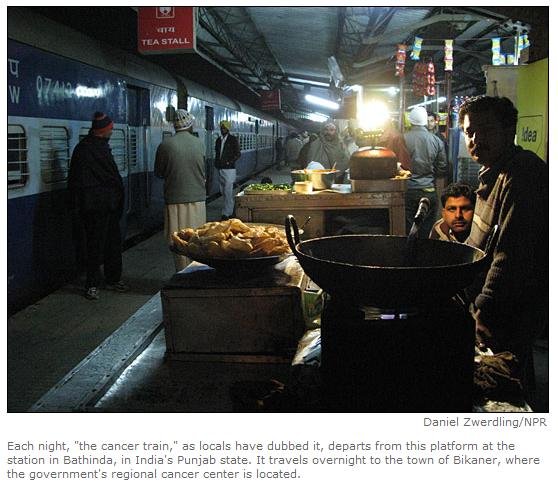
 Every night at about 9:30, Train No. 339 pulls into the shabby station in the northern Indian farm town of Bathinda, in Punjab state.
Locals call No. 339 by a chilling name — "the cancer train." It routinely carries at least 60 cancer patients who make the overnight journey with their families to the town of Bikaner for treatment at the government's regional cancer center.
People say they never used to see so many cancer patients in this farm region. Cancer was considered an urban disease, suffered by people who lived in cities choked with industry and pollution.
But research by one of the most respected medical institutes in India recently found that farming villages using large amounts of pesticides have significantly higher rates of cancer than villages that use less of the chemicals.
Researchers caution that the findings do not prove that pesticides are causing cancer. But they say the passengers crowding the cancer train are part of a medical mystery that could have repercussions around the world: Are the modern farming methods brought by the so-called Green Revolution of the 1960s and '70s making people sick?

'Everyone Is Getting Ill'
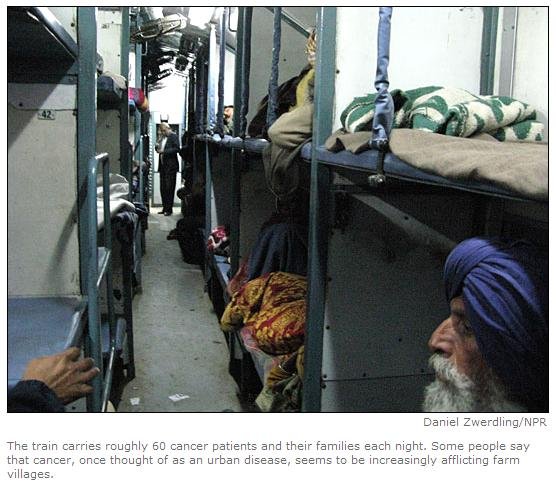 On a recent evening, just before the train arrives, waiting passengers wrapped in shawls sit glumly on the bare pavement. Vendors hawk tea and chapattis.
"He has blood cancer," says one man, explaining his upcoming journey by gesturing at his skinny, pale 16-year-old son, Jassa Singh, beside him. Another man points toward his little boy, and says bone cancer has attacked his hip.
A gaunt but dignified-looking man wearing a bright yellow turban says he is going to Bikaner for treatment of cancer in his throat.
"It's difficult to talk," he says, pushing a button in a device inserted in his throat that makes his voice sound like a computer synthesizer.
They are all from farm families. "The thing is, production is good," one of them says. "But everyone is getting ill. The health of people around here is deteriorating."
The Green Revolution swept across Punjab and much of Asia in the 1960s and '70s. In the context of the times, "green" did not refer to what it means today — organic, pesticide-free farming methods. This Green Revolution was led by a loose network of politicians, scientists and philanthropists in the U.S. and other nations, driven by a combination of humanitarian zeal and Cold War-era politics.
They were convinced that if farmers in developing countries like India switched from traditional methods to the American way of farming — with pesticides, fertilizers and high-yield seeds — they could fight hunger and prevent the region from going communist.
The Green Revolution helped India transform itself from a nation that chronically begged for food aid to one that often exports grains. But many farmers in Punjab now wonder if they're paying a price.
Troubling Signs Led To Study
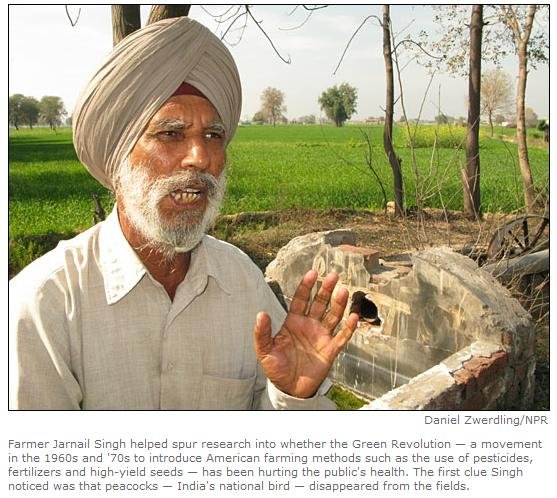 In the Punjab village of Jajjal, farmer Jarnail Singh played a role in spurring university researchers to study whether the Green Revolution has been hurting the public's health.
Singh says he noticed one of the first troubling clues in the late 1980s and early '90s: Peacocks — India's national bird — disappeared from the fields. Over the years, seven people in his family got cancer — and three of them died. People in Jajjal and surrounding villages got cancer, too.
Singh says he saw that many fellow farmers were overusing pesticides and not handling the toxic chemicals safely.
Many farmers "get totally covered" by pesticides when they spray them — "in their hair, on their body, in their eyes," he says. "And that got me thinking about, why aren't we really looking at that, how that may affect the farmers?"
Critics say government leaders pushed the Green Revolution before they had safeguards in place to protect the population. Although pesticide containers have warning labels, many farmers in countries like India cannot read well. Government agents hold workshops to teach farmers how to use chemicals safely, but those infrequent lessons may not sink in.
Overuse Of Pesticides
Some farmers in the area say they spray their crops a dozen times or more a season, not one or two times as the pesticide labels instruct. And many say they do not bother wearing protective clothing.
Singh started speaking out about the issue, first at a meeting in the village square, and then at environmental conferences. Several years ago, medical researchers at Punjab's School of Public Health, at the Postgraduate Institute of Medical Education and Research, launched a study to see if the fears were founded.
The study, based mainly on interviews with thousands of families in farming villages, and reviews of their medical records, was released last year. It found that Singh's hunch was right: There was a significantly higher rate of cancer in villages where pesticide use was heavy.
But the head of the School of Public Health who supervised the study, Rajesh Kumar, cautions that the research does not prove that pesticides were the culprit. He says it is important to remember something about health studies in general: They are difficult to carry out and often inconclusive, especially in developing countries.
Even in the U.S., which keeps better medical records than most countries, it takes years of research to link a certain chemical in the environment to cancer or other health problems in people. Even then, an epidemiological study can generally suggest a link but not prove it.
More Years Of Research Needed
Kumar says it would take many more years to demonstrate whether pesticides actually triggered the elevated cancer rates they found in some farming areas.
"It could be industrial pollution," says Kumar, mulling the other possibilities. Or perhaps as many farmers have improved their standard of living, they have smoked more tobacco and changed to unhealthful diets. Or a combination of all those factors, including pesticides, might have driven cancer rates higher, Kumar adds.
Meanwhile, other recent research suggests that pesticides might be linked to other health issues in Punjab. One study shows that children in villages that use high levels of pesticides score worse on memory and coordination tests.
Scientists caution that this research is not conclusive. But it's potentially troubling, particularly as the world's population keeps booming and the pressure remains for farms to produce high yields.
Cancer Train Commute Goes On
 The cancer train lurches to a stop in Bikaner's station, under a fat, full moon, at 6 a.m. The passengers file silently down the platform, as though they are sleepwalking, and line up for the motorized rickshaws idling outside.
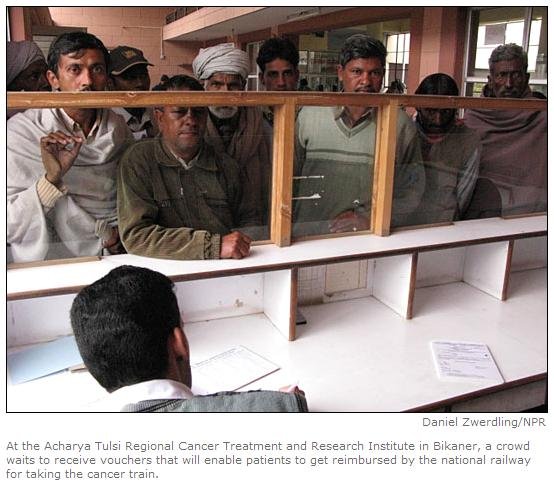
Soon, scores of them are crowding the hallways of the Acharya Tulsi Regional Cancer Treatment and Research Institute. There is a long line at one counter to get appointments. A crowd presses against another counter, where an employee fills out vouchers that will enable the patients to get reimbursed by the national railway for taking the cancer train.
Jassa Singh, the 16-year-old who has blood cancer, says he is "feeling well," but he and his family look anxious. He is about to get his blood test, which will tell him whether the treatments are working — or whether his life might be running out.
When they get the results, his family and most of the other passengers will head right back to the station for the eight-hour ride home — on the cancer train.