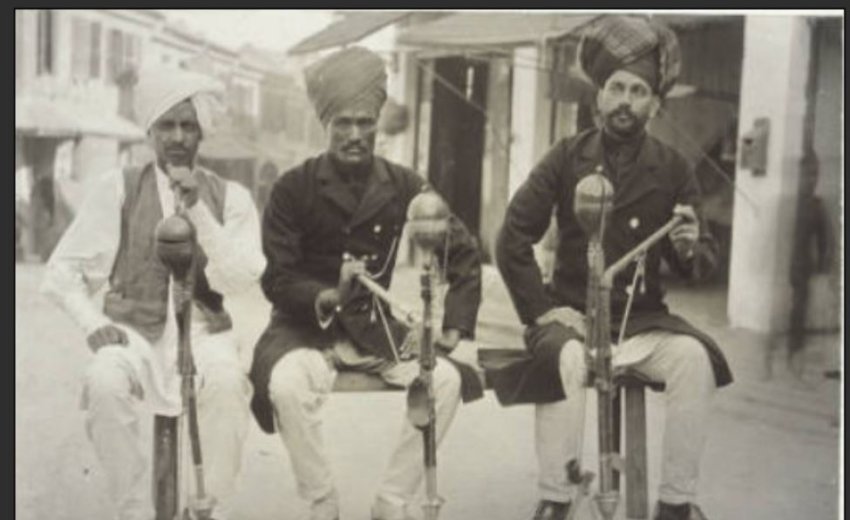
 It is widely accepted that Sikhs played a significant role in the British Indian Army, and hence the many British military campaigns fought on and abroad Indian soil . They impressed the British officers with their fearsome, martial persona and adept ability at mastering the drill. The ‘proud Sikh soldier’ and his various attributes prompted British administrators of Malaya and the Straits Settlements to consider the Sikhs as an appropriate racial category to recruit from for the para - military policing needs of the Malayan Native States and the Straits Settlements. The Sikh appearance and presence was effective, in the opinion of the British, in intimidating the Chinese Secret Societies and deterring the activities of the other ‘Eastern criminal classes’. Although the presence of significant Sikh communities in the Far East today can be largely attributed to the migration of Sikhs during the colonial era, in search for employment in the various law enforcement and security agencies of the eastern colonies, very little has been written about the role and contribution of the Sikhs in the colonial police forces of Malaya and the Straits Settlements.
 The recent publication, ‘Sikhs in the policing of British Malaya and Straits Settlements: (1874-1957)’ by Arunajeet Kaur explains the recruitment of Sikhs for the colonial police forces in British Malaya . Using primary documentation from the British and Malaysian Archives , the author pieces together the life and times of the early Sikh policeman - migrant to these parts of Asia. Beginning with their arrival on Malayan soil in1874, as Speedy’s men, to protect British tin and mineral investments in Perak , Arunajeet elaborates the structure and principles of Colonial policing and demonstrates how the Sikhs became a valuable strategy of colonial power in keeping subjects of the British colonies in the Far East in check. A second part to this publication describes how these Sikh policemen then formed the genesis and subsequent establishment of Sikh communities in Southeast Asia by being the initiators and contributors to the construction of places of Sikh worship and as propagators and participants of Sikh religious precepts and politics .
This publication fills the lacunae in the knowledge of the Sikh Diaspora in the Far East. While Sikh communities in the UK, US and Canada have received sufficient academic and public attention, Sikh communities in Southeast Asia have been constantly overlooked , at best mentioned in passing or as casual footnote when theorizing on overseas Sikhs . This publication is a first in focusing on the Sikh communities in Asia .