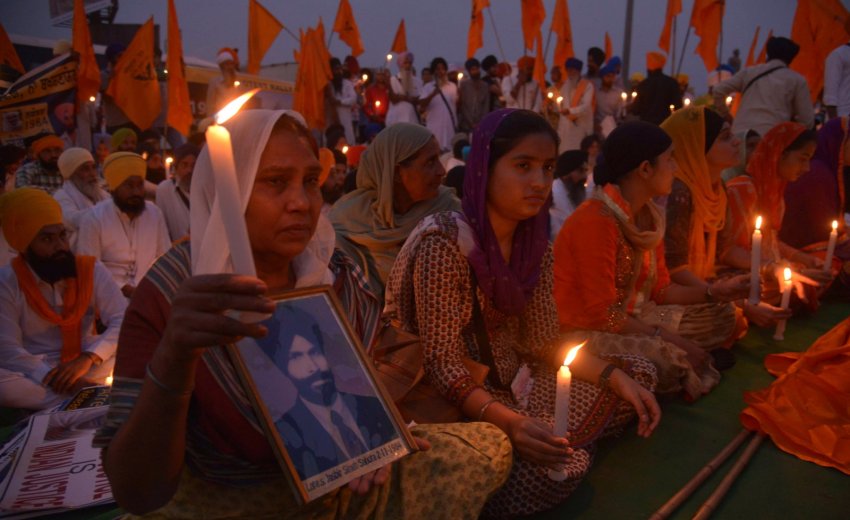
In the News: 1984

November 5th, 2009 by Sundari Source: thelangarhall.com

25 years ago history was made for several different reasons.  Today, as we reflect on the invasion, on the assassination, and on the massacres, we come across multiple news articles which provide information and commentary on the events of that year.  I wanted to take the time to document and highlight these articles as they’re worthy reads in providing information to readers around the world.  I encourage you to read these pieces – they are vital to our understanding and they will inform Sikhs and non-Sikhs alike about events in our history.
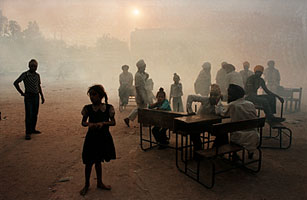
sikh_1022.jpg1. TIME magazine featured an article titled, “India’s 1984 Anti-Sikh Riots: Waiting for Justice.”  Our readers have previously argued against the use of the word “riot” and suggested that “genocide” is the more fitting description of what happened.  Regardless, this is an important article which discusses the often silent victims of 1984 – the widows and their children and the impact the events (and lack of justice) has had on their future.

The widows’ colony in Tilak Vihar is a cheaply built and neglected cluster of homes, which were given by the government to hundreds of women and their children who survived what have become known as the anti-Sikh riots of 1984. But as the grim event’s 25th anniversary nears at the end of this month, crime, addiction and prostitution have taken root in what was supposed to be a survivors’ safe haven. Residents say this is because of the damage to the mental health of children who were witness to their parents’ and siblings’ murders and who grew up in impoverished homes and weren’t given any medical help — physical or mental — for their problems. [link]

Of note: for the 25th anniversary of the event, advertisements by Ensaaf — showing an old woman wiping away her tears, with the words, “25 years ago, our loved ones were burned alive in front of our eyes,” and in the next line, “Why has India, the world’s largest democracy, denied us justice?” — are scheduled for the month of November in the San Francisco Bay Area’s transit system!

2. The BBC has an article titled, “Indira Gandhi’s death remembered” with a focus on the massacres that followed Indira Gandhi’s assassination.

As we walked through this implausible slaughter in the light of hurricane lamps provided by some residents, the complete silence despite the large mob surrounding us was eerie. No one spoke and nothing, except the bizarre, dancing shadows moved during this surrealistic interlude. Even one of the only survivors – a young polio-afflicted mother – holding her new born in her arms gazed sightlessly upon us. Her blank look momentarily changed into one of abject terror as we bent down to take her child to whom she fiercely clung. She probably took us to be the butchers who had massacred her entire family piled up high in the room behind her. A whimper led us to a barely conscious young Sikh, hiding under a heap of bodies, his slashed stomach wrapped crudely around with a turban. [link]

The sad reality?  Of the 2,733 officially admitted murders, only nine cases have so far led to the conviction of 20 people in 25 years; a conviction rate of less than 1%.

3. UK-based The Guardian reports on “No Justice for India’s Sikhs.”  In a personal account, the journalist speaks of her memories of 1984 and the lack of accountability which still permeates the Indian government.

Two and a half decades later, the language used to describe that night remains as blurry as ever. Was it a genocide? Who drew up lists of identification? Why did the police disappear or intervene to protect the mobs rather than the victims? Did Rajiv Gandhi, the incumbent prime minister, encourage the murders through his statements on the radio? Did members of Congress incite the killings? Why did ministers fail to act when they had been warned by the army that a “holocaust” might be unleashed that very night? Who kept the army at bay? In short, was this state-sponsored violence of the order that led to another decade of brutality in which some 10,000 Punjabi Sikhs, mostly men, were “disappeared” by the state? [link]

4. In another Guardian piece, “Garden murder that sparked a Delhi pogrom” describes one correspondent’s memories of the events that followed Indira Ghandi’s assassination.

In retrospect, one of the most interesting things is how quickly people learned to behave in new ways. The looters might have been looting all their lives, the youths who manned the road barriers might have served apprenticeships in stopping cars and searching them, the mobs who poured kerosene over dead or dying Sikhs did so, according to witnesses, quite matter-of-factly. Somewhere in south Delhi I came across a group setting fire to a Sikh-owned furniture factory and asked them what they thought they were doing. “Setting fire to a Sikh furniture factory,” one man said, as though it was the most natural thing in the world. [link]

5. Finally, Jaskaran Kaur, co-director of Ensaaf, wrote an opinion piece in the  San Jose Mercury News describing the role Bay Area residents can play in helping to seek justice for the massacres in India.  She speaks about the Sikh massacres as well as the violence against Muslims in Gujarat and Christians in Orissa.

Scars linger for survivors who have rebuilt their lives in the Bay Area. While local Sikhs will reflect on the 25th anniversary of the massacres this week, the vast majority of their neighbors will be unaware of the grief gripping the community. [link]

Read and be informed!

Comments

IN THE NEWS: 1984

Yesterday I raised simple and relevent question that "there is no mention of unlawful and inhuman activities by some sikhs in the state of punjab in 1984 in this topic" which has been deleted. now I am copy/pasting the comments from sikhnet which is indirectly more relevent. "I heard these people were defending Guru Beadbi(respect). These so called sikhs were staying illegally and told lies to get political asylum. I do not know how much sikh maryada they were following. What a bunch of Hypocrites proud of their upper class egoism. Akal takhat issues Hukamnama against people who dye their beards or sit in langar on chairs. what about Hukamnama against these type of people. On other hand thay are encouraging this type of phenomena as I read couple of days back that SGPS has made a task force of youths that will take care of any Guru's disrespect with force. Are we following Guru's footsteps? On one hand we are told our Gurus are supreme and powerful and on other hand we think people can disrespect our Guru. I think Guru is not confined to size or object. It is beyond and more than we can imagine. Did 6th Guru took revenge and ordered killings after Guru Arjun Dev Ji were tortured. Sikhs have to come out and oppose this Guru Bachao (save our Guru) movement. Now we save our Guru because he is so helpless and we are so powerful. If we keep encouraging this phenomena there is no difference between us and Talibans. We cannot blame the recent survey done in Canada where Canadians hated sikhs as much they hated muslims. This is wake up call. Do not blame other people when they hate us".

Toronto star

http://www.thestar.com/news/world/india/article/722530---blood-for-blood-wounds-still-raw-in-india NEW DELHI–For four blood-chilling days in the fall of 1984, Hindu rioters fanned through dusty alleys and leafy boulevards of this capital city thirsting for vengeance as they screamed "blood for blood." Indian prime minister Indira Gandhi had been gunned down by her two Sikh bodyguards while walking through the garden of her Delhi home. News spread fast that Oct. 31 morning and Hindu mobs demanded revenge. Through the weekend, they killed more than 2,700 Sikhs – first cutting their hair – then stabbing and bludgeoning them and tossing their bodies inside burning stores and homes. It was the worst rioting in India since it attained independence in 1947. Making matters worse, it became clear that police officers and the army, called in after the first day of rioting, stood idle amid the carnage. Dazed Sikh survivors later filed affidavits testifying the rioters had been directed by leaders of the ruling Congress Party. This week, 25 years after the riots, the north Indian state of Punjab has faced a virtual shutdown with a general strike and protesters blocking highways and trains to highlight the government's alleged failure to hold anyone to account for the mass killings. After some 10 government inquiries into the slayings – at least one of which concluded that politicians were responsible – long-simmering anger over that dark period of Indian history continues to haunt. Manmohan Singh, India's first Sikh prime minister, who has become known for his familiar powder-blue turban, used his first press conference as his country's leader to address the massacre. "I bow my head in shame that such a thing took place," he told Parliament four years ago. That apology hasn't eased anger in Punjab, India's Sikh majority state. "We felt like Jews in World War II," says Jarnail Singh, an Indian journalist whose new book I Accuse details the 1984 murders. "Sikhs were taking refuge in the Swedish embassy, we were being murdered, butchered, raped and hospitals were refusing to treat Sikhs who came in with burns. These wounds are still so deep. "For the first 24 hours after Indira Gandhi was murdered there were no killings," Singh says. "But overnight, there were buses brought in and rioters used voter lists to determine where Sikhs lived. It was state-sponsored murder." Both Amnesty International and Human Rights Watch issued reports this week asking the Indian government to prosecute those involved in the 1984 riots. "The victims of the 1984 massacres have waited for the law to take its course and, sadly, they are still waiting," said Meenakshi Ganguly, a senior researcher with Human Rights Watch. "Two decades after the incident, victims and their families seeking justice have been confronted by prolonged trials, biased prosecutors, an unresponsive judiciary, police intimidation and harassment of witnesses." In 1987, one inquiry concluded that as many as 19 people involved with the Congress Party were involved in the violence, including local leaders, party workers, youth workers and a personal assistant to a member of Parliament. The commission, headed by a Supreme Court judge, did not disclose names, however. Still, Sikh leaders have continued to point a finger at long-time Congress Party politicians Jagdish Tytler and Sajjan Kumar. Tytler and Kumar have denied the charges and this spring, as India prepared to hold a federal election, its Central Bureau of Investigation stated it had no evidence to suggest either politician was complicit in the riots. But both men have been asked by Congress leader Sonia Gandhi not to seek re-election. Author Singh, who threw a shoe at India's home minister for not prosecuting culprits for their roles in the riots, asked: "How is it that people accused of mass murder can go scot-free for 25 years?" While one Sikh bodyguard who murdered Gandhi was hanged (the other was shot dead after he killed her), those responsible for the 1984 riots still have not been convicted. The Times of India reported that 2,733 Sikhs were murdered in the rioting, but only eight people had been convicted.

Anti-sikh riots followed by

Anti-sikh riots followed by failure on part of indian govt to bring culprits to justice is blackest chapter of independent india's history. This is unbelievable but true. Along the same lines, skipping the mention of inhuman and anti-national acts on part of few sikhs before assasination of IG is equally inhuman and biased.

Comment viewing options

Select your preferred way to display the comments and click "Save settings" to activate your changes.