
 Just in case the rest of the world didn't know what a sorry state Punjab was in with respect to its gender imbalance, there has been two headline reports from Canada's biggest newspapers in recent weeks. The first deals with the problem in India and the second talks about how the problem has been exported to Canada.
The first from the Globe and Mail entitled "Land of the Rising Son", examines how India has responded to the decline of female births. There's two sad learnings from the article. One is that Punjab is still in the worst position with respect to male-female gender ration and the second is that an individual's level education has does little to reverse generations of discrimination.
The richest neighbourhoods in the country – the wealthy farming areas of the Punjab, the middle-class areas of Mumbai and other cities, and here, the leafy neighbourhoods in the south of the capital – have the biggest gaps.The article also speaks to economics of raising a female in India.
High-caste families in urban areas of the Punjab have just 300 girls for every 1,000 boys, researchers financed by Canada's International Development Research Centre (IDRC) reported last year. In South Delhi, it's 832 girls born per 1,000 boys; in the state of Haryana, home to the high-tech hub of Gurgaon, it's 822. (In “normal” circumstances, demographers expect to find 950 to 1,000 girls born for every 1,000 boys).
Conventional wisdom has long held that as India develops – as more families struggle their way into the middle class, more girls go to school and more women join the work force – traditional ideas about the lesser value of girls will erode. The incentive to abort them would fall away.
Instead, the opposite has happened, and the reasons – and solutions – have government and activists stumped.
“These educated, well-off women, who still want sons – this is really the crux of the problem and the government has not caught on to it,” says Farah Naqvi, author of a major study on attitudes to “son preference.”
“Yes, you have these very modern women today – you see them in spandex at the local gym … but it's a complicated modernity. It's two worlds these women are straddling.”
Women with a Grade 10 education or higher are four times as likely to have a second child who is a son, after a first daughter, as are women who are illiterate. “These educated, employed women are earning very well, and yet they prefer a son,” says N.B. Sarojini, head of SAMA, a health organization that tries to help women resist sex-selection pressure. “Why are rich women worst? If you have a male child, you are more valued in society – it's true in any class.” The crucial question, she adds, is why that idea has proved so immutable.
And then there's cold, hard economics: In the words of a Punjabi proverb, raising a daughter is like watering your neighbour's garden. Girls leave home at marriage, taking whatever skills or assets they have accrued. And the practice of dowry, once restricted to the highest castes, has been adopted at all levels of society – as a sign of social status – and is nearly universally practised even though it was outlawed in 1961. (Like the law against sex selection, this one seeks to alter a widely accepted social practice, and there is little enforcement – in fact, many feminists argue, government is reinforcing the practice by offering cash to unwed girls on their 18th birthdays.)So what happens to all these men who can't find wives?
In aspirant middle-class families in south Delhi today, a typical dowry provided to a groom's family can include a sports car, a large apartment, all its furniture including high-end electronics, and thousands of dollars in clothing. “Increasing materialism … and the emphasis on obtaining consumer lifestyle products has exacerbated the problem of dowry,” Ms. Naqvi says.
The shortage of potential wives is a subject of frequent coverage by the Indian media. And there are alarming stories – particularly from Punjab and Haryana – of human trafficking. Lower-caste women are bought in states such as Jharkhand, where the sex ratio is roughly equal, and then sold for a few hundred dollars in higher-caste communities.
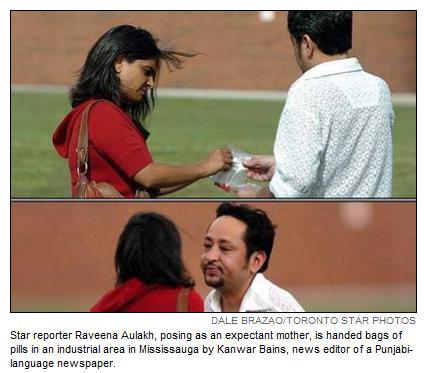
On a windswept street in a bustling industrial area on the outskirts of town, a stocky man in a white shirt and dark jeans pulls out three Ziploc bags containing red, brown and silver pills.Magic pills or not, the trend of more girls than boys in South Asian (and Punjabi) parts of Canada is clear.
Take two red and brown pills each day for a week, he tells the woman who says she is nine weeks pregnant, and your baby has an 85 per cent chance of being a boy. Then he demands $750 in cash.
Canada does not collect statistics based on ethnicity at birth. But statistics here, now home to more than a million Indo-Canadians, many from Punjab, also show a somewhat skewed gender ratio. According to 2006 census figures, nationally there are 932 girls to 1,000 boys under age 15 in the South Asian community, compared to 953 girls to 1,000 boys in the general population.Some significant indeed. If education doesn't help back home and moving to the West isn't helping us here, what then? Where do we go from here? Where are we going to end up?
The numbers in the South Asian community in the Toronto area become much more skewed: 917 girls to 1,000 boys in the Toronto Central Metropolitan Area. Broken down further, it shows 904 girls to 1,000 boys in Mississauga, and 864 girls to 1,000 boys in Brampton.
"That means the sex-ratio is 50 per cent higher for under-15 South Asians as compared to the general population (in the Toronto CMA)," said David Foot, professor of economics at the University of Toronto and a demographics expert. "I would say that is concerning."
That's a huge gap proportionally, says Myer Siemiatycki, a professor in immigration settlement studies at Ryerson University.
"In the Punjabi and South-Asian population, the numbers show a clear tilt in favour of men while it's the opposite in the national population (where overall there are more Canadian women than men). There's no question something significant is happening in the under-15 age group."
Hopefully the story of the Bedi family gives us hope.
Prabhsharan Bedi was born on a snowy March night 13 years ago.
While the baby and mother, Rupinder Bedi, were still in hospital, Randhir Bedi, the father, bought sweets and distributed them to family members and friends. When the mother and her baby girl returned home, the couple invited almost a 100 people for a celebration.
Over the next 12 years, the couple welcomed three more daughters – and celebrated in similar fashion. Manmeet is 10, Binwant is 8 and Japneet will shortly turn 3.
It is not rare but unusual for a Punjabi family to have three or four daughters.
"Girl or boy, it never mattered to us," says Randhir. "But people are funny. Every time we've had our babies, people, even family members, have almost ... commiserated."
Randhir, 39, who lives in Mississauga and works in Woodbridge, says even his own parents, who live with the family, have dropped subtle hints "that it'll be nice to have a boy also. They love the girls but think there should be a boy too."
The couple, who immigrated in 1991, laugh it off and tell their parents how brilliant the girls are and how they will make the family proud.
"It's the way our culture is – everyone believes a family is incomplete without a boy," says Randhir.
"Rupinder and I don't believe in it and we tell people that."