Piety by Proxy: Who Are We Kidding?
Many years ago, I happened to be in Nanded (Maharashtra) and went to Hazur Sahib gurdwara to pay homage to the Tenth Guru, Gobind Singh, who was assassinated there in 1708.
It is one of the most sacred of gurdwaras.
I came across something which baffled me.
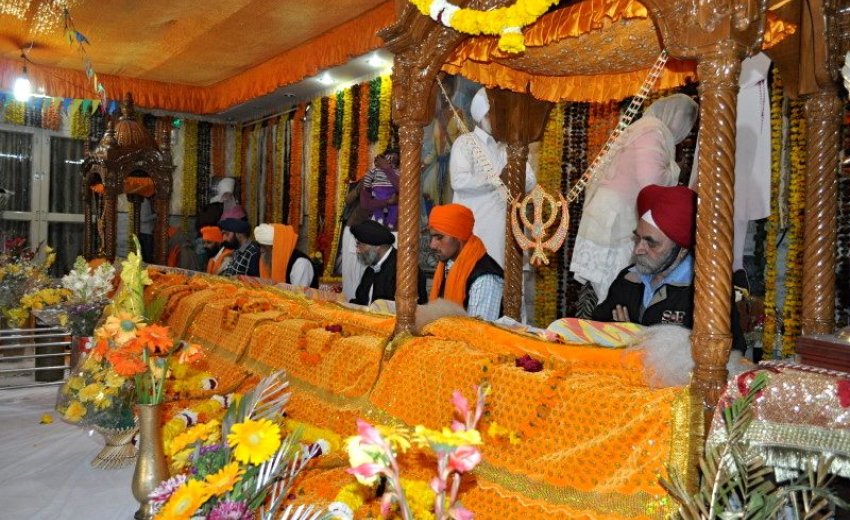
There was a row of cabins separated by thin walls of plywood in which a dozen akhand paths (non-stop reading of the Guru Granth by a relay of paathees - readers) were being performed with no one listening to them.
I sought explanation from the head granthi (caretaker). He told me people from India and abroad sent money for akhand paths, to be followed by Guru-ka-langar, as thanksgiving or for wish fulfilment.
I could not comprehend how prayers recited by someone else could benefit a devotee who paid for them.
However, I found such practices more prevalent in other communities, as well.
Hindus have havans (fire ceremonies) performed at distant places.
Muslims pay expenses to people going for Haj, hoping that benefits will accrue to them.
Even Mirza Ghalib pleaded with Emperor Bahadur Shah Zafar to take him along on Haj and he would give his tswaab (benefit) to his majesty. However, the British did not allow the Mughal king to leave Delhi.
What came as a big surprise to me was to find that Europeans, Canadians and Indian Christians are also into outsourcing prayers. Well-to-do English, Canadians and Americans, who can't be bothered to go to church, paid for holy masses in euros or dollars, outsourcing religious rituals to Kerala Christian priests.
I read about it in the latest Private Eye of May 15. To wit: "The outsourcing of American and European jobs to low-wage countries like India has been happening for years," Archbishop Jacob Thoomkuzhy told reporters in Kerala, "and religious outsourcing is no different. Because of shortage of priests in the industrialised world, prayers for the dead and holy masses are being paid for by the westerners, then offshored to India."
"It is a lucrative business for churches in Kerala. Mass intentions that are paid for in dollars or euros are carried out here by local priests. The prayers are recited, and the fees paid by westerners help cash-starved parishes here. So what's the problem? " asked the Archbishop.
For example, when British newspapers whipped up a storm about David Beckham's affairs, a Beckham fan from London paid 350 euros for a mass to save the soul of his hero.
The holy mass, however, was not held in a London parish.
It was outsourced by the church authorities to a Bishop in India, who passed it to a remote church at Anthikad in Thrissur diocese, where the mass took place.
"We do not want to look at this commercially, but it is a huge boost to the local religious economy here,'' said the Archbishop.
Comments
aye!
Our pathetic state of affairs
Theo and Gagandeep: Multiple Akhand Paaths
Sat Sri Akal
Gagandeep ji, there is absolutely no reason why people should not do as they wish with their money. If by using money to fund the paath, which perhaps, because as you say, they are unable to read Bani, it brings them peace of mind, that can only be good. The rest of the sanghat also gets an opportunity to listen to the paath.
Theodorus ji, it can only be good if by paying some money, in the knowledge that some of it is put to charitable purposes. If it is used to pay for the paathis, who would otherwise struggle, then that’s a great use of money.
However multiple paths running concurrently in the same hall are, in my humble opinion, open disrespect of Gurbani. Gurbani is intended to be heard, and I have witnessed when these paaths run concurrently, in UK. You may have been to some as well. All the paathis do not keep in sync with each other, and they can’t be expected to either. So we get the situation when one paathi gets to say, Page 246, and the loudpeakers were connected to his booth. Then, for the sake of another family who paid for another paath, speakers are switched to “their” path. So it switches to another paath, who happens to be on say page 230. So the sanghat listens to the same pages twice. Then after a while, say 15 pages, it switches back to the first or another paathi who is ahead, say on P262 by now. So the sanghat now misses out P246 to P262 altogether. This happens repeatedly throughout the two days. Also on, say, the Friday evening, all these paaths are disconnected, whilst the sanghat listens to the Kirtanees, as the Gurudwara has arranged that in the same hall as well, as part of its regular program. So the ones who paid for the Paaths have no opportunity to listen to any Paath at that time, even though there are several running.
Only one paath is required, recited clearly and completely. If money is required to provide this then fine. Some resources are obviously required. However if there are surplus funds because of multiple requests then it not impossible for the money to be channelled to more needy causes, rather than to the particular Gurudwara which was paid these funds.
__________________________________________________________________________________________
Of all religions, the best religion is to chant the Name of the Lord and maintain pure conduct.(266-13)
but what is the need...........
a great topic, a western perspective
There is nothing wrong with this if hearts are pure!
Waheguru Ji Ka Khalsa, Waheguru Ji Ki Fateh
Multiple Akhand Paaths
Sat Sri Akal
Theodorus ji, it may be interesting to note where any practice originates, but I’m not sure whether this should affect why the practice takes place today. People should be able to analyse the situation, in terms of what is reasonable, in today’s world. If not, some could even use basis of past practices recommended by past priest/gurus/prophets to justify an act such as a human sacrifice to a sun god. God may not evolve, but His subjects are quite capable of evolving physically and mentally. Does He not expect them to?
Doing as many Akhand Paaths as possible makes money for the Gurudwara, and there are plenty of people willing to pay. The reasons why they are willing to pay will be multifarious. Even when they know it is nonsensical to pay, some will still do it. So the chances of the practice not continuing for the foreseeable future, are pretty much next to nil. Money always talks for some; it apparently buys God’s Grace, and the people who have set up their businesses as intermediaries of God are most willing to accept whatever is offered, instead of acting professionally. They of course set higher market rates, whenever demand exceeds supply.
__________________________________________________________________________________________
Of all religions, the best religion is to chant the Name of the Lord and maintain pure conduct.(266-13)
I do not approve, I understand
himmat singh ji,
Of course this practice has nothing to do with religion it is purely economical. The fact that people believe that they can buy God's Grace is not only wrong but stupid too. It surely was not my intention with my comment to say that I approve of this practice because it makes a mockery of a religious practice.
In this case there is an other side to the practice though, an economical one. If you are poor and you can earn a living by reciting gurbani then what is wrong with that? I can even imagine that it is more honourable to earn your living like this than just getting free gifts (from people abroad).
I mean I'm a westerner, suppose I wanted to support people in the punjab how would I go about? I can randomly select somebody and send him money then I have no idea where that money ends up, I can send money to a Gurdwara but who knows where that money ends up? So by 'buying' recitation time (although I know it is nonsensical) I can support people there. I then know the money I send will be earned by somebody who at least knows gurbani (so he/she is probably a Sikh?).
Come to think of it, it was exactly the reason why I payed the Catholic parish for 10 masses when my mother died. I have not attended one of them (I knew it was nonsensical to that respect). It was just a. A costum b. The thing to do and c. To thank the pastor for the work he did with the funeral.
That still is no reason to maintain this practice though but it is understandable and it will not easily stop.
well said sir
Stand for Truth: Sehaj Paath is best
Sat Sri Akal
Stand for Truth ji, I think you are absolutely right about Sehaj Paaths being the answer. It cannot be right to "race" to finish a paath, because of time limits. Sometimes, a few paathis even skip some pages, late at night when they think no-one is paying attention. This is normal, because as you say, many of the families do not listen to much of the paath at all.
Even part of a sehaj paath, read slowly, so people can grasp what is being said, understand it, and then act as Guru ji advises, would be much better, in my humble opinion.
__________________________________________________________________________________________
Of all religions, the best religion is to chant the Name of the Lord and maintain pure conduct.(266-13)
no assassination
Waheguru Ji Ka Khalsa,
Waheguru Ji Ki Fateh
Sikhchic wrote:
Many years ago, I happened to be in Nanded (Maharashtra) and went to Hazur Sahib gurdwara to pay homage to the Tenth Guru, Gobind Singh, who was assassinated there in 1708.
---------------------------------------------------------------------------------------------------------------------------------------------
As a Sikh its improper to say assassination.
I believe there was an attempt at assassination by Pathans.
I believe a Sikh is suppose to use the term Jyoti Jot Saemiah or Their Spirit is with the Everlasting.
Please forgive me if I too have mistranslated and kindly correct this fool as well.
Waheguru Ji Ka Khalsa,
Waheguru Ji Ki Fateh
True business is to listen and practice Gurbani
Infuence from Christianity?
I think this practice stems from Christianity as there you have a 'class' of people that intermediate between God and the Congregation (normal people). These Priest, monks, nuns etc. have a full time job in intermediating (of course they do other things within the congregation too) so they need to be payed.
I know in the Catholic church (in my country) it is not uncommen to pay for 10 masses when somebody dies and after that one mass per year. Often these masses are combined for several persons at once. You are suppose to attend these messes though. When they are 'outsourced' that is not possible.
It even has become more of a tradition. When my scouting group organised a big outdoor event the organisation went to a nuns cloister nearby with a gift (meat products) asking the nuns to pray for good weather during the event. Although people do believen in this it is more culture than religion.
So having somebody that is suppose to be closer to God than you is not uncommen in the Catholic church and it is also a very old 'custom'.
Rituals !!