Siri Guru Granth Sahib was originally compiled by the first Sikh Guru, Guru Arjan Dev ji in 1604. It included the sacred teaching songs of the previous Sikh Gurus, the songs of Guru Arjan himself, as well as sacred songs from Hindu and Muslim saints. The name given to this compilation was Adi Granth. During the time of the tenth Sikh Guru, Guru Gobind Singh, the sacred songs of the ninth Sikh Guru, Guru Teg Bahadur, were added to the Granth. Before his death, Guru Gobind Singh ji appointed the Adi Granth, which would come to be known as Siri Guru Granth Sahib, as the final and ultimate teacher for the Sikhs.
According to Guru Gobind Singh's poets Sainapat, Bhai Nand Lal and Dhadi Nath Mal, all of whom were present at Nanded, a day before the Guru's death, the Sikhs enquired as to whom Guru Gobind Singh was entrusting his Khalsa. Bhai Nand Lal in Rahitnama records that the Guru stated that he has three forms. The first form is nirgun or invisible. The second form is his Word and the third is sagun or the visible. After his physical death his soul would be invisible. His second form would be Adi Granth. "Dusar Rup Granthji jan, Mera rup Granthji jan. Is men bhed nahin kuchh man." The third sagun, or visible form was the Khalsa. He added that he had bestowed his physical form upon his Khalsa.
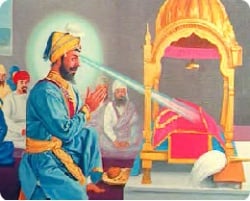
After explaining this, it is recorded that Guru Gobind Singh, accompanied by his Khalsa, went to the place where Adi Granth had been installed. He opened the Sacred Granth, placed five paise and a coconut before it, bowed before it, then went round the Granth five times, bowing every time. After this, it is said that he declared the Granth as the Guru for all times to come.
Granth consists of two words, Gur and Ant meaning eternal Guru. Guru Gobind Singh asserted: “In the future whoever wishes to seek enlightenment, guidance and solace, let him read the holy Granth. This is your Guru forever - till eternity.†The Guru said that he was entrusting the Khalsa to the care of AkalPurukh (God). His poets record him as saying the following:
"Dusara rup Granth ji jan, Un ke ang mero kar man.
Jo sikh gur darshan ki chah, Darshan karo granth ji ah.
Jo mam sath chaho kar bat, Granth ji parhe bichare sath.
Jo muj bachan sunan ki chai, Granth ji parhe sune chit lae.
Mero rup Granth ji jan, Is men bhed nahin kuchh man."
His poets also record the following as being Guru Gobind Singh's final teaching. Sikhs everywhere repeat it as part of our daily routine, after Ardaas):
Sab Sikhan ko hukum hai Guru Manyo Granth.
Guru Granth ji manyo pargat Guran ki deh.
Jo, prabh ko milna chahe khoj shabad men le.""The Granth is my second self. It should be taken for me. A Sikh who wants to see me, should have a look at the Granth. One who wishes to talk to me, should read the Granth and think over it. One who is anxious to listen to my talk, he should read the Granth and listen to its recitation with attention. Consider the Granth as my ownself. Have not the least doubt about it."
"Aagya bhai Akal ki Tabhi chalayo Panth,
"Under orders of the Immortal being the Panth was started. All the Sikhs are enjoined to accept the Granth as their Guru. Consider Guru Granth as representing Guru's body. Those who wish to meet God can find the way in its hymns."
Thus the Siri Guru Granth Sahib ji as the final manifestation of the Guru's Light came into being. Guru Granth has 1430 pages of songs. The text is in poetic meter, and specific scales are assigned to the singing of these songs. The Guru Granth is full of devotion, meditation, and the grace of Guru and God. In addition to recording the teachings of songs of the first five Sikh Gurus and the ninth Sikh Guru, it includes the hymns of more than 20 Hindu and Muslim saints of India, who were revered during their day. It is the only record among any religion where the teachings of the founders were recorded completely and accurately.